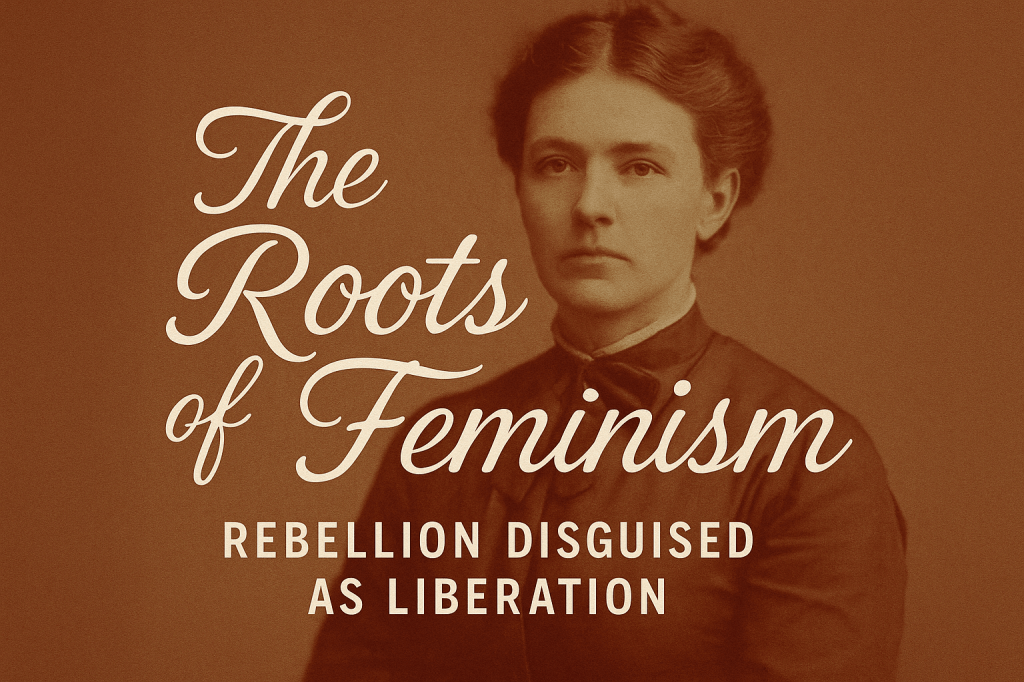
Feminism is often spoken of today as if it were the most noble and necessary movement of modern history, a righteous struggle for freedom and equality that rescued women from centuries of oppression. But if we strip away the cultural slogans and emotional appeals, what we discover is that feminism is not truly about equality—it is about rebellion. It is rebellion against God’s design for men and women, rebellion against the authority of Scripture, and rebellion against the very fabric of the family and society. To see this clearly, we need to trace the history of feminism and uncover its ideological roots.
The so-called “first wave” of feminism in the late 19th and early 20th centuries is often portrayed as the innocent, pure, and necessary stage of the movement. It was concerned with legal rights for women, particularly the right to vote, the right to own property, and protection against abusive men. While some of these efforts addressed legitimate injustices, even in the first wave there were seeds of rebellion. Many of the early feminist leaders were not simply seeking justice—they were rejecting biblical order. For example, Elizabeth Cady Stanton, one of the most prominent figures of the first wave, produced The Woman’s Bible in 1895, in which she openly rewrote Scripture to erase passages she considered oppressive to women. From the beginning, then, feminism was not simply about social reform, but about redefining truth and authority.
The “second wave” emerged in the 1960s and 1970s and was far more radical. Figures like Betty Friedan and Gloria Steinem pushed feminism far beyond the realm of suffrage and into the realm of family, sexuality, and identity. Friedan’s The Feminine Mystique (1963) painted homemaking and motherhood as a form of slavery. Steinem once declared, “A woman needs a man like a fish needs a bicycle.” Feminism in this period declared war on the very notion of male headship and female submission, which are clearly taught in Scripture (Ephesians 5:22–24, 1 Corinthians 11:3). What God gave as a gift—complementary roles of men and women in marriage and society—feminists labeled oppression. The result was a massive social upheaval: skyrocketing divorce rates, abortion on demand, the sexual revolution, and the redefinition of womanhood as independence from men and children.
The “third wave,” rising in the 1990s, went further still. Feminism became less about universal “women’s rights” and more about radical individualism. Gender itself was questioned, sexual expression became central, and identity politics grew. This stage blurred into today’s “fourth wave,” which is intertwined with the LGBTQ+ agenda. Now, feminism is not only rejecting biblical womanhood but rejecting womanhood altogether. Men can claim to be women, and women who dare to question it are called bigots—even by other feminists. This is the inevitable outcome of a movement rooted not in truth, but in rebellion against the Creator. When you reject God’s order, you end up with chaos and contradiction.
But why is feminism fundamentally rebellion? Because it rejects the authority of God’s Word. In Genesis 1:27, we are told, “So God created man in his own image, in the image of God he created him; male and female he created them.” God’s creation of male and female was intentional, purposeful, and good. In Genesis 2, we see Adam formed first, given the command, and then Eve formed as his helper—a role that is noble, God-ordained, and beautiful. Yet in Genesis 3, the curse of sin distorted this relationship. The woman was told, “Your desire shall be contrary to your husband, but he shall rule over you” (Genesis 3:16). From that point onward, the sinful tendency of women has been to resist male headship, and the sinful tendency of men has been to abuse it. Feminism is simply the modern expression of this ancient rebellion. It promises liberation but delivers bondage—bondage to sin, to bitterness, to broken homes, and to cultural collapse.
Feminism’s roots are not in Scripture but in secular philosophy. Simone de Beauvoir, a French existentialist and one of the most influential feminist thinkers, wrote in her 1949 book The Second Sex: “One is not born, but rather becomes, a woman.” By this she meant that gender roles are not part of God’s creation but are imposed by society and can therefore be dismantled. This rejection of God’s design is the same lie the serpent told Eve: “Did God actually say…?” (Genesis 3:1). From its inception, feminism has been about questioning God’s Word and redefining reality according to human autonomy.
Christians must see through the veneer of feminism. While there were certain injustices that needed to be addressed in history, feminism was never a neutral tool for good. It was always a movement with destructive ideological roots. It was not content to seek justice under God’s law; it sought to replace God’s law with man’s law, God’s design with human invention. And the fruit speaks for itself: the destruction of marriage, the killing of millions of unborn children, the vilification of fathers, and the confusion of gender itself. Jesus said, “You will recognize them by their fruits” (Matthew 7:16). By that standard, feminism stands condemned.
The church must resist the temptation to baptize feminism, to soften it, or to find common ground with it. There is no fellowship between light and darkness (2 Corinthians 6:14). What Christians need instead is a return to biblical truth. We must affirm with boldness and compassion that men and women are created differently, designed for different roles, and that these roles are good. True liberation is not found in rejecting God’s design, but in embracing it. As Jesus said, “If you abide in my word, you are truly my disciples, and you will know the truth, and the truth will set you free” (John 8:31–32).
Feminism enslaves, but Christ sets free.
 TheoloJeep
Leave a comment