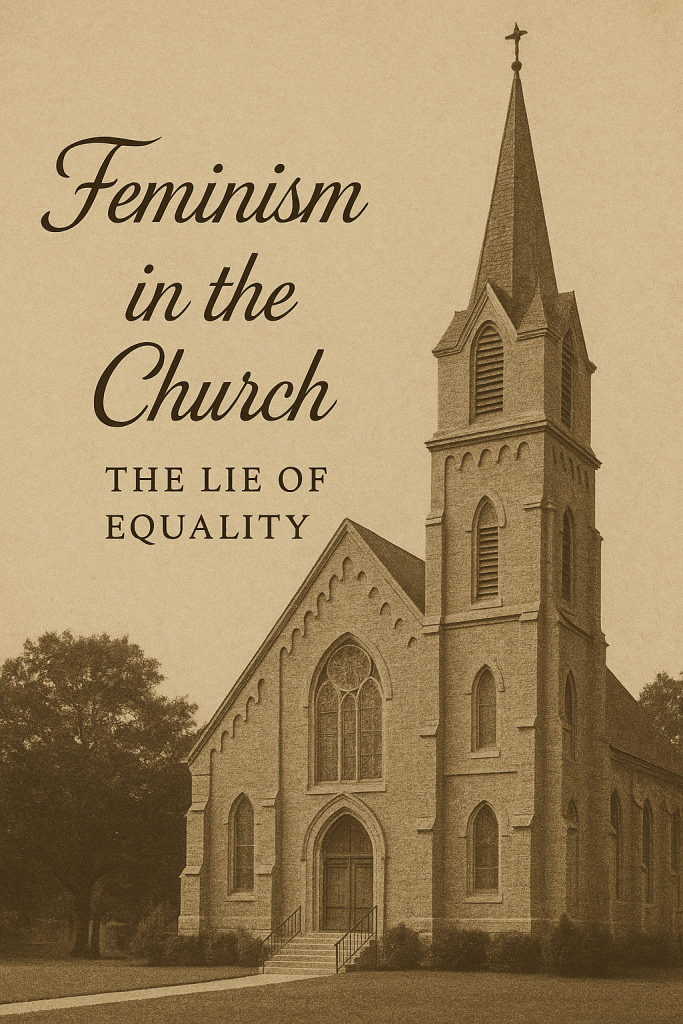
One of the most dangerous aspects of feminism is not simply what it has done to the culture at large, but how it has crept into the church. While many Christians recognize the devastation feminism has caused in marriage, family, and society, too often the church has tried to accommodate it under the guise of “justice” and “equality.” The result has been compromise, confusion, and decline. Feminism outside the church is destructive; feminism inside the church is deadly.
At the heart of feminist theology is the rejection of God’s created order. Scripture is clear: men and women are equal in value and dignity (Genesis 1:27; Galatians 3:28), but they are not identical in role. God has given men the responsibility of headship in the home and leadership in the church. Husbands are called to be the loving head of their wives (Ephesians 5:23), and elders in the church are to be men who meet the qualifications laid out in 1 Timothy 3 and Titus 1. Paul explicitly states, “I do not permit a woman to teach or to exercise authority over a man; rather, she is to remain quiet. For Adam was formed first, then Eve” (1 Timothy 2:12–13). The reason given is not cultural or temporary, but rooted in creation itself.
Yet, feminism has convinced many that these passages are outdated, oppressive, or culturally bound. The egalitarian movement insists that women should be pastors, elders, and preachers, arguing that to deny this is unjust. But this is not a new debate. From the very beginning, Satan’s strategy has been to undermine God’s Word by asking, “Did God actually say?” (Genesis 3:1). Feminist theology is simply that same question in modern dress. Did God actually say that men alone are to lead the church? Did God actually say that wives should submit to their husbands? And tragically, many churches have answered, “No.”
The results are plain. Denominations that have embraced feminism and women’s ordination have not flourished—they have declined. The Episcopal Church, the United Methodist Church, the Presbyterian Church (USA), and many others have ordained women for decades, and what has followed? Empty pews, doctrinal compromise, and rapid membership decline. Why? Because once you reject God’s Word on gender and roles, you open the door to reject His Word on everything else. In fact, the acceptance of women pastors has often gone hand in hand with the acceptance of LGBTQ+ ideology. The same logic that says “men and women have no distinct roles” is the logic that says “male and female themselves have no real distinction.”
By contrast, churches that hold fast to God’s Word—even when it is unpopular—remain stronger. This is not because of tradition or culture, but because obedience to God brings blessing. God’s design is not arbitrary; it is good. When men lead in the home and church, and women joyfully embrace their God-given roles, the result is harmony, fruitfulness, and gospel witness.
Feminism in the church promises liberation for women, but it delivers confusion and destruction. Women pastors are not empowered—they are burdened with a role God never intended for them. Congregations are not strengthened—they are weakened by disobedience. The gospel is not clarified—it is distorted.
The truth is this: God’s design for men and women in the church is not a matter of power but of picture. Marriage points to Christ and His church (Ephesians 5:32). Male eldership points to Christ, the Head of the church, who lovingly leads His bride. Female submission points to the church’s joyful submission to Christ. When we distort these roles, we distort the gospel itself. That is why feminism in the church is not a secondary issue—it is a gospel issue.
We must hold the line. To affirm male and female roles is not oppression—it is obedience. To say that women cannot be pastors is not to deny their value—it is to honor God’s Word. Women are indispensable in the church, gifted by the Spirit, and called to serve in countless ways: discipling younger women (Titus 2:3–5), teaching children, showing hospitality, engaging in evangelism, praying, serving, and exercising their gifts for the body of Christ. But Scripture draws a line at authority over men in the home and church, and to cross it is to rebel against God Himself.
The church must be courageous enough to say, “God has spoken, and His Word is good.” The world will rage, feminists will sneer, and even some professing Christians will cry “injustice.” But in the end, obedience is better than compromise, and faithfulness is better than popularity. Feminism has no place in the household of God. The church is not called to echo the world’s ideologies—it is called to shine as a light in the darkness, holding fast to the Word of life.
 TheoloJeep
Leave a comment