A Celebration of Grace, Grit, and Gospel Clarity
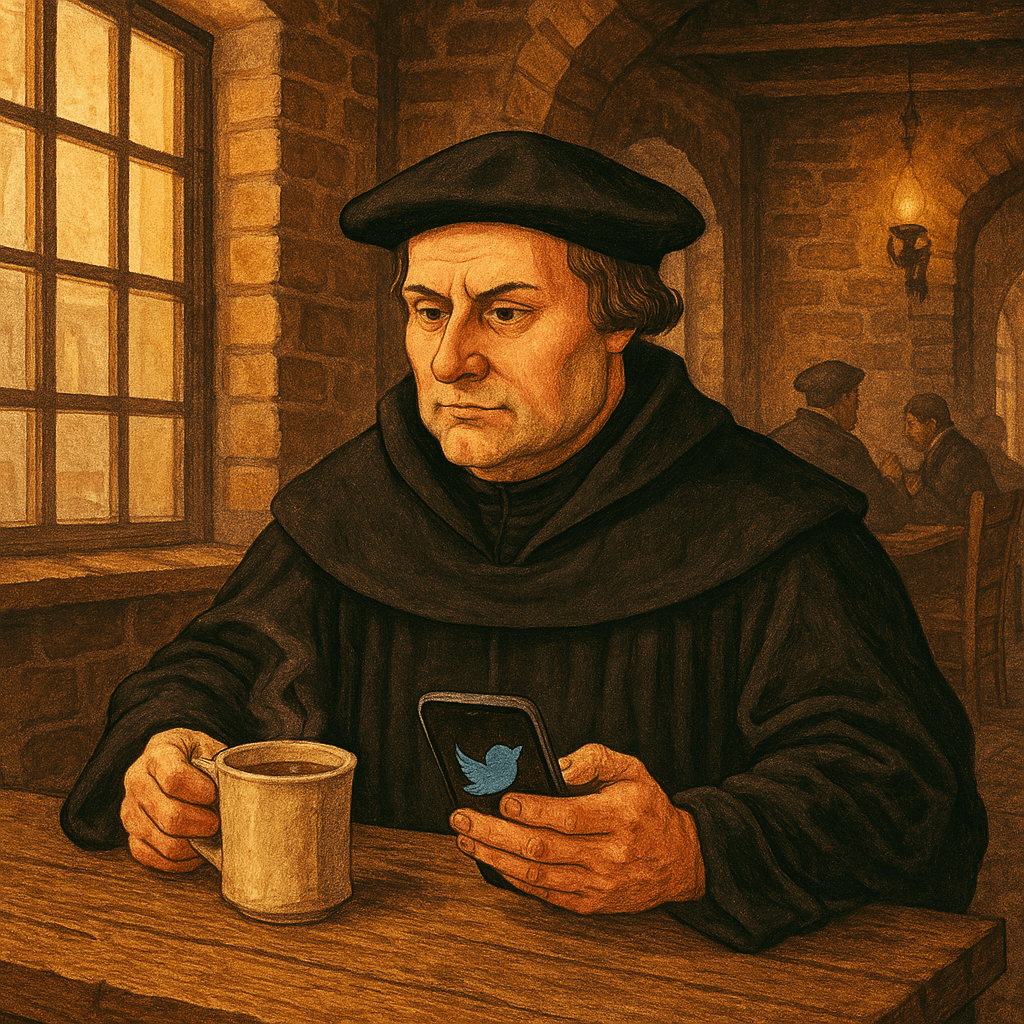
If you’ve got your coffee, your Bible, and at least a vague memory of what “Sola” means, congratulations — you’re ready to celebrate Reformation Day.
Every October 31st, while the world gears up with costumes, candy, and questionable fashion decisions, a few of us weirdos celebrate something far better: the day a German monk got so fed up with the corruption of his age that he accidentally jumpstarted a theological revolution.
🏰 A Hammer, a Door, and a Disruption
Picture it: Wittenberg, 1517. The church door doubled as the community bulletin board. People posted everything there — announcements, sermons, debate topics, maybe a lost-and-found parchment or two. And on this particular day, Martin Luther, a 34-year-old theology professor with a monk’s haircut and a fire in his bones, walked up with a hammer and some grievances.
His document? Ninety-five points of contention — what we now call the Ninety-Five Theses.
His tone? Less “angry rebel” and more “concerned professor who’s had enough nonsense for one lifetime.”
He wasn’t trying to break away from the Church; he was trying to call it back to biblical truth. But as anyone who’s ever tried to correct a powerful institution knows, that’s not usually how it goes.
Within weeks, those theses — written in Latin for scholarly debate — were translated, printed, and scattered across Europe faster than a rumor at a church potluck. The Reformation was on.
⚔️ The Spark Behind the Fire
Luther’s main issue wasn’t about choir robes or candlelight. It was about the Gospel itself — that glorious truth found in Scripture:
“The righteous shall live by faith.” — Romans 1:17
The Church of his day had drifted far from that simple message. Salvation had become a transaction — grace with a price tag. You could buy “indulgences” to reduce your loved one’s time in purgatory. Priests peddled forgiveness like it was a fundraiser. And ordinary believers were left spiritually bankrupt, unable to read the Word for themselves, dependent on a system that fed on their fear.
Luther’s conscience couldn’t take it. He saw that Scripture, not man-made systems, held the key to salvation. Not money. Not merit. Not membership. Christ alone.
That’s when the dam broke. And out of the flood came five enduring declarations — not invented by Luther, but recovered from Scripture itself.
📜 The Five Solas: The Gospel in Five Phrases
1. Sola Scriptura — Scripture Alone
The Reformers didn’t invent the Bible; they just finally let it speak.
In their day, church tradition had been placed above Scripture — the Pope could decree truth, councils could rewrite doctrine, and the average Christian had about as much access to a Bible as a hamster has to the moon.
But the Reformers brought the Word back to the people. They believed that the Bible is clear enough for the common believer and authoritative enough to correct every error.
“A simple layman armed with Scripture is greater than the mightiest pope without it.” — Martin Luther
That’s not arrogance — it’s confidence in God’s Word. And you can see why the institutional church panicked. A Bible in every home meant a revolution in every heart.
2. Sola Fide — Faith Alone
No ladder-climbing, no checklist Christianity, no earning your spot at the table. Faith — genuine trust in the finished work of Christ — is the only way a sinner is made right with God.
The Roman Church taught that faith was a starting point, but you had to add works to finish the job. Luther called that out as spiritual robbery — robbing Christ of His sufficiency and robbing believers of assurance.
“Faith alone justifies, but the faith that justifies is never alone.” — Martin Luther
In other words, real faith produces works, but it’s the root, not the fruit, that saves.
3. Sola Gratia — Grace Alone
If Sola Fide tells us how we’re saved, Sola Gratia tells us why we’re saved: because God is gracious — and that’s it.
Grace isn’t divine leniency or spiritual duct tape; it’s the sovereign kindness of God toward the utterly undeserving.
Luther knew this firsthand. He once spent hours confessing every sin he could remember — even the ones he might have imagined. He was tormented by guilt until he finally realized something liberating: he could never be good enough.
That realization didn’t lead to despair — it led to freedom. If salvation depends on grace, then God does the saving. Period.
“If any man ascribes anything of salvation, even the very least, to the free will of man, he knows nothing of grace and has not learned Jesus Christ rightly.” — Martin Luther
4. Solus Christus — Christ Alone
In Luther’s time, priests acted as spiritual brokers. You couldn’t approach God directly — you needed a middleman, and usually, a payment.
But Scripture screams the opposite:
“For there is one God, and there is one mediator between God and men, the man Christ Jesus.” — 1 Timothy 2:5
Christ alone is sufficient. No pope, no priest, no purgatory, no performance can improve upon His finished work. He is the perfect High Priest who sits at the right hand of God, interceding for His people even now.
When Jesus said, “It is finished,” He meant it. Not “mostly done, now you finish it.” Not “it’s begun, but the Church will complete it.” Finished. Done. Paid in full.
5. Soli Deo Gloria — To God Alone Be the Glory
If salvation is by Scripture, through faith, by grace, in Christ — then all glory belongs to God alone.
The Reformation wasn’t just about theology; it was about worship. It was about reclaiming the glory that had been stolen from God and given to men in fancy hats.
“From Him and through Him and to Him are all things. To Him be glory forever.” — Romans 11:36
🧠 Theology with Teeth
Now, at this point, you might be thinking: “Okay, cool history lesson. But what does any of this have to do with me trying to survive Monday morning?”
Well, everything.
Because Reformation theology isn’t just dusty doctrine — it’s dynamite. It’s the difference between anxiety and assurance. Between moralism and mercy. Between a religion that crushes you and a Gospel that frees you.
The Reformers weren’t sitting in ivory towers debating Latin phrases; they were fighting for the souls of ordinary people who were being spiritually scammed.
They believed — and risked their lives to proclaim — that the Gospel actually works. That it’s strong enough to save the worst sinner and simple enough for a child to understand.
And that’s still true today.
You don’t need to climb a spiritual ladder; the cross already bridges the gap.
You don’t need to impress God; Christ already did.
You don’t need to buy indulgences; grace is free.
That’s good news worth nailing to every door.
🎃 Meanwhile, Across Town…
While all this world-altering theology was brewing, the calendar rolled around to October 31 — which, if you’re counting, also happens to be Halloween.
It’s almost poetic, isn’t it? The same day the world dresses up as ghosts and goblins, we celebrate the day light broke through the darkness.
The day a man nailed truth to a door, God nailed our sins to a cross.
So yes, pass out candy, enjoy the costumes — but don’t forget: this is our day. The day the Gospel went viral — without Wi-Fi, hashtags, or TikTok filters.
🕯 From Darkness to Light
Before the Reformation, the Church kept the Bible chained — literally. In many cathedrals, the Scriptures were locked to pulpits so the common people couldn’t touch them.
The Reformers, often at the cost of their lives, translated those sacred words into the language of the people. William Tyndale was strangled and burned for doing it. His crime? Translating the Bible into English. His dying prayer?
“Lord, open the King of England’s eyes.”
God answered that prayer. Today, the Bible sits on shelves, apps, and dashboards across the world — and yet, ironically, remains unopened by millions.
Maybe the real “Reformation” we need today isn’t external — it’s internal. Maybe it’s time to dust off our Bibles, not just our costumes.
💥 The Gospel Doesn’t Need Upgrading
The temptation in every age — including ours — is to think the Gospel needs a little PR help. A little modernization. A little “relevance.”
But the Reformers remind us that truth doesn’t age. It doesn’t need makeup. It doesn’t need mood lighting. It needs proclaiming.
The Gospel doesn’t evolve — it endures.
Every generation faces the same question Luther faced: Will we trust God’s Word, or will we let culture, tradition, and convenience rewrite it?
If the 1500s had indulgences, maybe ours has “self-help spirituality.” Different packaging, same poison.
And just like then, the cure is the same: the pure, undiluted Gospel of Jesus Christ.
🧩 Still Reforming — Always Reforming
There’s a Latin phrase that came out of the Reformation: Ecclesia reformata, semper reformanda — “The Church reformed, always reforming.”
That doesn’t mean constantly changing with the times. It means constantly being changed by the Word.
We don’t reform the truth; the truth reforms us. We don’t shape Scripture to fit our culture; we let Scripture shape our lives.
The moment we think we’ve “arrived,” we start drifting again — just like the Church in Luther’s day. That’s why the Reformation isn’t a museum piece. It’s a mirror. Every believer, every church, every generation needs to ask: “Have we drifted from the Gospel?” And if so — repent, return, and reform.
📖 A Modern Parallel
Imagine Luther in our age. He’d probably be labeled “divisive” or “legalistic.” His Theses would trend on X with a #NailedIt hashtag. He’d be shadow-banned for “misinformation.”
But the truth would still spread — because you can’t cancel the Word of God.
The Reformation reminds us that courage in the face of compromise is costly — but it’s worth it.
It wasn’t comfortable for Luther to stand before the Diet of Worms (and no, that’s not a keto meal). He was standing before the Holy Roman Emperor himself, told to recant or face death. His reply still echoes through history:
“My conscience is captive to the Word of God.
I cannot and will not recant anything,
for to go against conscience is neither right nor safe.
Here I stand, I can do no other.
God help me. Amen.”
That’s not arrogance. That’s conviction. That’s the kind of backbone the Church desperately needs again.
❤️ The Legacy Lives On
You and I are the beneficiaries of their courage. We hold the Scriptures in our hands because men and women held the line in theirs. We worship freely because others refused to bow. We know salvation by grace because someone refused to let it be sold.
The Reformation wasn’t about being trendy — it was about being true.
And every faithful church, every Gospel-centered preacher, every believer who opens the Word today is proof that their labor wasn’t in vain.
So today, take a moment to thank God for the Reformers — not as heroes to be worshiped, but as servants who pointed us back to the only true Hero: Jesus Christ.
🙌 Reformation Day Challenge
So what can we do this Reformation Day — besides quoting Luther on social media and singing “A Mighty Fortress” with a smirk?
- Read the Word — the Reformers died to give it to you.
- Share the Gospel — it’s still the power of God to save.
- Stand firm on truth — even when it’s unpopular.
- Worship like you’re free — because you are.
- Thank God that salvation is by grace, through faith, in Christ alone.
And if you happen to enjoy a few Reformation-themed memes today, that’s fine too. Just remember — this isn’t nostalgia. It’s a reminder of what’s worth defending.
✝️ Final Word
Over 500 years later, the echo of that hammer still rings. Not because of Luther’s strength — but because of God’s faithfulness.
The Reformation wasn’t about one man. It was about one message: The Gospel that saves sinners and glorifies God.
That message hasn’t changed, and it never will.
So today, lift your coffee mug (or your communion cup) and join the chorus of saints through the ages:
Sola Scriptura. Sola Fide. Sola Gratia. Solus Christus. Soli Deo Gloria.
Happy Reformation Day! May the truth that set Luther free continue to set hearts free today.
Soli Deo Gloria.
 TheoloJeep
Leave a comment