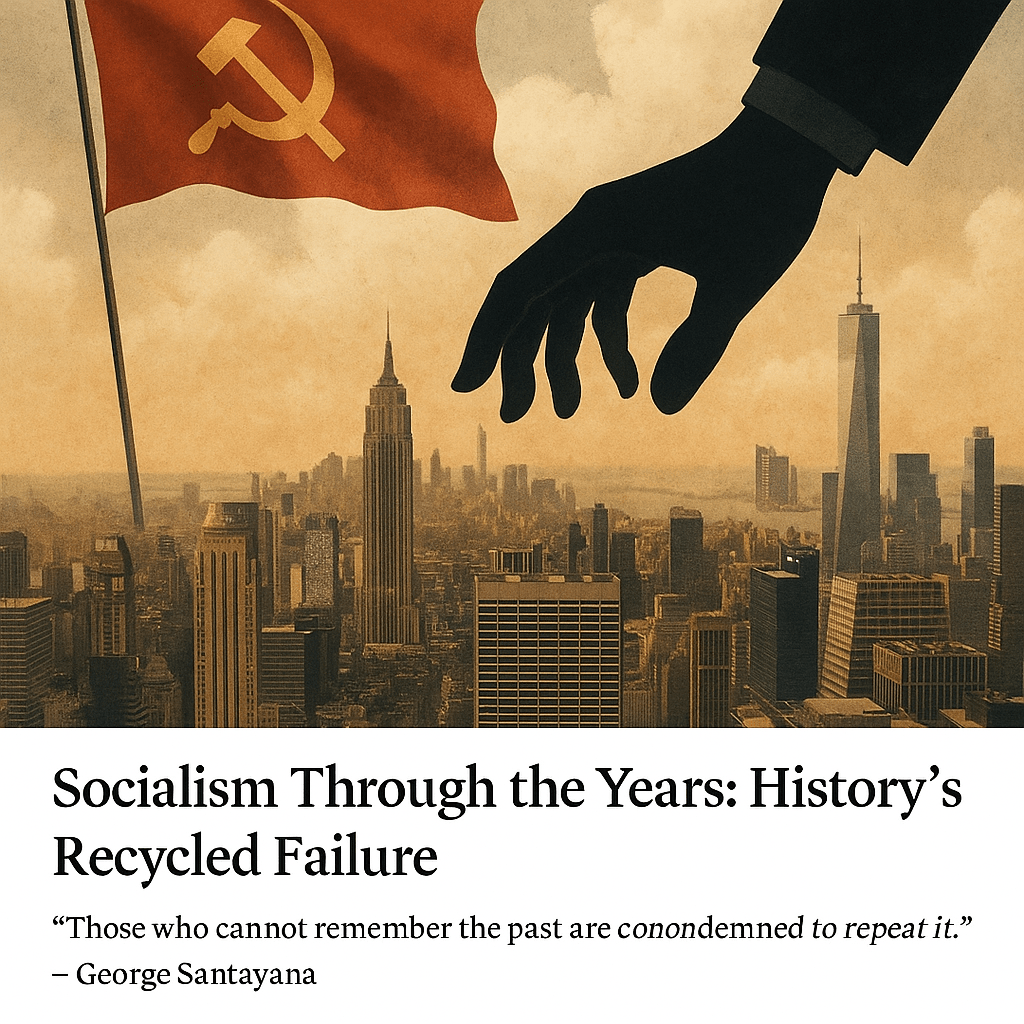
Every generation seems to have a group enchanted by socialism. It’s the same recycled dream, dressed in new language—“equality,” “justice,” “fairness,” or “democratic socialism.” The slogans are modern, but the foundation is ancient. Each time, socialism promises paradise on earth. Each time, it delivers scarcity, fear, and the erosion of freedom. The dream becomes a nightmare, and the so-called “workers’ paradise” ends in tyranny.
I. The Seeds of a False Utopia
Socialism, at its heart, is the belief that the collective should own or control the means of production, wealth, and property. Its roots trace all the way back to Plato’s Republic, which imagined a class of guardians who would own everything in common. Even then, the idea required an elite group to manage what belonged to everyone—which is to say, control was never actually shared equally.
Fast forward to the 19th century: Karl Marx and Friedrich Engels published The Communist Manifesto in 1848. They preached revolution, declaring, “Workers of the world, unite!” Marx’s vision was not one of freedom but of destruction—he called for the abolition of private property, religion, and the family structure itself. In theory, socialism was to be the bridge to communism. In practice, it became the bridge to totalitarianism.
“The problem with socialism is that you eventually run out of other people’s money.” – Margaret Thatcher
II. The 20th Century’s Grim Experiment
When the 20th century arrived, socialism left the classroom and entered the real world—and the world paid a horrific price. In 1917, Vladimir Lenin led the Bolshevik Revolution, promising freedom from the czars. Instead, he created the Soviet Union, a one-party state where dissent was crushed, the Church was persecuted, and millions were starved or executed.
Under Joseph Stalin, the “worker’s paradise” became a slaughterhouse. The Holodomor famine in Ukraine killed millions. The Gulag system imprisoned millions more. Stalin’s reign demonstrated a universal truth: socialism begins with equality and ends with a dictator.
Across the globe, Mao Zedong’s China repeated the cycle. During the “Great Leap Forward,” over 40 million people perished in a man-made famine caused by forced collectivization. The “Cultural Revolution” followed, erasing history, destroying families, and worshiping the state as god. North Korea became a living museum of this madness—a nation sealed off from the world, starving under dynastic communism.
In Cuba, Fidel Castro’s revolution promised education and healthcare for all, but those came at the cost of freedom and truth. Those who disagreed fled on rafts across shark-infested waters. In Venezuela, once one of South America’s richest nations, socialism drained its wealth, crushed industry, and left citizens scavenging for food. The pattern is not a coincidence—it’s a consequence.
“Socialism is a philosophy of failure, the creed of ignorance, and the gospel of envy.” – Winston Churchill
III. Why Socialism Fails Every Time
Socialism fails because it defies both economic logic and human nature.
Economically, it destroys incentives. When people realize that extra effort brings no extra reward, productivity collapses. Innovation dies because the state decides what’s “fair” rather than what’s effective. The result? Shortages, rationing, and a black market where only the connected survive.
Morally, it replaces generosity with compulsion. True charity springs from love and personal conviction. Socialism demands giving at the threat of punishment. It steals the virtue from giving and calls it compassion.
Politically, socialism always centralizes power. It begins with equality and ends with control. History’s socialist regimes have required secret police, censorship, and informants to maintain the illusion of unity. Power doesn’t flow to the people—it flows to the bureaucrats who claim to represent them.
Socialism’s ultimate trajectory is toward communism because it cannot function without coercion. The more it fails, the more control it demands. The more control it demands, the less freedom the people retain.
IV. The Biblical Contrast: God’s Design for Work and Stewardship
The Bible presents a radically different vision of human society—one rooted in responsibility, not redistribution.
In 2 Thessalonians 3:10, Paul writes, “If anyone is not willing to work, let him not eat.” Work is not a punishment; it’s part of the divine order. God created man to cultivate and steward the earth (Genesis 2:15). That stewardship assumes private property, personal labor, and individual accountability. The Eighth Commandment—“You shall not steal” (Exodus 20:15)—assumes ownership. You can’t steal what doesn’t belong to someone.
In God’s economy, wealth is not evil. It’s the love of money that corrupts (1 Timothy 6:10). Scripture commands generosity, but it must come from a willing heart: “Each one must give as he has decided in his heart, not reluctantly or under compulsion” (2 Corinthians 9:7). Socialism removes that freedom and replaces it with forced equality—a counterfeit virtue.
Charity that is coerced is not love; it’s tyranny with a smiling face.
V. The Modern Case Study: Mamdani’s Victory in New York
In November 2025, a pivotal moment occurred in American urban politics. Zohran Mamdani, a 34-year-old state assemblyman from Queens and self-described democratic socialist, was elected mayor of New York City. [oai_citation:0‡The Guardian](https://www.theguardian.com/us-news/2025/nov/04/zohran-mamdani-mayor-new-york-city?utm_source=chatgpt.com)
Mamdani ran on a platform of “affordability and equity,” promising major policy changes such as freezing rents, offering free city buses, creating city-owned grocery stores, instituting universal child care, and raising taxes on the wealthy. [oai_citation:1‡New York Post](https://nypost.com/2025/11/04/us-news/zohran-mamdani-wins-2025-nyc-mayoral-election/?utm_source=chatgpt.com) His campaign represented a clear shift toward progressive and socialist-style governance—even in the heart of one of the world’s major capitalist cities.
His victory is notable for multiple reasons: the size of the win, the policies he promises, and the broader ideological implications. For the purposes of this blog, Mamdani’s election serves as a contemporary illustration of what happens when the socialist impulse gains real political power in a major jurisdiction.
Look at the key features:
- A large-scale redistribution agenda: higher taxes on “the rich,” large public subsidies, sweeping government programs.
- A promise to elevate collective provision—free public buses, city-owned grocery stores—instead of relying solely on market mechanisms or individual enterprise.
- An ideological alignment with democratic socialist organizations, signaling that this is not simply moderate reform but a shift toward a stronger state-role vision.
This moment should prompt serious reflection: if one of America’s largest cities embraces such a platform, what does that say about the broader direction of American political life? And what risks does it carry—given the long history of socialist policies leading toward more state-control and less individual freedom?
From a biblical and historical vantage point, it raises questions: Can a society thrive that substantially diminishes individual initiative and prioritizes government provision? Will the economic incentives hold up when the state commits to so many promises? And when those promises inevitably strain under real-world constraints, who pays the price? History tells us: the burden often falls hardest on the vulnerable and the powerless.
VI. The Modern Mask of Socialism
Today, socialism rarely advertises itself as such. It wears new masks—“progressivism,” “equity,” or “democratic socialism.” But the principles remain the same: redistribution of wealth, expansion of state power, and moral hostility toward biblical truth.
In Western nations, this ideology has shifted from economics to culture—what some call “cultural Marxism.” It divides society into oppressors and oppressed, teaching envy instead of empathy. The result is social chaos, resentment, and dependence on the very system that caused the division.
History’s warning lights are flashing again, but this time they’re being ignored in the name of compassion. What once was enforced with guns is now promoted through universities, media, and social pressure. The language is softer, but the goal is the same: control the mind, then control the man.
VII. Freedom and Responsibility: Twin Pillars of a Healthy Society
Socialism promises equality but produces envy. It promises prosperity but breeds poverty. It promises freedom but always demands obedience. Meanwhile, the biblical worldview teaches that human dignity comes from being made in God’s image—not from government approval or social status.
Free societies flourish when they honor moral responsibility, limited government, and the right to work, worship, and give freely. History has proven this truth repeatedly: liberty and faith create prosperity; socialism and godlessness create despair.
“A government big enough to give you everything you want is strong enough to take everything you have.” – Gerald Ford
Conclusion: Learning From the Ruins
From the ashes of Soviet gulags to the breadlines of Caracas to the bold promises in New York City, the evidence is overwhelming: socialism fails because it misunderstands the human heart. Only the gospel changes hearts; socialism only chains them.
As Christians, we are called to remember that freedom is not man’s invention—it is God’s gift. Where the Spirit of the Lord is, there is liberty (2 Corinthians 3:17). May we guard that liberty with truth, humility, and the courage to say what history has already proven: socialism has never worked because it never can.
Freedom and faith rise together—or fall together.
Soli Deo Gloria.
 TheoloJeep
Leave a comment