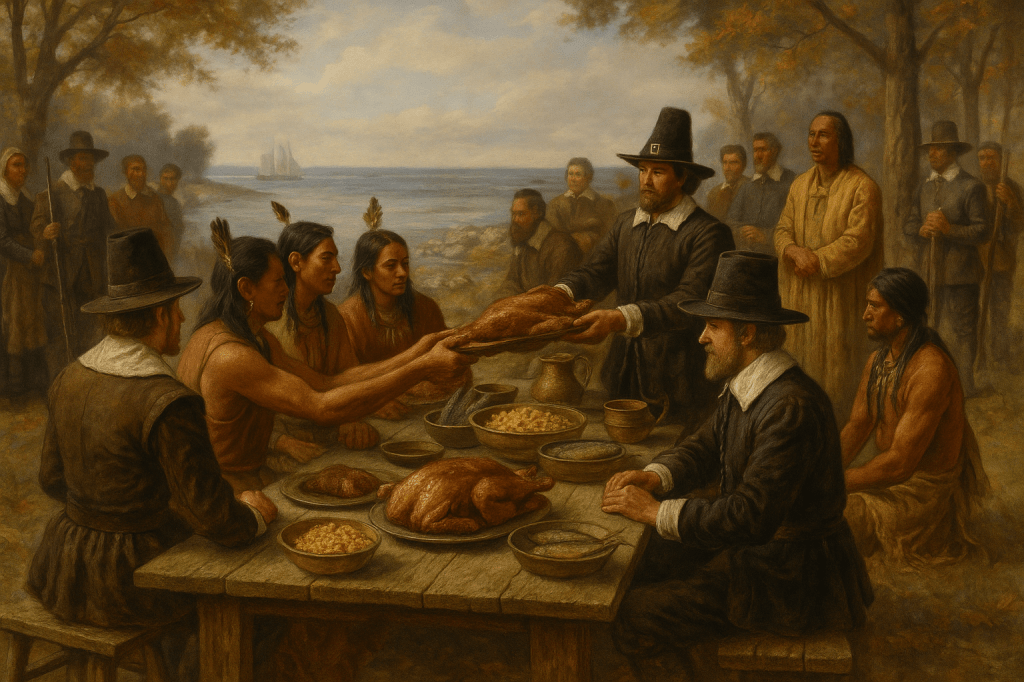
Few American traditions are wrapped in more layers of myth, propaganda, and modern cultural guilt than Thanksgiving.
Depending on who you ask, the first Thanksgiving was either:
- A warm, fuzzy kumbaya potluck where everyone held hands, or
- A sinister prelude to genocide, colonialism, and stolen land.
The truth is—of course—far more complex.
If we’re going to talk about the Pilgrims of Plymouth Colony and their relationship with the Wampanoag people, we owe it to history (and to the providence of God) to recover what actually happened.
Myth #1: The Pilgrims Invaded a Peaceful, Populated Paradise
The Truth: The land was largely empty because the Wampanoag had been devastated by plague.
When the Pilgrims arrived in 1620, they did not land in a thriving coastal civilization. They landed in the aftermath of a catastrophe.
From 1616–1619, a mysterious epidemic—likely leptospirosis—swept through the region, killing up to 90% of the native population from present-day Maine to Cape Cod.
Entire villages were abandoned.
The land where the Pilgrims settled had belonged to the Patuxet tribe. All of them had already died. The Pilgrims didn’t drive them out—the land was empty because everyone who lived there was gone.
This catastrophe left the Wampanoag people weakened and vulnerable, especially to their rivals, the Narragansett.
They needed allies.
And the Pilgrims—starving, freezing, and barely surviving—needed allies too.
The famous “first Thanksgiving” was the beginning of a mutual survival alliance, not conquest.
Myth #2: The Pilgrims Hated the Natives and Wanted Nothing to Do With Them
The Truth: The Pilgrims pursued peace from the beginning and saw the Wampanoag as providential help.
Enter Squanto (Tisquantum), whose story is nothing short of astonishing.
Kidnapped by an English trader. Taken to Spain. Rescued by monks. Brought to England. Returned to America… only to find his entire village wiped out.
He alone survived—and he alone could help the Pilgrims.
He taught them how to plant corn, where to fish, and how to adapt to the environment they didn’t understand.
Governor Bradford called Squanto “a special instrument sent of God for our good.”
Through Squanto, the Pilgrims established a mutual-defense treaty with Wampanoag sachem Massasoit. It included terms such as:
- Return stolen goods
- Do no harm to one another
- Provide military aid if either party was attacked
- Respect boundaries and property
That treaty held for over 50 years—a rare accomplishment in colonial history.
Myth #3: The First Thanksgiving Was a Cozy Holiday Meal Like Today
The Truth: It was a 3-day political feast celebrating a military alliance and a successful harvest.
The Pilgrims didn’t set out to create an annual holiday. They were simply celebrating survival.
According to Bradford and Winslow, the 1621 event included:
- A successful first harvest
- Massasoit arriving with 90 warriors
- A 3-day feast with fowling, deer, fish, and corn
- Games, diplomacy, and reaffirming alliances
Yes—there was fellowship and peace. But it was also diplomacy, politics, and survival.
Myth #4: The Pilgrims Were Early Agents of Genocide and Land Theft
The Truth: Plymouth Colony had remarkably fair and peaceful dealings for its time.
Much of modern critique dumps all colonial sins onto Plymouth, but the historical record shows something different.
1. The Pilgrims paid for every piece of land they settled.
They negotiated with native leaders, and records show exchanges of goods, corn, furs, and tools.
2. Their treaty demanded mutual justice.
Both sides agreed to punish those who harmed the other.
3. Plymouth protected the Wampanoag from rival tribes.
This was foundational to the alliance.
4. The peace lasted over 50 years.
Most conflicts associated with “Puritans vs. Natives” happened decades later, in other colonies with very different policies.
The Pilgrims weren’t perfect—no one is. But the narrative of immediate, eager oppression simply doesn’t match the evidence.
Myth #5: Thanksgiving Was Invented in the 1800s as Propaganda
The Truth: While the national holiday was formalized later, thanksgiving celebrations are deeply Puritan.
The Pilgrims didn’t host annual Thanksgiving dinners, but the Puritans regularly held formal Days of Thanksgiving: worship services dedicated to gratitude for God’s mercy.
Our modern holiday blends:
- The 1621 harvest feast
- The Puritan tradition of thanksgiving worship
- Abraham Lincoln’s 1863 declaration of a national Thanksgiving Day
So the spirit of the holiday truly is deeply biblical: gratitude in hardship.
Why This Matters Today
Our society loves simplistic stories—heroes and villains, good guys and bad guys.
But the first Thanksgiving wasn’t a fairy tale or a horror story.
It was two wounded, vulnerable peoples coming together in a fragile peace—held together by God’s providence.
The Pilgrims were weak. The Wampanoag were weakened. And God brought them together.
“Every good gift and every perfect gift is from above.” — James 1:17
Conclusion: Recovering Gratitude Through Truth
Understanding the real history doesn’t diminish Thanksgiving—it enriches it.
It reminds us that:
- God works through suffering
- Peace is possible between different peoples
- Gratitude is forged in hardship, not ease
- History is more complex—and more providential—than slogans
This Thanksgiving, give thanks not for the mythology, but for the real mercies of God in the real story He wrote.
Soli Deo Gloria.
 TheoloJeep
Leave a comment