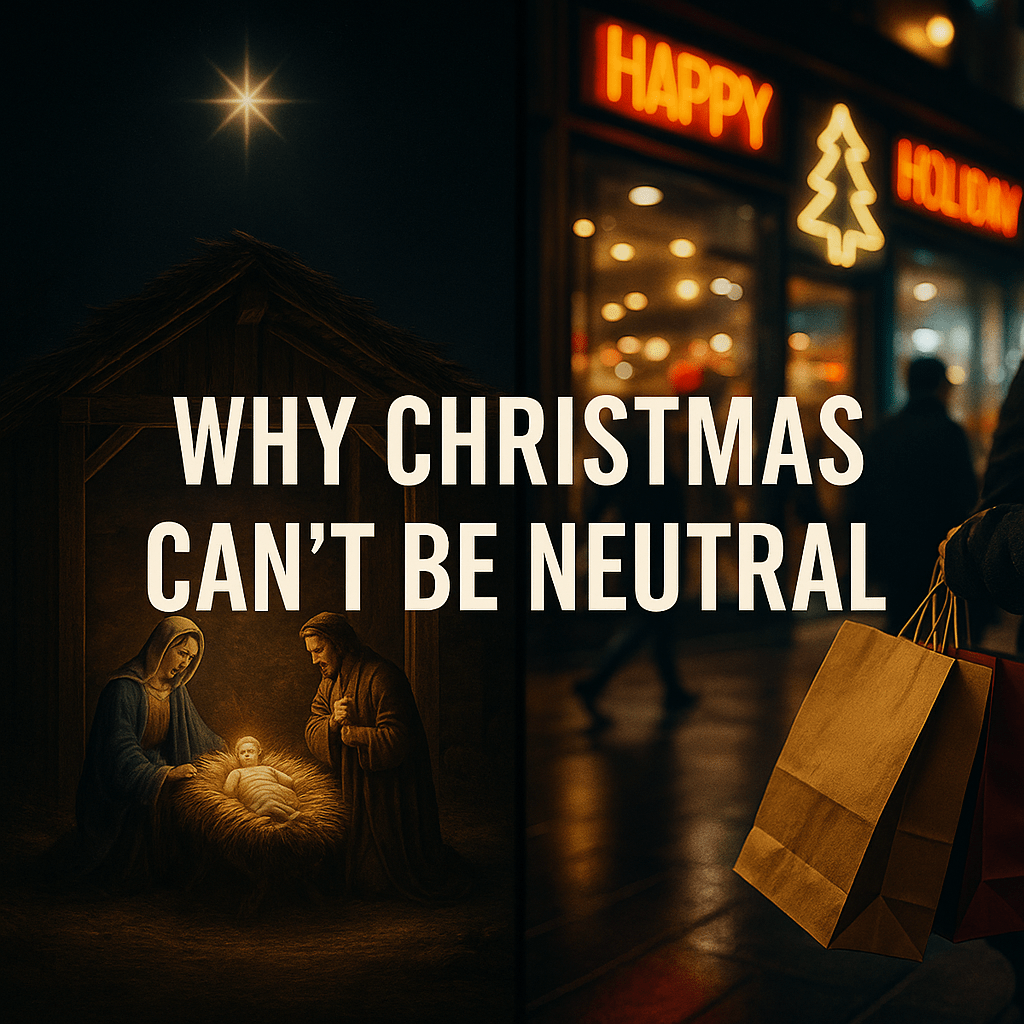
There is a popular myth in modern culture that Christmas can be celebrated “neutrally.” That it can simply be a cultural holiday—warm, inclusive, and meaningful—without making any claims about truth, authority, or God.
That myth collapses the moment we ask a single question:
Why does Christmas exist at all?
The Illusion of Neutrality
Neutrality is one of the great idols of the modern age. It promises peace without conviction and unity without truth. It assures us that we can all gather together so long as no one insists that their beliefs actually correspond to reality.
But neutrality is never neutral.
To say that Christmas can be “about something else” is already to take a position. It is not the absence of belief—it is the rejection of one.
Christmas either commemorates the incarnation of the Son of God, or it does not. There is no third option.
Christmas Is a Claim About History
At its core, Christmas is not a feeling—it is a historical declaration.
It proclaims that at a particular time, in a particular place, under a particular Roman ruler, a child was born who was not merely human.
The Gospel writers anchor the birth of Christ in real geography and real politics for a reason. Christianity does not float above history—it invades it.
“In those days a decree went out from Caesar Augustus…” (Luke 2:1)
If Christmas is true, then history has a center.
If it is not true, then Christmas is a lie worth abandoning—not redefining.
Why Secular Culture Must Redefine Christmas
Secular culture cannot allow Christmas to stand on its own terms.
A God who enters history demands allegiance. A King born in humility still claims authority. An incarnate Christ does not ask to be added to our traditions—He reorders them.
So culture does what it always does with dangerous truths:
- It softens them.
- It sentimentalizes them.
- It reframes them as optional.
By doing so, it can keep the benefits of Christmas—beauty, warmth, tradition—while avoiding the submission Christmas demands.
Neutral Christmas Is Still a Theology
When Christ is removed from Christmas, something else takes His place.
Neutral Christmas preaches a theology of humanity:
- We are basically good.
- The problem is external, not internal.
- What we need is kindness, not redemption.
- What saves us is generosity, not grace.
This is not neutrality—it is anthropology.
And it stands in direct contradiction to the gospel.
The Incarnation Forces a Decision
The incarnation leaves no room for polite distance.
If Jesus is who Scripture claims He is, then Christmas demands worship. If He is not, then honesty demands rejection.
What Christmas does not permit is indifference.
Herod understood this. So did the religious leaders. So did the shepherds.
Everyone who encountered the reality of Christ’s birth responded—either with worship or with resistance.
Why Christians Must Reject “Neutral” Christmas
Christians should not seek to make Christmas palatable by emptying it of its meaning.
We do not honor Christ by pretending His birth was merely inspirational. We honor Him by proclaiming what His birth actually accomplished.
Christmas announces that:
- God has acted.
- Sin is real.
- Salvation is necessary.
- Christ is Lord.
To call Christmas neutral is to deny all four.
A Final Word
The question is not whether Christmas will communicate something. It always does.
The question is what gospel it will preach.
Christmas can proclaim that God has come to save sinners.
Or it can proclaim that we can save ourselves with lights, gifts, and good intentions.
But it cannot proclaim both.
“For unto you is born this day in the city of David a Savior, who is Christ the Lord.” (Luke 2:11)
That announcement is not neutral.
And neither is Christmas.
Soli Deo Gloria.
 TheoloJeep
Leave a comment