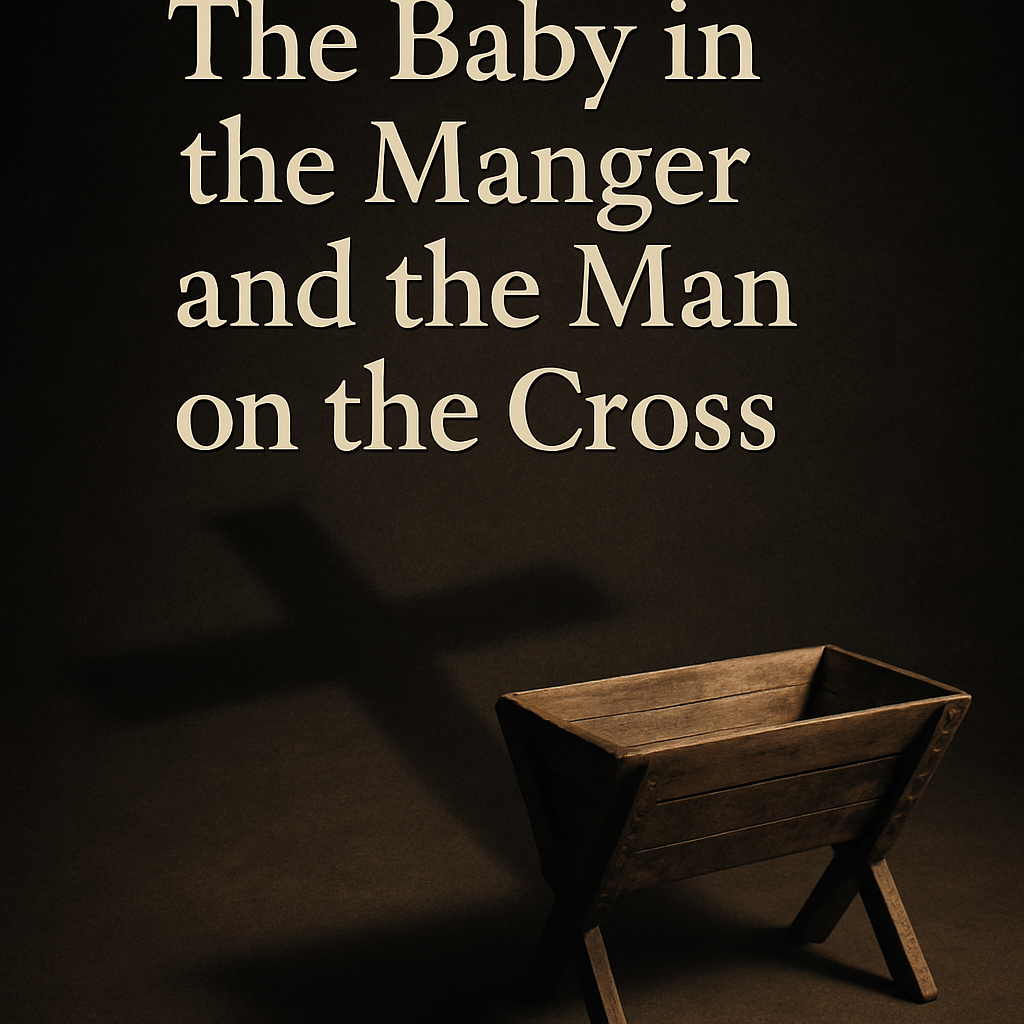
There is no such thing as an isolated manger.
The child laid in straw cannot be understood apart from the man lifted on wood. To separate Bethlehem from Golgotha is not only a theological mistake—it is a deliberate softening of the gospel.
The manger makes no sense without the cross.
And the cross cannot be understood without the incarnation.
Christmas is not the beginning of a story that ends happily.
It is the opening movement of a story that ends violently—and gloriously.
The Cradle Was Never an End in Itself
The modern imagination treats the birth of Christ as a self-contained moment: a holy interruption, a peaceful scene, a divine visit.
Scripture does not.
From the very beginning, the birth of Jesus is framed in terms of purpose, not sentiment.
“She will bear a son, and you shall call His name Jesus, for He will save His people from their sins.” (Matthew 1:21)
The name comes with a mission.
The mission comes with a cost.
Jesus was not born merely to be admired.
He was born to die.
Wood and Wood
The first object to receive the incarnate Christ was not a throne—it was a feeding trough.
Rough wood.
Borrowed space.
No permanence.
This is not coincidence.
The same hands that would one day be pierced were first laid upon splintered boards. The same body wrapped in swaddling cloths would later be wrapped in burial linens. The same humility that placed Him in a manger would carry Him silently to the cross.
The incarnation already assumes the atonement.
To speak of Christ’s birth without His death is to tell half the truth—and half-truths always mislead.
Why the World Loves the Manger but Hates the Cross
The manger is manageable.
It invites admiration without submission. It allows wonder without repentance. It permits reflection without confrontation.
The cross does not.
The cross declares:
- Sin is real
- Judgment is deserved
- Blood is required
- Substitution is necessary
The world can tolerate a baby because babies make no demands.
It cannot tolerate a crucified King who claims absolute authority over life, death, morality, and eternity.
This is why culture sentimentalizes Christmas and silences Good Friday.
The Cross Was Not an Accident
The crucifixion was not a tragic turn of events. It was not a failure of leadership or an unfortunate misunderstanding.
It was the plan.
“This Jesus, delivered up according to the definite plan and foreknowledge of God…” (Acts 2:23)
The child in the manger was already marked.
Marked by covenant.
Marked by prophecy.
Marked by purpose.
The incarnation is God’s declaration that salvation will not come through instruction, inspiration, or improvement—but through substitutionary sacrifice.
No Cross, No Christmas
If Christ does not go to the cross, then the manger becomes meaningless.
- No atonement → no forgiveness
- No sacrifice → no reconciliation
- No blood → no peace
Christmas without the cross is not hopeful—it is hollow.
But when the manger is seen in light of the cross, Christmas becomes terrifying and beautiful all at once.
God did not merely come near.
God came to die.
The Glory Hidden in Plain Sight
The humility of Christ is not weakness—it is strategy.
The King enters quietly.
The Lamb walks willingly.
The Judge submits to judgment.
And by doing so, He disarms the powers of darkness, satisfies divine justice, and secures redemption for His people.
This is why Christmas is not cute.
It is calculated.
He was born to be crushed—so that sinners could be spared.
A Final Word
Do not linger too long at the manger.
If you stop there, you have missed the point.
Follow the child:
- From straw to rejection
- From teaching to betrayal
- From trial to crucifixion
- From grave to glory
Only then does Christmas make sense.
“Behold, the Lamb of God, who takes away the sin of the world.” (John 1:29)
The baby in the manger is the man on the cross.
And that truth changes everything.
Soli Deo Gloria.
 TheoloJeep
Leave a comment