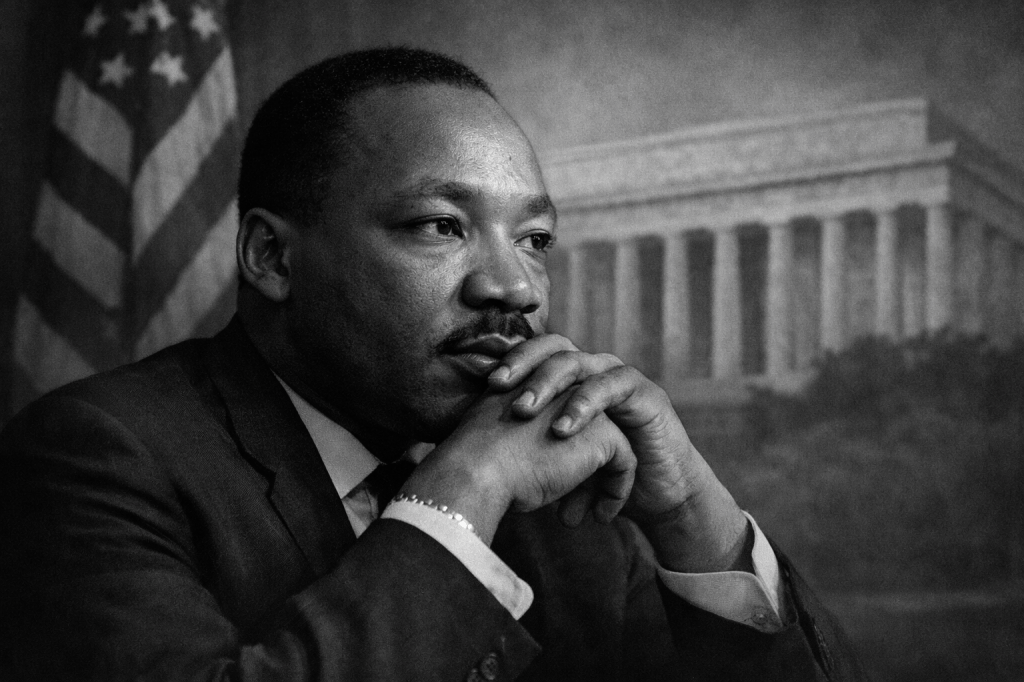
Every January, Martin Luther King, Jr. is either canonized beyond criticism or condemned beyond usefulness.
Neither approach is honest.
Neither approach helps us learn.
If we are going to talk about Dr. King—and we should—then we need to do so with both gratitude and discernment. Christians, of all people, ought to be able to walk that line. Scripture does it constantly. Hebrews 11 celebrates flawed men without airbrushing their sins. The Bible neither pretends David was spotless nor denies that God used him mightily.
So let’s talk about Martin Luther King, Jr.—the good he pursued, the errors he held, and why discernment matters.
The Good He Sought to Achieve
There is no denying that Martin Luther King, Jr. played a pivotal role in confronting racial injustice in America.
He spoke forcefully against segregation when it was culturally costly to do so. He appealed to the conscience of a nation that had grown comfortable with partiality—something Scripture explicitly condemns (James 2:1). He insisted, rightly, that human dignity is not grounded in skin color but in something deeper than social utility or political power.
His insistence on nonviolent resistance, shaped in part by Christian moral language, restrained what could have become an even more destructive cycle of retaliation and bloodshed. His leadership helped force conversations the nation had avoided for generations.
Many of the legal and cultural gains made during the Civil Rights Movement were not inevitable. They required courage, sacrifice, and perseverance. For that, Dr. King deserves acknowledgment—not worship, not sainthood, but honest recognition.
We can say thank you without saying amen to everything he believed.
His Theology Was Not Orthodox Christianity
This is where many Christians become uncomfortable—either because they don’t know it, or because they fear saying it out loud.
Martin Luther King, Jr. did not hold to historic, orthodox Christian doctrine.
By his own admissions and academic writings, he denied or reinterpreted foundational Christian truths, including:
- The virgin birth of Christ
- The bodily resurrection of Jesus
- The authority and inerrancy of Scripture
King was shaped deeply by liberal Protestant theology, which sought to retain Christian language while emptying it of supernatural substance. Sin became primarily social. Salvation became primarily political. Redemption became primarily structural.
This matters.
Not because it disqualifies every moral insight he ever voiced—but because Christians must never confuse Christian vocabulary with Christian theology. A man can quote Scripture and still misunderstand the Gospel.
The kingdom of God is not brought about by legislation, protest, or social reform alone. It is brought by regeneration—by the Spirit of God making dead hearts alive.
His Moral Failings Were Real
It is also historically dishonest to pretend Martin Luther King, Jr. was morally exemplary in his personal life.
Credible evidence—including contemporaneous documentation—points to repeated marital unfaithfulness. These were not isolated accusations manufactured by enemies, but patterns that grieved those closest to him.
This does not erase his public courage. But it does remind us of something Scripture never lets us forget: charisma is not the same as character.
Christians should resist the impulse to excuse sin for the sake of preserving a legacy. We don’t do that for our own leaders—nor should we do it for national icons.
Why Christians Should Speak Carefully—but Honestly
The temptation today is to flatten King into a symbol useful for our current arguments. Both sides do it. One side baptizes him. The other dismisses him entirely.
Both approaches fail.
Christians can affirm that racism is sin without affirming flawed theology.
Christians can acknowledge cultural progress without confusing it with the Gospel.
Christians can respect courage while refusing to overlook moral compromise.
We do not need perfect heroes. We have a perfect Savior.
And perhaps that is the most important takeaway of all.
A Better Way Forward
Martin Luther King, Jr. was neither a saint nor a devil. He was a man—used by God’s common grace to restrain evil and expose injustice, yet deeply flawed in belief and behavior.
We honor truth best when we tell it fully.
Let us reject shallow hero worship.
Let us reject cynical dismissal.
And let us anchor our hope not in movements, leaders, or moral revolutions—but in Christ crucified and risen.
History teaches us lessons.
Scripture tells us the truth.
And only the Gospel saves.
Soli Deo Gloria.
 TheoloJeep
Leave a comment