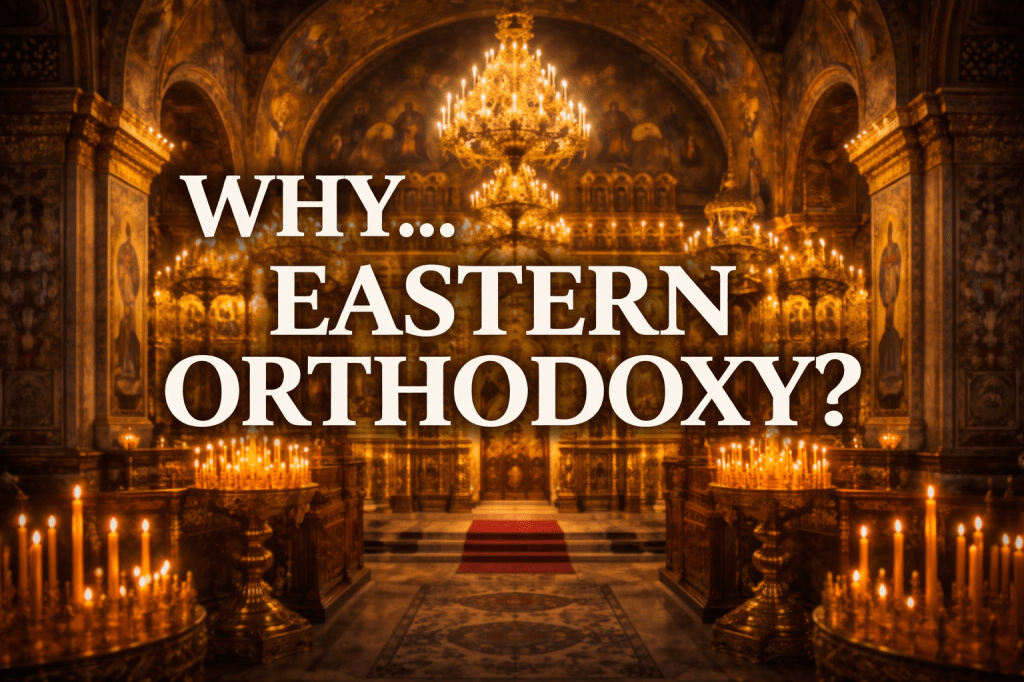
A Biblical Examination
Eastern Orthodoxy is often called “the ancient Church.” It traces its roots back to the earliest centuries of Christianity. Its worship is formal and reverent. Its churches are filled with icons and incense. Its theology speaks often of mystery and transformation.
To many Protestants who are tired of shallow modern church culture, Orthodoxy feels steady, historic, and deep.
But as with every tradition in this series, the question is not whether it is old.
The question is: Is it faithful to Scripture?
This is not written to dismiss Orthodoxy. It has preserved much that is good and beautiful in Christian history. But age alone does not make something biblical.
Scripture must be the final measure.
1. Historical Roots
Eastern Orthodoxy developed in the eastern part of the Roman Empire — in cities like Constantinople, Antioch, and Alexandria.
In 1054, the East and West formally split in what is called the Great Schism. The division had many causes:
- Disagreement over the Pope’s authority
- Disputes about wording in the Nicene Creed
- Cultural and political tensions
Unlike Roman Catholicism, Orthodoxy does not believe one bishop has authority over the entire Church. Instead, authority is shared among bishops.
Orthodoxy holds tightly to:
- The first seven church councils (from AD 325 to 787)
- The writings of the early Church Fathers
- The continuity of its worship practices
It sees itself not as a new movement, but as the original Church preserved.
That claim deserves careful examination.
2. What Eastern Orthodoxy Gets Right
Eastern Orthodoxy strongly affirms:
- The Trinity
- The full deity and humanity of Christ
- The resurrection
- The historic creeds
- The seriousness of sin
- The necessity of grace
Its worship is reverent and focused. There is no casual approach to gathering before God.
Orthodoxy also emphasizes that salvation is not merely about being forgiven, but about being transformed. Believers are called to grow in holiness and become more like Christ.
That emphasis on transformation is biblical.
Christ does not merely forgive us. He changes us.
Those strengths should be acknowledged.
3. Major Doctrinal Distinctives
Authority
Orthodoxy teaches that Holy Tradition and Scripture belong together. The Bible is part of the Church’s Tradition, not something standing above it alone.
The Church, guided by the Holy Spirit, preserves and interprets the faith through councils and the writings of early Christian leaders.
Salvation (Theosis)
Orthodoxy often describes salvation as “theosis,” meaning participation in God’s life. Believers do not become God, but they are changed and drawn into deeper fellowship with Him.
This language focuses more on healing and transformation than on courtroom language like “justification.”
Original Sin
Orthodoxy teaches that we inherit corruption and death from Adam, but it does not speak as strongly about inherited guilt as many Western traditions do.
Sacraments
Orthodoxy practices sacramental worship, including baptism and the Lord’s Supper, and believes grace is given through these “holy mysteries.”
Icons
Icons are central in Orthodox worship. They are honored as visual reminders of heavenly realities and the saints who have gone before.
4. Where Scripture Challenges Orthodoxy
Authority and Tradition
Scripture says it is God-breathed and sufficient to equip believers (2 Timothy 3:16–17). While the Church teaches and guards truth, the Bible itself is the final authority.
The early Church Fathers were faithful in many ways — but they were not infallible. They must be measured by Scripture.
The question remains:
Where does the Bible teach that Tradition stands alongside it with equal authority?
Salvation and Justification
Orthodoxy speaks beautifully about transformation. But Scripture also clearly teaches that sinners are declared righteous by faith apart from works (Romans 3:28).
Before we are changed, we are justified — declared righteous because of Christ’s finished work (2 Corinthians 5:21).
If that legal declaration is softened or overshadowed, clarity about assurance can become less certain.
Transformation matters.
But justification must remain clear.
Original Sin
Romans 5 teaches that Adam’s sin brought condemnation to all. Death spreads because sin spreads.
If we downplay inherited guilt, we risk weakening Paul’s argument about why Christ’s obedience must be credited to us.
Icons and Worship
Orthodoxy carefully distinguishes between worship and honor when it comes to icons. But Scripture repeatedly warns against images in worship (Exodus 20:4–5).
Even if the intention is not idolatry, the practice requires careful biblical examination.
5. Why It Matters
Eastern Orthodoxy is appealing because it feels rooted and stable.
But stability must be grounded in truth.
If Scripture does not function as the final authority, reform becomes difficult.
If justification is not clearly understood as a declaration based entirely on Christ’s righteousness, assurance can become unclear.
If practices develop without clear biblical grounding, they may slowly shape the heart in unintended ways.
These are not abstract concerns.
They shape how believers understand salvation, worship, and authority.
Final Assessment
Eastern Orthodoxy offers:
- Deep historical continuity
- Reverent worship
- Strong Trinitarian theology
- A serious vision of spiritual growth
But it also maintains:
- A view of Tradition that stands alongside Scripture
- A way of speaking about salvation that deemphasizes justification by faith alone
- Sacramental practices that require biblical scrutiny
- The use of icons in worship
The issue is not whether Orthodoxy is ancient.
The issue is whether it submits fully to the authority of Scripture.
And so we ask again:
Why Eastern Orthodoxy?
If Scripture alone is the final court of appeal, then even the most historic tradition must be measured by it.
The Church belongs to Christ.
And Christ speaks through His Word.
Soli Deo Gloria.
 TheoloJeep
Leave a comment