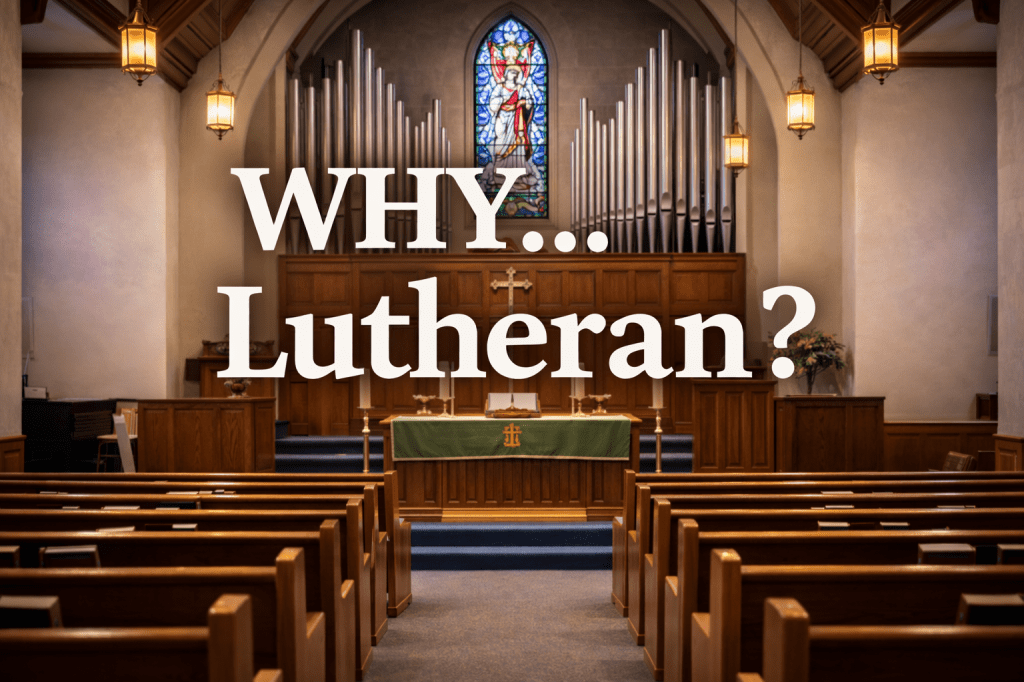
A Biblical Examination
Lutheranism traces directly to the Protestant Reformation.
It begins with Martin Luther in 1517, when he challenged the sale of indulgences and the theological system behind them.
Unlike later Reformed traditions, Lutheranism did not seek to reconstruct the Church from the ground up. It sought to reform it around one central conviction:
Justification by faith alone.
Luther’s question was simple:
How can a sinner stand righteous before a holy God?
The Lutheran answer was revolutionary.
But as with every tradition in this series, the question is not whether it was historically significant.
The question is: Is it faithful to Scripture?
1. Historical Roots
Lutheranism began in Germany in the early 16th century.
Luther’s writings — particularly The Bondage of the Will and his commentary on Romans and Galatians — shaped Protestant theology profoundly.
The Augsburg Confession (1530) became the foundational doctrinal summary of Lutheran belief.
Unlike the later Reformed tradition, Lutheranism maintained:
- A strong sacramental theology
- A more liturgical form of worship
- A sharp distinction between Law and Gospel
Lutheranism spread throughout Germany and Scandinavia and later into America.
It remains one of the largest Protestant traditions in the world.
2. What Lutheranism Gets Right
Lutheranism strongly affirms:
- Justification by faith alone
- The total inability of man apart from grace
- The authority of Scripture
- The seriousness of sin
- The sufficiency of Christ’s atoning work
Luther’s recovery of justification by faith was one of the most important theological clarifications in church history.
The insistence that sinners are declared righteous solely because of Christ’s righteousness is foundational to Protestant theology.
Lutheran preaching also preserves a careful distinction between Law and Gospel:
- The Law exposes sin.
- The Gospel announces grace.
That clarity guards against moralism.
There is deep strength here.
3. Major Doctrinal Distinctives
The Lord’s Supper
Lutheranism rejects transubstantiation but affirms what is often called “sacramental union.”
Christ’s body and blood are truly present “in, with, and under” the bread and wine.
This differs from both Roman Catholic transubstantiation and many Reformed symbolic views.
Baptism
Lutheranism affirms infant baptism and teaches that baptism is a means of grace — that God truly works through it.
Law and Gospel
Lutheran theology emphasizes a sharp distinction between Law (God’s commands) and Gospel (God’s promise).
Confusing the two is seen as spiritually dangerous.
Election
Classical Lutheranism affirms election but avoids strong formulations of double predestination found in some Reformed theology.
4. Where Scripture Challenges Lutheran Theology
The Lord’s Supper
Jesus says, “This is my body” (Luke 22:19).
Luther took these words very literally.
Yet Scripture also frequently uses figurative language (“I am the door,” “I am the vine”).
The question is whether Christ’s physical body can be present in multiple places simultaneously, or whether the Supper is primarily a spiritual participation (1 Corinthians 10:16).
The exact nature of Christ’s presence remains debated.
Baptism as a Means of Grace
Scripture connects salvation with faith (Romans 3:28).
While baptism is commanded and significant, the New Testament consistently presents faith as the instrument of justification.
If baptism is said to regenerate apart from conscious faith, tension arises with passages emphasizing personal belief.
Election and Sovereignty
Luther himself wrote strongly about the bondage of the will.
Later Lutheran theology, however, softened certain aspects of predestination to avoid strong formulations about reprobation.
The question becomes whether Scripture allows us to soften what Romans 9 presents plainly.
5. Why It Matters
Lutheranism offers remarkable clarity on justification.
That alone is no small gift to the Church.
But sacramental theology shapes how believers understand grace.
If grace is tied too closely to sacramental participation, assurance may shift subtly from Christ’s finished work to ecclesial administration.
If Law and Gospel are separated too sharply, sanctification may be misunderstood.
These distinctions affect preaching, assurance, and worship.
Final Assessment
Lutheranism offers:
- Historic recovery of justification by faith
- Strong preaching of grace
- Theological seriousness
- Liturgical continuity
But it also raises questions regarding:
- The nature of Christ’s presence in the Supper
- Baptism and regeneration
- The consistency of its doctrine of election
The Reformation began with Luther.
For that, the Church owes him gratitude.
But gratitude does not replace examination.
And so we ask:
Why Lutheranism?
If Scripture alone governs the Church, then even the earliest Reformers must remain accountable to it.
The Church belongs to Christ.
And Christ’s Word must remain final.
Soli Deo Gloria.
 TheoloJeep
Leave a comment