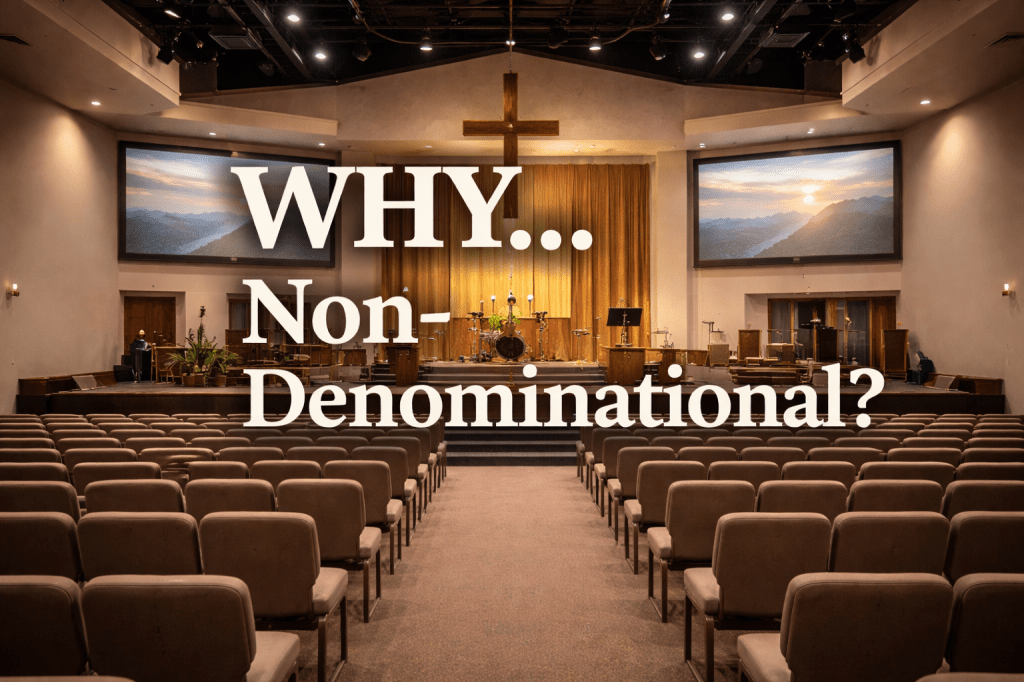
A Biblical Examination
“Non-denominational” is not technically a denomination.
It is often a statement of distance from denominational identity.
In many cases, it signals:
- Independence
- Flexibility
- A focus on the Bible alone
- Freedom from historical structures
Non-denominational churches range from deeply doctrinal to broadly pragmatic.
Some are essentially Baptist in theology but avoid the label.
Some are loosely evangelical with minimal confessional structure.
Some are pastor-led networks without formal oversight.
So the question is not whether non-denominational churches exist.
Is avoiding denominational identity a strength — or a weakness?
1. Historical Roots
The rise of non-denominational churches accelerated in the late 20th century.
Many emerged from:
- Dissatisfaction with denominational bureaucracy
- The church growth movement
- Cultural shifts toward institutional skepticism
- A desire for simpler, more accessible worship
Some non-denominational churches grew from independent Baptist or charismatic backgrounds but rebranded to broaden appeal.
Others formed intentionally outside historic denominational structures.
The movement is not unified by confession, but by independence.
2. What Non-Denominational Churches Get Right
Non-denominational churches often emphasize:
- The authority of Scripture
- Personal conversion
- Practical preaching
- Mission and evangelism
- Flexibility in structure
Many are effective at outreach. They often adapt quickly to cultural shifts. They may avoid denominational political entanglements.
There is often a strong focus on local church life and community.
That flexibility can be a strength.
3. Major Distinctives
Independence
Non-denominational churches typically operate without formal denominational oversight.
Authority rests locally — often in elders, but sometimes primarily in a senior pastor.
Minimal Confessional Identity
Most non-denominational churches operate with short statements of faith rather than historic confessions.
The emphasis is often on core gospel truths rather than comprehensive theological systems.
Pragmatic Structure
Leadership models and worship styles are often shaped by perceived effectiveness rather than historic tradition.
4. Where Scripture Challenges the Model
Accountability and Oversight
The New Testament presents local churches connected in relationship (Acts 15).
While each church had leadership, they were not entirely isolated.
When churches operate without meaningful external accountability, correction can become difficult.
Isolation can lead to doctrinal drift or leadership abuse.
Doctrinal Depth
Short statements of faith may preserve unity — but Scripture calls churches to guard the whole counsel of God (Acts 20:27).
If theology is minimized for the sake of accessibility, long-term stability may suffer.
Personality-Driven Leadership
Without denominational structure, authority may concentrate in a single pastor or leadership team.
When structures are weak, leadership failures can have widespread consequences.
Scripture emphasizes plurality of elders and shared oversight (1 Peter 5:1–3).
5. Why It Matters
Non-denominational identity often appeals because it feels simple and biblical.
But “no denomination” does not mean “no theology.”
Every church stands somewhere theologically — even if it does not formally admit it.
If a church avoids confessional clarity, its theology may be shaped more by culture than by history.
If independence eliminates accountability, long-term health may suffer.
The question is not whether non-denominational churches can be faithful.
Many are.
The question is whether historic denominational identity provides guardrails that Scripture itself assumes.
Final Assessment
Non-denominational churches offer:
- Flexibility
- Local autonomy
- Strong evangelistic focus
- Freedom from bureaucratic structures
But they also risk:
- Doctrinal shallowness
- Weak accountability
- Personality-driven leadership
- The illusion of theological neutrality
The Church did not begin as a brand.
It began as a body rooted in apostolic teaching.
And so we ask:
Why Non-Denominational?
If Scripture alone governs the Church, then independence must still submit to biblical patterns of accountability, doctrine, and shared leadership.
The Church belongs to Christ.
And Christ’s Word must shape not only what we believe — but how we structure and guard His Church.
Soli Deo Gloria.

 TheoloJeep
Leave a comment