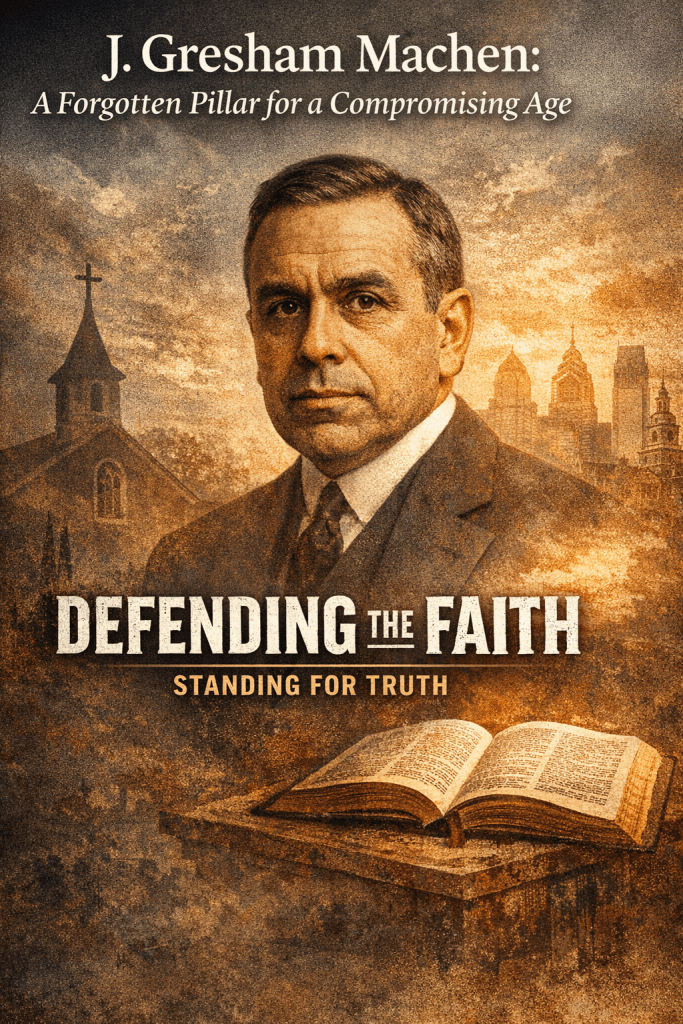
There are names in church history that everybody knows—Luther, Calvin, Spurgeon. And then there are men who stood just as firmly, fought just as faithfully, but somehow get left out of the conversation.
J. Gresham Machen is one of those men.
And that’s a problem—because the battle he fought is the same one we’re fighting right now.
The War Wasn’t “Out There”—It Was in the Church
Machen didn’t spend his life pushing back against atheism or paganism. His primary concern wasn’t the world.
It was the church.
More specifically, it was what happens when the church starts to sound like the world while still using Christian vocabulary.
That was the genius—and the danger—of theological liberalism in the early 1900s. It didn’t come in waving a flag that said, “We deny Christianity.” It came in saying:
- “We just need to reinterpret it.”
- “We’re making it more accessible.”
- “We’re removing unnecessary stumbling blocks.”
Sound familiar?
Because we’re hearing the exact same language today.
“A Different Religion Altogether”
In his landmark book Christianity and Liberalism, Machen didn’t mince words.
He didn’t say liberal theology was a branch of Christianity or a less mature version of it.
He said it was something else entirely.
Not a different denomination.
Not a different emphasis.
→ A different religion.
Why?
- Sin became brokenness, not rebellion
- The cross became inspiration, not substitution
- Jesus became example, not Savior
- The Bible became suggestive, not authoritative
And once those foundations shift, you’re not dealing with Christianity anymore—you’re dealing with something that just sounds like it.
He Refused to Play Along
Machen wasn’t interested in platform-building. He wasn’t trying to win popularity contests.
He was trying to be faithful.
While teaching at Princeton Theological Seminary, he watched an institution that had once stood firm on Scripture begin to drift toward compromise.
And here’s where his courage shows up.
He didn’t just complain.
He didn’t just write letters.
He walked away.
In 1929, he helped found Westminster Theological Seminary—because he believed the next generation of pastors needed something better than theological confusion dressed up as sophistication.
Later, he would help establish the Orthodox Presbyterian Church.
Not because he loved division—but because he loved truth more than institutional comfort.
This Is Our Moment Too
If we’re paying attention, we’re not dealing with new issues—we’re dealing with recycled ones.
We’re seeing:
- Churches afraid to speak clearly about sin
- Sermons that sound more like therapy than proclamation
- Worship that prioritizes atmosphere over theology
- A growing pressure to make Christianity more “acceptable” to a culture that hates its claims
And just like in Machen’s day, it’s not coming from outside.
It’s coming from within.
That’s what makes it dangerous.
Clarity Is Kindness
One of the things that stands out about Machen is that he wasn’t harsh—but he was clear.
And clarity, in a confused age, often feels like aggression.
But it’s not. It’s love.
Because if the gospel is:
- Watered down — it cannot save
- Redefined — it cannot transform
- Softened — it cannot confront
The most loving thing we can do is tell the truth about God, man, and Christ—without flinching.
Faithfulness Over Fame
Machen never led a megachurch.
He wasn’t trending.
He didn’t have a platform in the modern sense.
But he stood.
And sometimes that’s the call.
Not to grow something big.
Not to be widely known.
But to be unmovably faithful in your generation.
His Final Words Say Everything
“I’m so thankful for the active obedience of Christ. No hope without it.”
Not:
“I’m glad for what I built”
“I’m proud of what I defended”
But Christ alone.
We Don’t Need Innovation—We Need Backbone
The church doesn’t need to reinvent itself.
It needs men—and women—who will:
- Hold fast to Scripture
- Speak clearly about the gospel
- Refuse to trade truth for relevance
- Stand firm, even when it costs something
Machen did that.
And whether most people know his name or not…
we are still standing in the wake of his faithfulness.
Soli Deo Gloria.
 TheoloJeep
Leave a comment