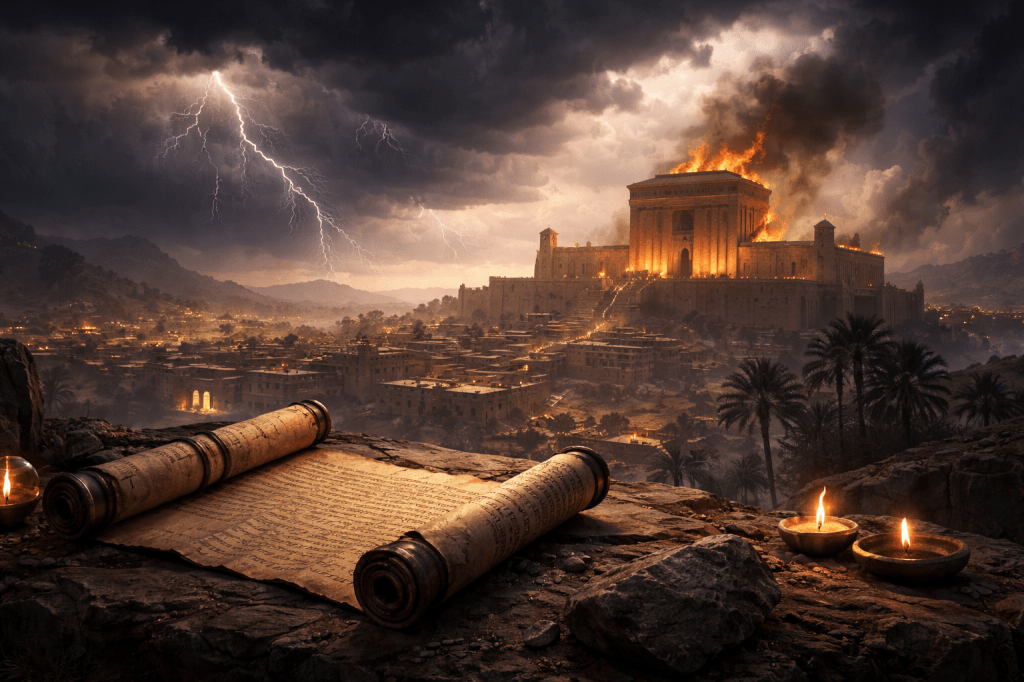
Few books of the Bible have captured the imagination of Christians quite like the Book of Revelation.
It is filled with dragons and beasts, trumpets and bowls, cosmic battles and apocalyptic visions. For generations, believers have tried to decode its symbols, chart its timelines, and match its imagery to events unfolding in the modern world.
Every few years it seems another theory rises to the surface.
A world leader is labeled the Beast.
A new technology becomes the mark of the beast.
A war somewhere in the world suddenly looks like the battle of Armageddon.
The result is that Revelation is often treated like a kind of prophetic puzzle box—a mysterious roadmap of events that will unfold sometime far off in the future.
But what if the first readers of Revelation would have understood the book very differently?
A Letter to Real Churches
Before Revelation became a subject for modern speculation, it was first a letter written to real Christians living in real places.
The opening lines tell us exactly who the book was written to:
“John to the seven churches that are in Asia…”
— Revelation 1:4 (ESV)
Those churches were not imaginary. They were congregations scattered throughout Asia Minor in the first century.
They lived in cities like Ephesus, Smyrna, and Laodicea.
These believers faced persecution, social pressure, and uncertainty about the future. They needed encouragement. They needed assurance that Christ was still reigning, even when the world around them seemed unstable.
The Book of Revelation was written to strengthen their faith.
It was not written primarily to satisfy the curiosity of Christians two thousand years later.
The Words We Often Skip Over
There is something else in the opening verses that many readers move past too quickly.
John tells us that the visions he received concerned events that would happen soon.
“The revelation of Jesus Christ, which God gave him to show to his servants the things that must soon take place.”
— Revelation 1:1
And again:
“Blessed is the one who reads aloud the words of this prophecy… for the time is near.”
— Revelation 1:3
Soon.
Near.
Those words appear repeatedly throughout the book.
Near in what sense?
Near for whom?
If Revelation was primarily describing events thousands of years away, those words would seem strangely misleading to the original readers.
But if John was describing events that would unfold within their own generation, the language suddenly begins to make sense.
A World Already Shaking
To understand Revelation, we must step back into the world of the first century.
The Roman Empire ruled the Mediterranean world with unmatched power. Its legions stretched across continents, and its emperors demanded loyalty that often bordered on worship.
At the same time, tensions were rising in Judea.
The Jewish people lived under Roman occupation, and resentment simmered beneath the surface. Revolutionary movements were growing. Messianic expectations were spreading. The political atmosphere was volatile.
In just a few years, those tensions would explode into one of the most devastating wars in ancient history.
The Jewish revolt against Rome would lead to a catastrophic siege of Jerusalem and the destruction of the temple in AD 70.
But decades earlier, Jesus had already warned that such a judgment was coming.
The Words of Jesus
In the final week before His crucifixion, Jesus stood with His disciples on the Mount of Olives overlooking Jerusalem.
The temple complex stretched before them in magnificent splendor.
To the disciples, it must have seemed impossible that such a structure could ever fall.
But Jesus said something astonishing.
“Truly, I say to you, there will not be left here one stone upon another that will not be thrown down.”
— Matthew 24:2
The disciples were stunned. They asked Jesus when these things would happen and what signs would accompany them.
Jesus then described wars, tribulation, false prophets, and the coming devastation of Jerusalem.
And then He made a statement that has puzzled readers ever since:
“Truly, I say to you, this generation will not pass away until all these things take place.”
— Matthew 24:34
The generation listening to Jesus would live to see the fulfillment of His prophecy.
And within forty years, they did.
Reading Revelation with First-Century Eyes
What if the Book of Revelation is closely connected to the prophecy Jesus gave on the Mount of Olives?
What if Revelation is not simply describing the end of the physical universe, but the dramatic end of an entire covenant era?
The fall of Jerusalem in AD 70 marked the destruction of the temple, the center of Israel’s sacrificial system, and the collapse of the Old Covenant order that had stood for centuries.
If Revelation was written before those events took place, its vivid imagery may have been describing the approaching judgment that Jesus Himself had foretold.
That possibility changes how we read the book.
Suddenly the time indicators begin to matter.
The historical setting becomes crucial.
The symbols begin to connect with real events unfolding in the world of the early church.
A Different Way to Read Revelation
This perspective is not new.
Many scholars and theologians throughout church history have suggested that much of Revelation describes the fall of Jerusalem and the upheaval of the first-century world.
In recent years, theologians like Kenneth Gentry have argued in detail that Revelation was written before the destruction of Jerusalem.
If that is correct, the book becomes something even more powerful than a distant prophecy.
It becomes a dramatic testimony to the faithfulness of Christ’s words.
Jesus predicted judgment.
And history proved Him right.
The Story Is Just Beginning
In the next post, we will step deeper into the world of the first century.
We will look at the rising tensions within the Roman Empire, the growing unrest in Judea, and the brutal persecution that Christians began to face under one of Rome’s most infamous rulers.
His name was Nero.
And some believe he may have been the Beast described in the pages of Revelation.
Soli Deo Gloria.
 TheoloJeep
Leave a comment