If we want to understand the Book of Revelation, we must step back into the world of the first century.
It was a world that felt increasingly unstable.
To Christians scattered across the Roman Empire, the future looked uncertain. The empire seemed unstoppable, its legions stretched across continents, and its emperors ruled with a power that few dared challenge.
Yet beneath the surface of that powerful empire, pressure was building.
In Judea, tensions between Rome and the Jewish people were reaching a boiling point.
Revolution was in the air.
The Roman World
By the middle of the first century, Rome had become the dominant power of the ancient world.
Its armies were disciplined and relentless. Its governors enforced Roman order across distant provinces. Its emperors commanded loyalty that increasingly bordered on worship.
To many people living under Roman rule, the empire seemed permanent.
But Rome’s power came at a cost.
Heavy taxation burdened the provinces. Roman soldiers enforced imperial authority with little patience for rebellion. Local cultures and religious traditions were often tolerated, but only so long as they did not threaten Roman control.
In Judea, resentment simmered.
The Powder Keg of Judea
The Jewish people were fiercely devoted to their covenant identity.
They worshiped one God.
They followed the law of Moses.
And they believed the promises given through the prophets—that one day God would send a Messiah who would deliver His people.
Living under Roman occupation was deeply humiliating for many Jews.
Roman governors ruled the land.
Roman soldiers patrolled the streets.
Roman taxes drained the economy.
And yet the temple still stood in Jerusalem, the center of Jewish life and worship.
To many Jews, it was unthinkable that God would ever allow that temple to fall.
But Jesus had already said otherwise.
A Warning from the Mount of Olives
Just days before His crucifixion, Jesus and His disciples stood overlooking Jerusalem.
The temple complex gleamed in the sunlight. Its massive stones and golden adornments made it one of the most impressive structures in the ancient world.
The disciples admired its grandeur.
But Jesus spoke words that must have shocked them.
“Do you see all these things? Truly, I say to you, there will not be left here one stone upon another that will not be thrown down.”
— Matthew 24:2 (ESV)
The disciples immediately asked when this would happen.
Jesus responded by describing a series of events:
- wars and rumors of wars
- false messiahs
- persecution of believers
- the surrounding of Jerusalem by armies
These were not vague predictions about the distant future.
They were warnings about events that would unfold within the lifetime of His hearers.
Forty Years of Rising Tension
After the resurrection of Christ, the gospel began spreading rapidly throughout the Roman world.
The early church grew in cities across the empire.
But the political and religious tensions in Judea continued to escalate.
Jewish nationalist groups—sometimes called the Zealots—began pushing for open rebellion against Rome.
Small uprisings became increasingly common.
Violence flared.
Roman authorities responded harshly.
Every year the atmosphere became more volatile.
And then the empire itself entered a dark chapter under one of its most infamous rulers.
The Rise of Nero
In AD 54, a young man named Nero became emperor of Rome.
At first, his reign appeared promising.
But over time Nero grew increasingly unstable and tyrannical.
Ancient historians such as Tacitus describe his paranoia, extravagance, and cruelty.
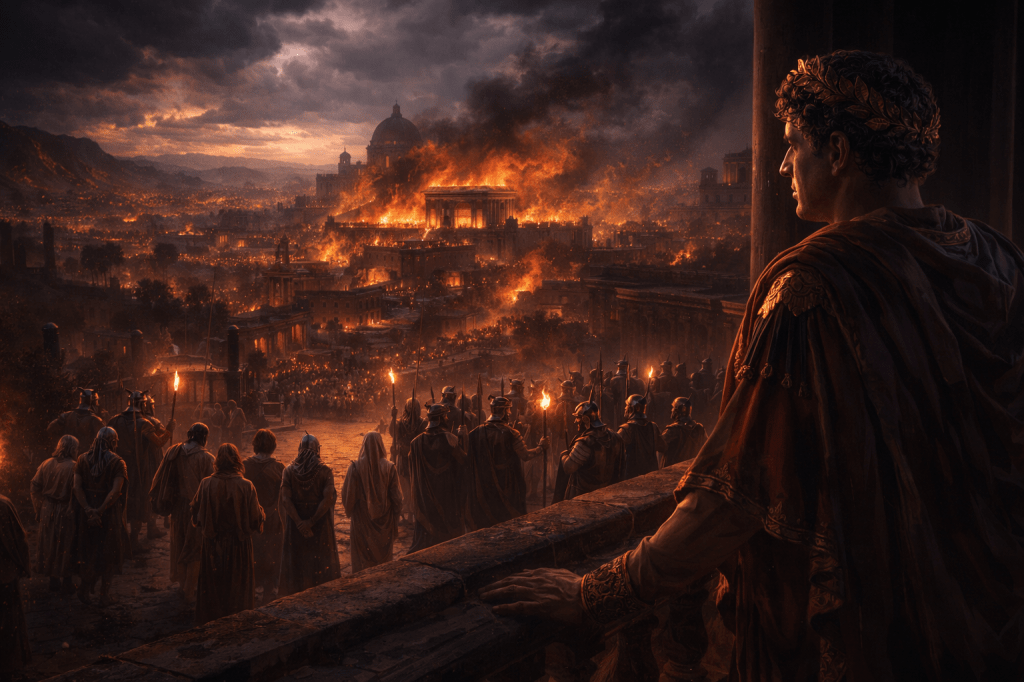
Then, in AD 64, disaster struck the city of Rome.
A massive fire broke out and raged for days, destroying large portions of the city.
Rumors quickly spread that Nero himself had ordered the fire.
Whether that accusation was true or not, Nero needed someone to blame.
And he found a convenient target.
The Christians.
The First Imperial Persecution
Christians were already viewed with suspicion in Roman society.
They refused to worship the emperor.
They rejected the pagan gods.
They proclaimed allegiance to a crucified man they called Lord.
To Roman authorities, this seemed subversive.
Nero seized the opportunity to turn public anger toward them.
The persecution that followed was brutal.
According to the Roman historian Tacitus, Christians were tortured and executed in horrific ways.
Some were crucified.
Some were torn apart by wild animals.
Others were burned alive to illuminate Nero’s gardens at night.
It was likely during this period that the apostles Peter and Paul were martyred.
The early church suddenly found itself facing a terrifying reality.
The most powerful empire in the world had turned against them.
The Gathering Storm
While Christians suffered persecution in Rome, another crisis was unfolding in Judea.
Jewish resistance to Roman rule was reaching its breaking point.
In AD 66, open revolt finally erupted.
Jewish rebels seized control of Jerusalem and drove out the Roman garrison.
Rome would not tolerate such defiance.
Roman legions soon marched toward Judea.
What followed would become one of the most devastating conflicts of the ancient world.
Within just a few years, Jerusalem itself would be surrounded by armies.
The temple would burn.
The city would fall.
Exactly as Jesus had warned.
The Stage for Revelation
When we read the Book of Revelation against this historical backdrop, the imagery begins to feel less like distant speculation and more like urgent prophecy.
The early Christians were not wondering about events thousands of years in the future.
They were living through the opening tremors of a world about to collapse.
Empires were shaking.
Jerusalem was on the brink.
Persecution had begun.
And in the middle of it all, the apostle John received a vision of Christ reigning over history.
In the next post, we will examine one of the most debated figures in the entire book of Revelation.
The Beast.
And we will ask a question that has sparked intense discussion among historians and theologians alike.
Could the Beast of Revelation have been the emperor Nero himself?
Soli Deo Gloria.
 TheoloJeep
Leave a comment