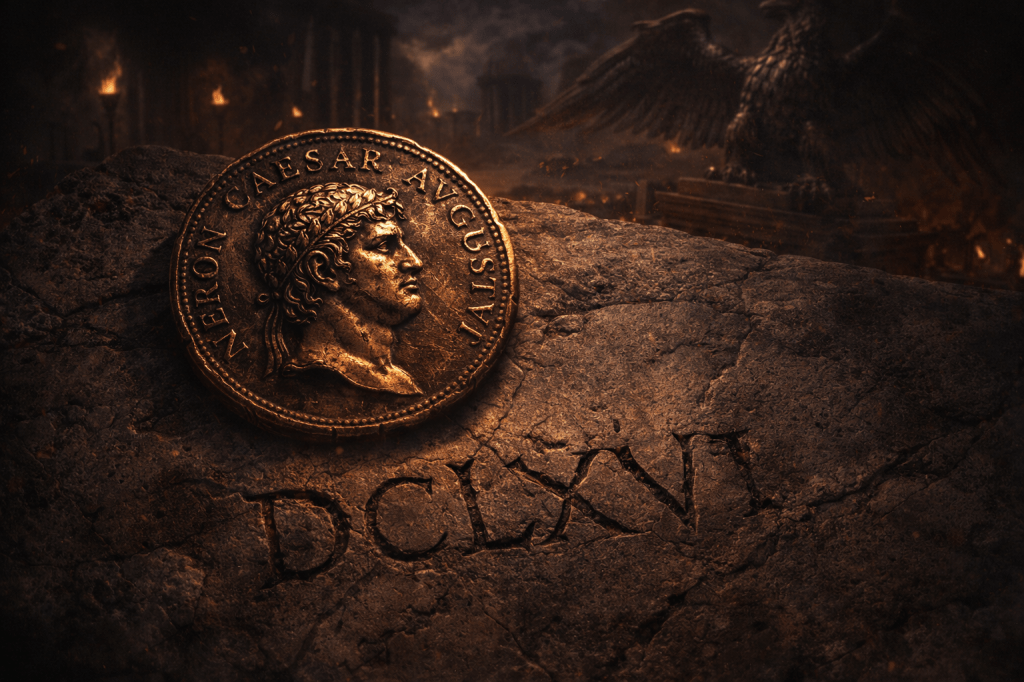
Few numbers in history have sparked as much speculation as 666.
For generations, Christians have tried to decode it.
Some have linked it to world leaders. Others have tied it to technology, barcodes, microchips, or secret conspiracies hidden beneath the surface of modern society.
But the first readers of the Book of Revelation would not have approached the number this way.
They lived in the first century, not the twenty-first.
And when they saw the number 666, they likely understood it in a way that modern readers often overlook.
A Number with a Name
The number appears in one of the most famous passages in Revelation:
“This calls for wisdom: let the one who has understanding calculate the number of the beast, for it is the number of a man, and his number is 666.”
— Revelation 13:18 (ESV)
John does not say the number is random.
He tells the reader to calculate it.
This was a clue.
In the ancient world, letters often doubled as numbers. Both Greek and Hebrew alphabets functioned this way.
This practice—known today as gematria—allowed names to be represented numerically.
To readers familiar with Jewish culture and Scripture, the instruction would have been clear.
The number pointed to a name.
The Name That Equals 666
When the name Nero is written in Hebrew letters—Neron Caesar—the numerical values of those letters add up to 666.
This is not speculation invented centuries later. It was a recognizable method of calculation in the ancient world.
Even more intriguing, some early manuscripts of Revelation record the number as 616.
At first glance, that might seem like a scribal mistake.
But when the Latin spelling of Nero’s name—Nero Caesar—is calculated using the same system, the total becomes 616.
Both numbers point to the same man.
The Emperor Behind the Number
Nero ruled the Roman Empire from AD 54 to AD 68.
His reign became infamous for cruelty, paranoia, and extravagance.
Ancient historians such as Tacitus and Suetonius describe a ruler who grew increasingly unstable as the years passed.
He ordered political rivals executed.
He murdered members of his own family.
And eventually, he turned his attention toward a small but growing religious movement spreading across the empire.
The Christians.
The Fire of Rome
In AD 64, a catastrophic fire swept through the city of Rome.
The blaze raged for days, destroying large portions of the capital.
Rumors quickly spread that Nero himself had started the fire as part of an ambitious plan to rebuild the city according to his own vision.
Whether those accusations were true or not, Nero faced a political crisis.
Public anger was rising.
And so he did what many rulers throughout history have done when facing blame.
He found a scapegoat.
The Christians.
The First Imperial Persecution
The Roman historian Tacitus records what happened next.
Christians were arrested in large numbers.
They were tortured.
They were executed in brutal ways meant to entertain the crowds.
Some were crucified.
Some were torn apart by wild animals.
Others were burned alive to illuminate Nero’s gardens at night.
It was likely during this persecution that two of the most prominent leaders of the early church were killed.
Peter was crucified.
Paul the Apostle, as a Roman citizen, was executed by the sword.
To the Christians living through these events, the Roman Empire suddenly looked less like a distant political power and more like a monstrous enemy.
An empire demanding worship.
An empire hunting believers.
An empire ruled by a man whose name mysteriously equaled 666.
The Beast from the Sea
Revelation describes a terrifying figure rising from the sea:
“And I saw a beast rising out of the sea, with ten horns and seven heads… and the dragon gave his power and his throne and great authority.”
— Revelation 13:1–2
To modern readers, this imagery can feel surreal.
But to Jewish Christians familiar with the Old Testament, the symbolism would have been recognizable.
The prophet Daniel had used similar imagery to describe powerful empires that rose from the chaos of the nations.
The beast represented a persecuting empire.
And in the first century, the empire persecuting Christians was Rome.
The Empire That Demanded Worship
Roman emperors increasingly demanded loyalty that bordered on worship.
Citizens throughout the empire were expected to participate in rituals honoring Caesar.
Most people complied without much thought.
But Christians could not.
They confessed that Jesus was Lord.
And that confession put them on a collision course with the empire.
To refuse emperor worship was to invite suspicion.
To proclaim another king was to risk death.
A Beast Already Revealed?
For many readers today, the Beast of Revelation is assumed to be a future world dictator.
But the first Christians may have seen something much closer to home.
An emperor who persecuted believers.
An empire that demanded allegiance.
A ruler whose name mysteriously matched the number John gave.
The Beast may not be a figure waiting to appear at the end of history.
He may have already ruled the Roman world.
The Story Continues
But the story of Revelation does not stop with Nero.
Beyond the persecution of the church, another crisis was approaching.
A war that would shake Judea to its foundations.
A siege that would devastate Jerusalem.
A judgment that Jesus Himself had predicted decades earlier.
In the next post, we will return to the words Jesus spoke on the Mount of Olives.
Because long before John wrote the Book of Revelation, Christ had already warned that the temple—and the city surrounding it—would soon fall.
Soli Deo Gloria.
 TheoloJeep
Leave a comment