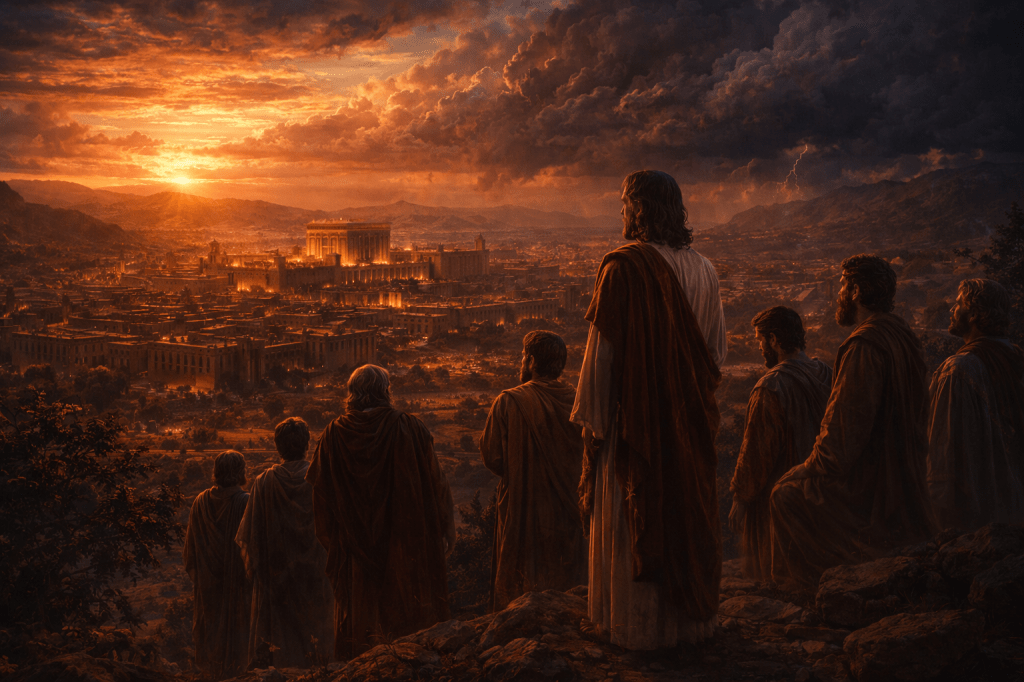
Long before the apostle John received the visions recorded in Revelation, Jesus had already warned that something catastrophic was coming.
It happened during the final week of His earthly ministry.
Jerusalem was crowded with pilgrims preparing for Passover. The temple courts were filled with worshippers. The massive stone structures of the temple complex gleamed in the sunlight.
To the disciples, it must have seemed indestructible.
But Jesus said something that would have sounded almost impossible.
“Do you see all these things? Truly, I say to you, there will not be left here one stone upon another that will not be thrown down.”
— Matthew 24:2 (ESV)
The disciples were stunned.
The temple was not merely a building. It was the center of Jewish worship, identity, and national life. For centuries it had stood as the symbol of God’s covenant with Israel.
And now Jesus was predicting its destruction.
The Question That Followed
After leaving the temple, Jesus and His disciples crossed the Kidron Valley and climbed the Mount of Olives.
From that hillside, the entire city of Jerusalem could be seen spread out below.
The disciples asked Jesus a question that would lead to one of the most discussed passages in all of Scripture.
“Tell us, when will these things be, and what will be the sign of your coming and of the end of the age?”
— Matthew 24:3
Jesus responded with a sweeping prophecy.
He spoke of wars and rumors of wars.
He warned about false messiahs and false prophets.
He foretold persecution against His followers.
And then He gave a specific warning about Jerusalem itself.
“So when you see the abomination of desolation spoken of by the prophet Daniel standing in the holy place… then let those who are in Judea flee to the mountains.”
— Matthew 24:15–16
These words were not vague predictions meant for some distant generation.
They were instructions for the disciples themselves.
Jerusalem Surrounded
The Gospel of Luke records the same prophecy with striking clarity.
“But when you see Jerusalem surrounded by armies, then know that its desolation has come near.”
— Luke 21:20
Jesus warned that when that moment arrived, people in Judea should flee immediately.
There would be no time to gather possessions.
No time to delay.
No time to hesitate.
The judgment coming upon Jerusalem would be devastating.
A Generation Would Witness It
Near the end of this discourse, Jesus made a statement that has puzzled readers for centuries.
“Truly, I say to you, this generation will not pass away until all these things take place.”
— Matthew 24:34
The meaning of those words is difficult to ignore.
Jesus was speaking to His disciples.
And He said that their generation would live to see the events He had described.
In the Bible, a generation is often understood as roughly forty years.
Within about forty years of Jesus speaking these words, Jerusalem would fall.
The temple would be destroyed.
And the world of first-century Judaism would be permanently changed.
The Collapse of a Covenant Era
For centuries, the temple had been the center of Israel’s sacrificial system.
Priests offered sacrifices daily.
Festivals drew pilgrims from across the region.
The entire religious life of the nation revolved around that sacred place.
But the coming of Christ had already begun something new.
Jesus had become the true sacrifice.
The cross had fulfilled what the temple sacrifices only foreshadowed.
The old system was passing away.
The destruction of Jerusalem in AD 70 would mark the final collapse of that covenant order.
Reading Revelation in This Light
When the Book of Revelation is read alongside the Olivet Discourse, the connections begin to multiply.
Both passages describe:
- tribulation
- persecution of believers
- false prophets
- cosmic imagery describing judgment
The language may appear dramatic, but it echoes the style of Old Testament prophets who used similar imagery when describing the fall of nations.
Revelation may not be introducing a completely new prophecy.
It may be expanding upon the prophecy Jesus had already given.
The Faithfulness of Christ
If the fall of Jerusalem fulfilled Jesus’ prophecy in Matthew 24, it becomes one of the most remarkable confirmations of His authority.
Christ predicted the destruction of the temple decades before it happened.
And within the lifetime of His hearers, the prophecy came true.
“Heaven and earth will pass away, but my words will not pass away.”
— Matthew 24:35
Empires rise.
Cities fall.
But the words of Christ remain.
The Siege Is Coming
In the next post, we will turn to the historical event that changed everything.
In AD 66, a Jewish revolt erupted against Roman rule.
Roman legions marched toward Jerusalem.
What followed would become one of the most devastating sieges in the ancient world.
Famine.
Civil war.
And finally the destruction of the temple itself.
Exactly as Jesus had foretold.
Soli Deo Gloria.
 TheoloJeep
Leave a comment