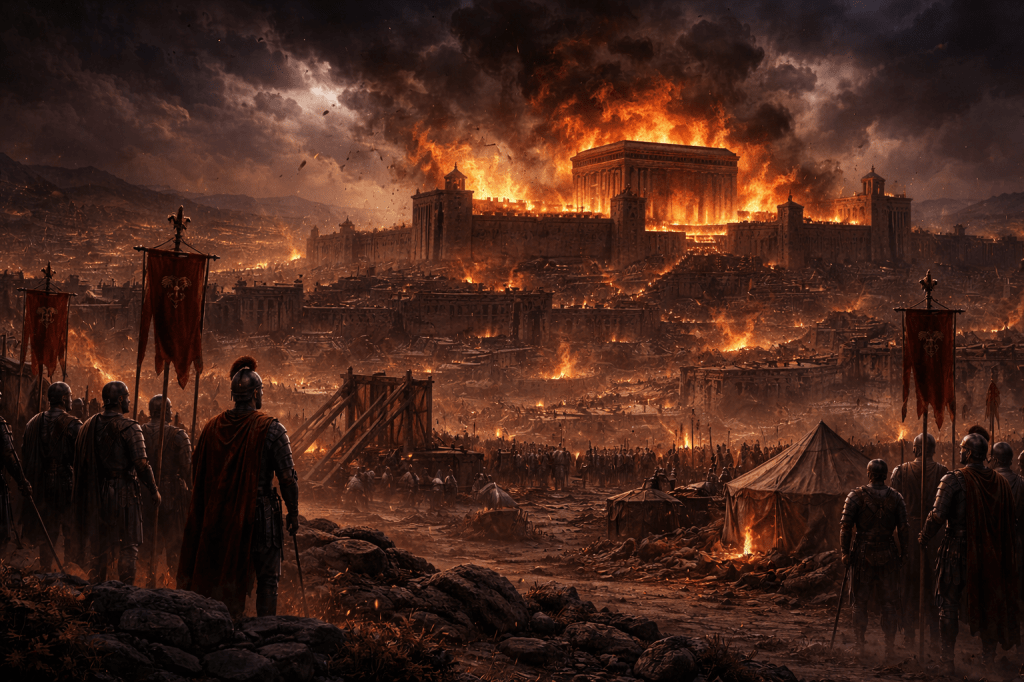
By the year AD 66, the tension that had been building in Judea for decades finally exploded.
The Jewish people had endured Roman occupation for generations. Roman governors ruled the land. Roman soldiers enforced imperial authority. Roman taxes burdened the population.
But resentment had been growing beneath the surface.
Nationalist movements were gaining strength. Revolutionary groups were forming. Many believed the time had come to throw off Roman rule once and for all.
When the revolt finally began, it spread like wildfire.
The Jewish Revolt
In AD 66, Jewish rebels seized control of Jerusalem and drove out the Roman garrison stationed in the city.
For a brief moment, it seemed as though the rebellion might succeed.
But Rome did not tolerate rebellion.
The empire responded with overwhelming force.
The Roman general Vespasian was sent to crush the revolt. Accompanied by his son Titus, he marched into Judea with seasoned Roman legions.
City after city fell before them.
The rebellion was being slowly and methodically crushed.
But Jerusalem remained the center of resistance.
Chaos Inside the City
As the Roman armies advanced, refugees flooded into Jerusalem.
The city became overcrowded and unstable.
Worse still, the Jewish factions inside the city began fighting each other.
Instead of uniting against the Roman threat, rival groups battled for control.
Food supplies were destroyed.
Violence broke out in the streets.
Political factions turned on one another.
The historian Flavius Josephus, who witnessed the war firsthand, described the situation inside Jerusalem as catastrophic.
According to Josephus, the city descended into chaos long before the Romans breached the walls.
The Siege Begins
In AD 70, the Roman army finally surrounded Jerusalem.
The siege had begun.
Roman legions encircled the city, cutting off all escape and preventing supplies from entering.
The strategy was simple.
Starve the city into submission.
Inside the walls, conditions deteriorated rapidly.
Food ran out.
Water became scarce.
Disease spread through the crowded population.
Josephus records horrifying scenes of starvation.
Parents watching their children die.
People fighting over scraps of food.
Entire neighborhoods collapsing into desperation.
The suffering was almost unimaginable.
The Words of Jesus Remembered
Decades earlier, Jesus had warned that Jerusalem would face a time of unprecedented distress.
“For then there will be great tribulation, such as has not been from the beginning of the world until now, no, and never will be.”
— Matthew 24:21 (ESV)
To those trapped inside Jerusalem during the siege, those words must have echoed with terrifying clarity.
The city was collapsing.
And the Romans were closing in.
The Fall of the Temple
Eventually, the Roman forces broke through the city’s defenses.
Fighting spread through the streets of Jerusalem.
Buildings burned.
Thousands were killed.
The Roman army pushed toward the temple complex.
Despite orders from the Roman commander Titus to preserve the temple, the chaos of battle overtook the situation.
A Roman soldier threw a torch into the structure.
Flames spread quickly.
The temple—the heart of Jewish worship for centuries—was engulfed in fire.
Gold melted and ran between the massive stones of the structure. In their effort to retrieve the precious metal, Roman soldiers later dismantled the temple stones themselves.
Exactly as Jesus had foretold.
“There will not be left here one stone upon another that will not be thrown down.”
— Matthew 24:2
The End of the Old Order
The destruction of Jerusalem marked a turning point in history.
The temple was gone.
The sacrificial system ended.
The priesthood lost its center.
The entire structure of Old Covenant worship that had defined Israel’s life for centuries collapsed in a single generation.
But the kingdom of Christ did not collapse.
It continued to grow.
The gospel spread across the Roman Empire and beyond.
While Jerusalem fell, the church expanded.
Prophecy and History Collide
When we read the warnings of Jesus alongside the historical events of AD 70, the connection becomes difficult to ignore.
Christ predicted the destruction of Jerusalem.
And within one generation, the prophecy was fulfilled.
The Book of Revelation, read against this backdrop, begins to look less like distant speculation and more like prophetic commentary on a world about to collapse.
The Mystery of Babylon
But Revelation contains another symbol that has puzzled readers for centuries.
A powerful city described as Babylon the Great.
A city accused of persecuting God’s people.
A city destined for catastrophic judgment.
Many assume this city represents Rome.
But the book itself contains a clue that points somewhere else.
In the next post, we will examine one of the most debated questions in the interpretation of Revelation.
Who—or what—is Babylon the Great?
Soli Deo Gloria.
 TheoloJeep
Leave a comment