There are moments in life when hope seems to slip through our fingers.
Not the shallow kind of hope that says, “Maybe things will get better.”
But the deeper kind—the kind that anchors the soul. The kind that believes God is near, that He sees, that He will act.
And yet, there are seasons when even that hope feels buried.
Easter speaks directly into that darkness.
When Jesus Arrives Late
In John 11, we are introduced to a family that knew Jesus well—Mary, Martha, and their brother Lazarus. These were not strangers. These were not distant followers. These were loved ones.
So when Lazarus fell ill, they sent word immediately:
“Lord, he whom you love is ill.”
They knew who Jesus was. They had seen His power. Surely, He would come quickly.
But He didn’t.
He delayed.
By the time Jesus arrived in Bethany, Lazarus had been dead for four days. The funeral was over. The mourning had begun. The tomb was sealed.
From every human perspective, it was finished.
Martha meets Him on the road with words that carry both faith and sorrow:
“Lord, if you had been here, my brother would not have died.”
Mary echoes the same cry.
You can almost feel the weight of it: You could have stopped this.
And that is often where we find ourselves.
“If only You had acted sooner, Lord…”
“If only You had intervened…”
“If only…”
But what they did not yet understand is this:
Jesus does not always arrive early to prevent death.
Sometimes, He arrives late to reveal His glory over it.
The Purpose Behind the Delay
Jesus had already declared what was happening:
“This illness does not lead to death. It is for the glory of God, so that the Son of God may be glorified through it.”
Now, that statement must have sounded confusing—perhaps even offensive.
Because Lazarus did die.
But Jesus was not speaking about the temporary outcome. He was speaking about the ultimate purpose.
What looked like defeat was actually divine design.
What appeared to be the end was, in reality, the stage upon which Christ would display His authority over death itself.
And this is where our understanding often breaks down.
- We assume that love means immediate rescue.
- We assume that power means instant relief.
- We assume that God’s glory is best displayed in preventing suffering.
But Scripture tells a different story.
Sometimes, the greatest display of God’s glory is not seen in avoiding the grave—but in conquering it.
The Weeping Savior
Before Jesus ever calls Lazarus out of the tomb, He does something remarkable:
“Jesus wept.”
This is one of the most profound moments in all of Scripture.
The One who knew He was about to raise Lazarus…
The One who had already declared victory over death…
The One who holds all authority in heaven and on earth…
He wept.
Why?
Because death is an enemy.
Because sin has ravaged what God created as good.
Because the pain we feel in loss is real, and it matters.
Jesus is not detached from our suffering. He steps into it.
He feels it.
He weeps with us.
And yet—He does not leave us there.
The Voice That Calls the Dead
Standing before the tomb, Jesus commands:
“Take away the stone.”
Martha hesitates. The reality of death has set in.
But Jesus presses forward.
And then, with divine authority, He cries out:
“Lazarus, come out.”
And the dead man walks.
No ritual.
No incantation.
No struggle.
Just a word.
Because when Christ speaks, even death must obey.
From Lazarus to the Cross
But this miracle was not the end of the story—it was a sign.
Lazarus would die again. His resurrection was temporary, pointing forward to something greater.
It pointed to another tomb.
A tomb where Jesus Himself would be laid.
And this is where everything changes.
The One who called the dead to life…
Would Himself enter death.
The Greater Victory
On the cross, Jesus bore something far greater than physical death.
He bore sin.
Every lie.
Every act of rebellion.
Every wicked thought.
Every injustice.
Every ounce of guilt and shame…
Laid upon Him.
And more than that—He bore the full wrath of God.
This is not sentimental.
This is the Son of God drinking the cup of divine judgment to its final drop.
Why?
So that those who are dead in sin might live.
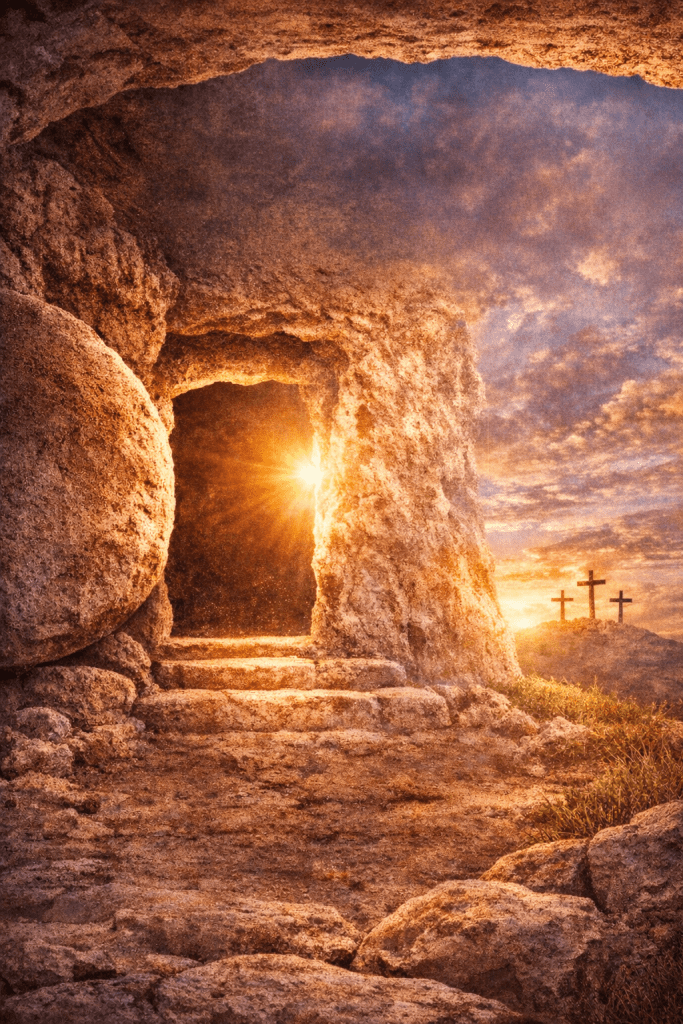
The Empty Tomb
Three days later, everything changed.
The stone was rolled away.
The tomb was empty.
Acts declares:
“God raised him up, loosing the pangs of death, because it was not possible for him to be held by it.”
Not possible.
Death could not hold Him.
The grave could not contain Him.
Sin had no claim on Him.
And because He lives… we will live also.
Beyond All Hope
Easter is not about optimism.
It is not about self-improvement.
It is about this truth:
When all hope is gone—Christ remains.
When the diagnosis comes.
When the phone call changes everything.
When the grave closes over someone you love…
Christ is still King.
He is the One who stepped into death—and walked out victorious.
He is the One who calls the dead to life.
The Call Today
The question is not whether Jesus has power over death.
The question is: Have you heard His voice?
“Come out.”
Come out of your sin.
Come out of your rebellion.
Come out of death—and into life.
This is the call of the risen King.
Final Word
Jesus did not arrive too late.
He arrived exactly when the glory of God would be most clearly seen.
There is no grave too deep.
No sin too great.
No darkness too thick…
For the power of Christ.
He is risen.
And because He is risen—
Hope is not lost.
Hope has a name.
Jesus Christ.
Soli Deo Gloria
 TheoloJeep
Leave a comment