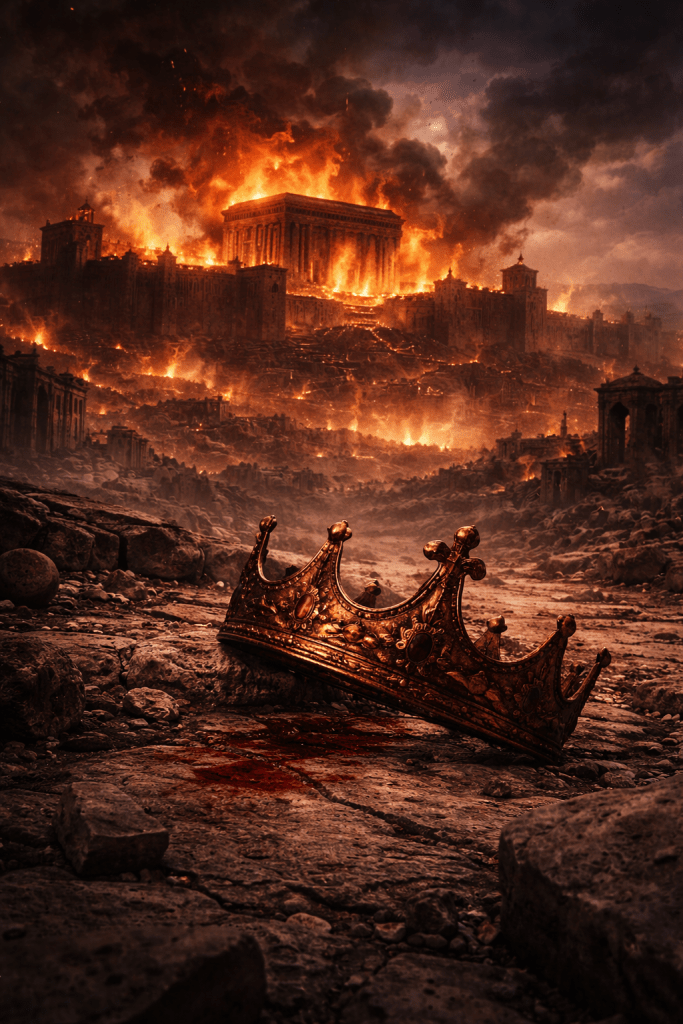
The Book of Revelation introduces a mysterious and powerful symbol.
A city described as Babylon the Great.
She appears in dramatic imagery throughout the later chapters of the book—a wealthy and powerful city accused of corruption, violence, and persecution.
Her fall is celebrated in heaven.
But one question has puzzled readers for centuries.
Who is Babylon?
The Traditional Answer
Many interpreters assume that Babylon represents Rome.
The Roman Empire was the dominant power of the first century, and the persecution of Christians under Roman rule makes the connection understandable.
Rome was powerful.
Rome was wealthy.
Rome ruled the world.
But the Book of Revelation contains a clue that complicates that interpretation.
A City with a Dark History
In Revelation 17 and 18, Babylon is described as a city guilty of shedding the blood of God’s people.
“In her was found the blood of prophets and of saints, and of all who have been slain on earth.”
— Revelation 18:24 (ESV)
This is a striking accusation.
According to Revelation, this city bears responsibility for the blood of the prophets.
But when we look through the pages of the Old Testament, a question arises.
Where were the prophets killed?
Not in Rome.
In Jerusalem.
The Words of Jesus
Jesus Himself made this accusation during His ministry.
“O Jerusalem, Jerusalem, the city that kills the prophets and stones those who are sent to it!”
— Matthew 23:37
Moments earlier, Jesus had spoken even more directly.
“So that on you may come all the righteous blood shed on earth… Truly, I say to you, all these things will come upon this generation.”
— Matthew 23:35–36
Jesus declared that Jerusalem bore responsibility for the blood of God’s messengers.
And He warned that judgment was coming.
The City Where the Lord Was Crucified
Revelation contains another clue that is often overlooked.
In chapter 11, John describes the location where two witnesses are killed.
“Their dead bodies will lie in the street of the great city that symbolically is called Sodom and Egypt, where their Lord was crucified.”
— Revelation 11:8
The verse identifies the city in unmistakable terms.
It is the place where the Lord was crucified.
And where was Jesus crucified?
Jerusalem.
The Language of the Prophets
The imagery used in Revelation to describe Babylon would have sounded familiar to readers steeped in the Old Testament.
The prophets frequently described Jerusalem using similar language when warning of covenant judgment.
The city was called:
- a harlot
- faithless
- corrupt
The prophet Ezekiel wrote:
“How the faithful city has become a whore.”
— Isaiah 1:21
Jerusalem had been chosen by God.
But the prophets repeatedly warned that covenant privilege did not guarantee covenant protection.
If the nation rejected the Lord, judgment would follow.
The Judgment of the City
Revelation describes Babylon’s fall in dramatic terms.
The city burns.
Its power collapses.
Its wealth disappears.
Kings and merchants mourn its destruction.
But heaven rejoices.
“Rejoice over her, O heaven, and you saints and apostles and prophets, for God has given judgment for you against her!”
— Revelation 18:20
If Babylon represents Jerusalem, this celebration begins to make sense.
The destruction of the city would mark the end of the Old Covenant system that had rejected the Messiah and persecuted His followers.
The temple would fall.
The sacrificial system would end.
The era of shadows would give way fully to the reality fulfilled in Christ.
The Collapse of an Age
The destruction of Jerusalem in AD 70 was not merely a political event.
It was a covenantal turning point.
The temple was gone.
The sacrifices ended.
The old order collapsed.
But the kingdom of Christ continued to expand across the world.
What appeared to be catastrophe was actually the closing of one chapter in redemptive history and the opening of another.
The King Still Reigns
The Book of Revelation ultimately is not about the triumph of beasts or empires.
It is about the triumph of Christ.
Kingdoms rise.
Kingdoms fall.
Cities burn.
But the throne of heaven remains occupied.
“The kingdom of the world has become the kingdom of our Lord and of his Christ, and he shall reign forever and ever.”
— Revelation 11:15
In the next post of this series, we will step back and look at what all of this means for how we read Revelation today.
Because once we see the historical setting of the book, the message becomes clearer.
Revelation was not written to terrify Christians about the distant future.
It was written to remind them that Christ rules history.
Soli Deo Gloria.
 TheoloJeep
Leave a comment