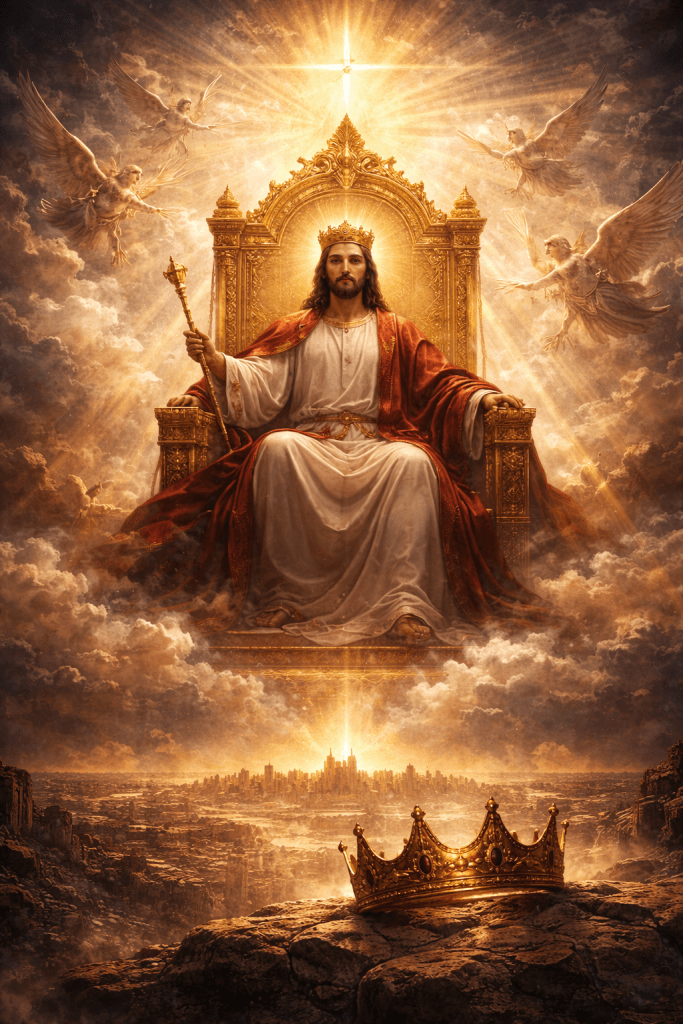
The story we have traced through this series is not merely a story about ancient wars or the collapse of a city.
It is the story of prophecy fulfilled.
Long before Roman legions surrounded Jerusalem, Jesus had already warned that the city and its temple would fall.
Standing on the Mount of Olives, overlooking the magnificent temple complex, He declared:
“Truly, I say to you, there will not be left here one stone upon another that will not be thrown down.”
— Matthew 24:2 (ESV)
At the time, those words must have sounded unimaginable.
The temple had stood for centuries. Its massive stones were legendary. Pilgrims traveled from across the world to worship there.
But within a single generation, the prophecy came true.
When Prophecy Meets History
In AD 70, Roman legions under the command of Titus surrounded Jerusalem.
The city fell after a brutal siege.
The temple burned.
The stones of the sacred complex were dismantled.
The entire structure of Old Covenant worship collapsed.
Exactly as Jesus had said.
The generation that heard His prophecy lived to see its fulfillment.
“Truly, I say to you, this generation will not pass away until all these things take place.”
— Matthew 24:34
History itself became a witness to the authority of Christ’s words.
30/33 AD — Crucifixion of Christ
33 AD — Resurrection / Church begins
64 AD — Nero persecutes Christians
66 AD — Jewish revolt begins
70 AD — Jerusalem and the temple destroyed
The End of the Old Covenant Order
The destruction of Jerusalem marked more than the fall of a city.
It marked the end of an era.
For centuries, the temple had been the center of Israel’s sacrificial system.
Priests offered sacrifices daily.
Festivals gathered thousands of pilgrims.
The entire religious life of the nation revolved around that sacred place.
But when Christ died on the cross, the true sacrifice had already been offered.
The temple sacrifices were shadows.
Jesus was the reality.
When the temple fell in AD 70, the Old Covenant system passed away in history just as it had already passed away in principle through the work of Christ.
The Book of Revelation Reconsidered
When we read the Book of Revelation in its first-century context, the imagery of the book begins to come into focus.
The time indicators matter.
The historical setting matters.
The warnings of Jesus matter.
Rather than describing events thousands of years in the future, much of Revelation may be describing the dramatic collapse of the Old Covenant world and the judgment that came upon Jerusalem.
The Beast represented a persecuting empire.
Babylon represented a corrupt city facing covenant judgment.
The fall of that city marked the end of an age.
The Kingdom That Cannot Be Shaken
Yet the message of Revelation is not ultimately about destruction.
It is about victory.
Empires rise.
Empires fall.
Cities burn.
But the throne of heaven remains occupied.
In one of the great declarations of the book, heaven announces:
“The kingdom of the world has become the kingdom of our Lord and of his Christ, and he shall reign forever and ever.”
— Revelation 11:15
This is the central message of the book.
Christ rules history.
No empire, no king, and no rebellion against God can ultimately overthrow His authority.
The Encouragement Revelation Was Meant to Give
For the first Christians, the Book of Revelation was not written to inspire fear about the distant future.
It was written to strengthen their faith in the present.
Rome looked unstoppable.
Persecution had begun.
The future seemed uncertain.
But Revelation reminded believers of a truth that remains just as powerful today.
Jesus Christ is King.
He reigns over history.
And every promise He makes will come to pass.
The Faithfulness of Christ
When we see how accurately Jesus foretold the fall of Jerusalem, our confidence in His words grows stronger.
If His prophecy about Jerusalem was fulfilled exactly as He said, then every promise He has made can be trusted.
The same Lord who foretold judgment also promised redemption.
The same King who rules history also rules His church.
The Story Is Not Finished
The fall of Jerusalem was the closing of one chapter in redemptive history.
But the story of Christ’s kingdom did not end there.
From the first century until today, the gospel has continued to spread across the world.
Nations rise and fall.
Cultures change.
Empires disappear.
But the kingdom of Christ continues to grow.
And one day, the final victory of that kingdom will be seen by all.
Until then, the message of Revelation still stands.
Jesus Christ is King. Forever and Ever.
Soli Deo Gloria.
 TheoloJeep
Leave a comment