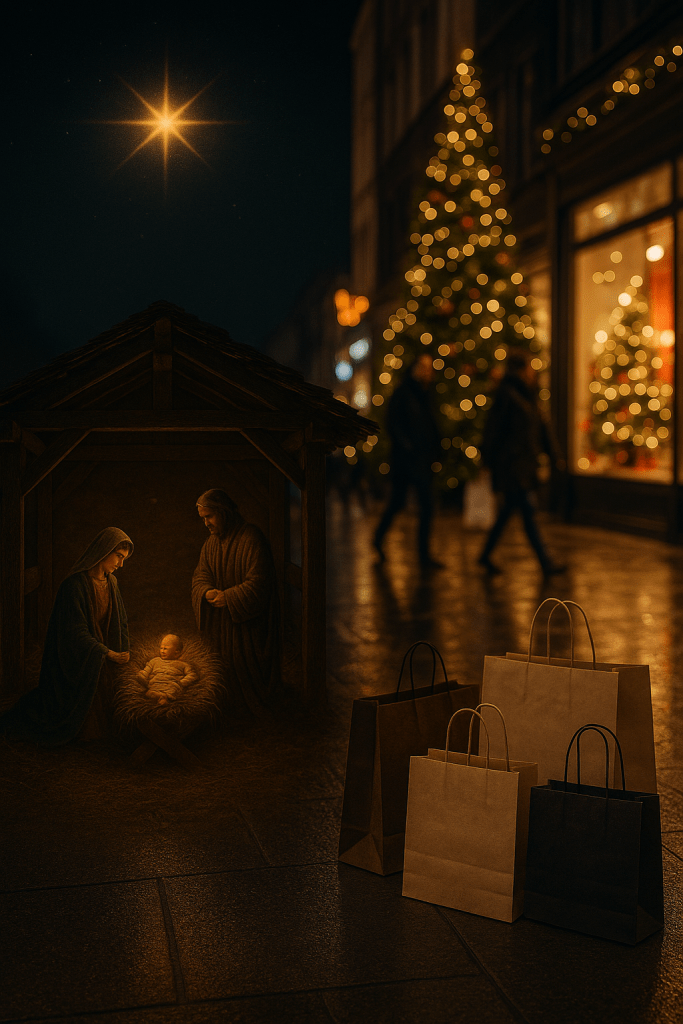
Every December, something strange happens.
Lights go up. Trees go up. Playlists get dusted off. Office parties appear on calendars. Cups turn red. Commercials grow sentimental. Everyone starts talking about Christmas—but almost no one is talking about Christ.
This isn’t accidental. It’s intentional.
What we now call “Christmas” in the public square is largely a secularized shadow of a profoundly Christian holy day. It borrows the aesthetics of Christianity while quietly evacuating its meaning. The result is not neutral. It is a replacement.
And replacements always catechize.
What Secular Christmas Is (and Is Not)
Secular Christmas is not merely celebrating cultural traditions. It is not enjoying family gatherings, meals, or even gift-giving in itself. Those things can be good and meaningful.
Secular Christmas is something more specific.
It is the celebration of Christmas stripped of Christ, reframed around vague sentimentality, consumerism, and emotional nostalgia rather than the incarnation of the Son of God.
In secular Christmas:
- Peace becomes a feeling, not reconciliation with God.
- Joy becomes seasonal cheer, not salvation.
- Love becomes abstract kindness, not sacrificial covenantal faithfulness.
- Hope becomes optimism, not the defeat of sin and death.
It keeps the form while rejecting the substance.
The manger becomes décor.
The star becomes ambiance.
The child becomes optional.
How Did We Get Here?
Secular Christmas did not arise because Christianity failed to explain itself. It arose because Christianity explained itself too well.
The incarnation is a truth claim.
“The Word became flesh and dwelt among us.” (John 1:14)
This is not poetry—it is confrontation.
If Jesus Christ is truly God in the flesh, then:
- History has a center.
- Authority has a name.
- Morality has an anchor.
- Salvation has a single door.
Secular culture cannot accommodate that claim. So instead of abolishing Christmas outright (which would provoke resistance), it redefined it.
This is how secularism usually works:
- It does not destroy holy days.
- It repurposes them.
- It drains them of transcendent meaning.
- It fills them with consumption and emotion.
You can keep the holiday—just don’t ask why it exists.
The Gospel According to Secular Christmas
Secular Christmas still preaches. It just preaches a different gospel.
Here is its message:
You are basically fine.
The world just needs a little more kindness.
Buy meaningful gifts.
Be generous once a year.
Feel warm.
Feel connected.
Then move on.
There is no sin.
There is no Savior.
There is no King.
There is no call to repentance.
There is no resurrection coming.
It promises peace without truth, joy without holiness, and love without obedience.
And like all false gospels, it cannot deliver what it promises.
Why It Still Feels Hollow
This is the great irony of secular Christmas: The more it removes Christ, the more it relies on borrowed Christian capital.
It still talks about:
- Light overcoming darkness
- Peace on earth
- Goodwill toward men
- Hope for a broken world
But it offers no mechanism for any of it.
Why is the world broken?
What darkness is being overcome?
What peace is needed?
Who defines “good”?
Without Christ, these words float untethered. They inspire briefly and disappoint quickly.
That’s why January always feels so empty.
The tree comes down.
The lights go dark.
The credit card bills arrive.
The world is still broken.
The heart is still restless.
“You have made us for Yourself, O Lord, and our heart is restless until it rests in You.”
Secular Christmas cannot give rest—because it refuses the only One who can.
The Real Scandal of Christmas
The scandal of Christmas is not that God became small.
The scandal is why He did.
Christ did not come to make us feel cozy.
He came because we were dead in our trespasses and sins.
He came because no amount of goodwill could fix what was broken.
He came to live the life we could not live and die the death we deserved.
The baby in the manger is inseparable from the man on the cross.
A Christmas without the cross is not just incomplete—it is dishonest.
Reclaiming Christmas Without Apology
Christians do not need to be embarrassed by Christmas. Nor do we need to surrender it to sentimentality.
Christmas is not about nostalgia. It is about invasion.
Heaven broke into earth.
God took on flesh.
The kingdom arrived.
The serpent’s head was marked for crushing.
This is why Christmas is dangerous to secular culture. It refuses to stay soft. It insists on truth. It demands a response.
You either worship the child…
or you redefine the holiday.
There is no neutral ground.
A Final Word
Secular Christmas will continue to dominate public life. That is to be expected in a culture that wants the blessings of Christianity without the authority of Christ.
But the church must not forget what Christmas actually is.
Not a season.
Not a vibe.
Not a marketing campaign.
It is the declaration that God has come, and everything—history, morality, salvation, and hope—now revolves around Him.
“For unto you is born this day in the city of David a Savior, who is Christ the Lord.” (Luke 2:11)
That is not sentiment.
That is reality.
And reality does not disappear just because we dim the lights.
Soli Deo Gloria.


Leave a Reply