The Problem of War
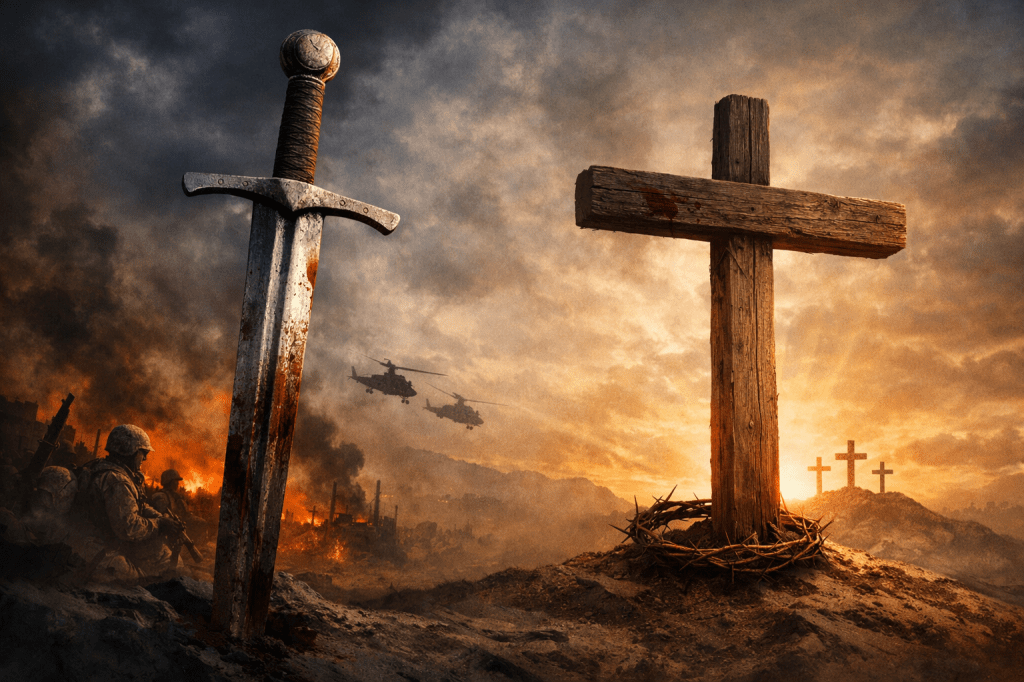
There is a question that haunts every generation, whether whispered in foxholes or shouted in war rooms:
Can a follower of Christ ever take part in war without betraying the Christ he follows?
It is not a theoretical question. It is not reserved for philosophers in ivory towers. It is a question soaked in blood—blood spilled across centuries, across continents, across battlefields where men have prayed to the same God while pointing rifles at one another.
And if we are honest, it is a question that refuses to stay “out there.” It presses in on us. It presses in on the church. It presses in on every believer who confesses that Jesus Christ is Lord in a world where nations still rage and kingdoms still rise by the sword.
Because we do not follow a warlord.
We follow the Prince of Peace.
And yet… we live in a world at war.
A World Born Into Blood
War is not a modern problem. It is not the product of advanced weapons or geopolitical complexity. War is as old as sin itself.
The first time human blood is spilled in Scripture, it is not on a battlefield—it is in a field.
A brother rises against his brother.
Cain kills Abel.
No armies. No politics. No nations. Just a heart corrupted by sin, a will turned inward, and a hand lifted in violence. And from that moment forward, the earth itself seems to groan under the weight of human conflict.
By the time you move through Genesis, violence is no longer an exception—it is the atmosphere.
“The earth was filled with violence.” (Genesis 6:11)
Violence becomes cultural. Systemic. Celebrated. Lamech boasts of vengeance. Kingdoms begin to form not merely for order, but for power. Men gather not only to build—but to dominate.
War is not an interruption of human history.
War is the fruit of the human heart.
And that means we cannot solve it merely with treaties or technology. You cannot legislate away what is rooted in rebellion against God.
The Sword Given by God
And yet—here is where the tension begins to rise.
Because Scripture does something that unsettles us.
It does not simply condemn violence.
It authorizes the sword.
In Romans 13, the Apostle Paul writes words that should stop us in our tracks:
“For he is the servant of God, an avenger who carries out God’s wrath on the wrongdoer.”
Let that land.
The governing authority—the state—is called the servant of God. And not merely in some abstract sense. It is given a specific role:
To bear the sword.
Not the suggestion.
Not the recommendation.
The sword.
Which means that God, in His providence, has ordained a structure in the fallen world that includes the legitimate use of force. Justice, in a sinful world, is not maintained by sentimentality. It is upheld—at times—by coercion, by restraint, by power.
And that creates a category that we cannot ignore:
There are times when violence is not merely permitted—it is commissioned.
That reality shatters simplistic answers. It will not allow us to retreat into naïve pacifism that pretends evil can be talked into submission. Because Scripture itself acknowledges that evil men do not always respond to reason.
Sometimes, they must be restrained.
Sometimes, they must be stopped.
And sometimes… that stopping involves force.
The King Who Refused the Sword
But just when you think you have clarity, Christ steps in—and turns the entire conversation upside down.
Because the same Bible that affirms the sword in the hand of the state presents us with a Savior who refuses to wield it for Himself.
In the garden, when betrayal comes and swords are drawn, one of His disciples strikes in defense. And Jesus responds with words that echo across history:
“Put your sword back into its place. For all who take the sword will perish by the sword.” (Matthew 26:52)
He does not call down angels.
He does not rally resistance.
He does not justify defensive violence in that moment.
He submits.
And the One who could have ended war in a moment chooses instead to absorb violence rather than unleash it.
He is beaten. Mocked. Crucified.
And in that moment, the most unjust act in human history becomes the very means by which God brings redemption.
The cross stands as both an indictment and a revelation:
- An indictment of human violence—we killed the Son of God.
- A revelation of divine mercy—He died for those who killed Him.
So now the tension sharpens to a razor’s edge:
The state bears the sword.
The Savior lays it down.
And the Christian lives in between.
Two Kingdoms, One Conscience
This is where many go wrong. They collapse the distinction.
Some look at Christ and say:
“All violence is wrong. Christians must reject it entirely.”
Others look at the state and say:
“Whatever my nation does must be justified.”
Both are errors.
Because Scripture does not give us the luxury of choosing one side of the tension.
It gives us both.
The Christian is a citizen of two kingdoms:
- The kingdom of man, where governments are tasked with maintaining order
- The kingdom of God, where Christ reigns in righteousness and peace
And these kingdoms are not identical.
They overlap—but they do not merge.
Which means the Christian must wrestle with a difficult reality:
You may live under a government that wages war…
and still be called to follow a King who died for His enemies.
You may be protected by the sword…
and still be commanded to love those who would harm you.
You may benefit from military power…
and still be warned not to place your hope in chariots and horses.
This is not clean. It is not easy. It is not comfortable.
It is costly.
The Lie of Clean War
One of the greatest deceptions in human history is the idea that war can ever be morally simple.
We like our narratives clean:
- Good guys vs bad guys
- Justice vs evil
- Freedom vs oppression
And while there are times when those categories are closer to reality, they are never pure.
Because war does not happen in a vacuum of righteousness.
It happens in a world where all have sinned.
Even the most “just” war is carried out by fallen men:
- Men who fear
- Men who hate
- Men who make mistakes
- Men who sometimes cross lines they swore they never would
Civilians die.
Motives get mixed.
Justice becomes tangled with vengeance.
And the longer a war drags on, the harder it becomes to tell where righteousness ends and self-interest begins.
War may be necessary.
But it is never clean.
Why This Matters Now
We are not studying this as an academic exercise.
We are not walking through history out of curiosity.
We are doing this because we are living in a moment where the drums of war are beating again. Where nations posture. Where leaders speak with certainty. Where Christians are tempted—once more—to baptize national action with divine approval.
And before we ever ask, “Is this war just?”
We must first ask a deeper question:
“What does God say about war itself?”
Because if we get that wrong—if we begin with assumptions instead of Scripture—we will not discern rightly when the moment demands it.
We will either justify what God condemns…
or condemn what God permits.
And both are dangerous.
A Call to Sobriety
So here, at the beginning of this series, we do not rush to conclusions.
We do not wave flags.
We do not make declarations about current conflicts—yet.
Instead, we slow down.
We let Scripture confront us.
We let the weight of history settle on our shoulders.
We acknowledge that war is not merely a political issue—it is a theological one.
And we adopt a posture that is almost entirely absent in modern discourse:
Sobriety.
Because if we are going to speak about war as Christians, we must do so with:
- Bibles open
- Hearts humbled
- Loyalties examined
- And consciences bound to Christ—not to a nation
The Road Ahead
In the next part, we will step into the development of what has come to be known as Just War Theory—not as a way to justify violence, but as an attempt by Christians to restrain it under the authority of God.
We will ask:
- When, if ever, is war justified?
- Who has the authority to declare it?
- What limits must be placed upon it?
But before we get there, you must feel this tension.
You must sit in it.
Because if you rush past it, you will not wrestle honestly when the stakes get higher.
And they will.
War is born from sin.
The sword is ordained by God.
Christ died without raising it.
And you—Christian—must now learn to live in the shadow of all three.
Soli Deo Gloria
 TheoloJeep
Leave a comment