When Is War Just?
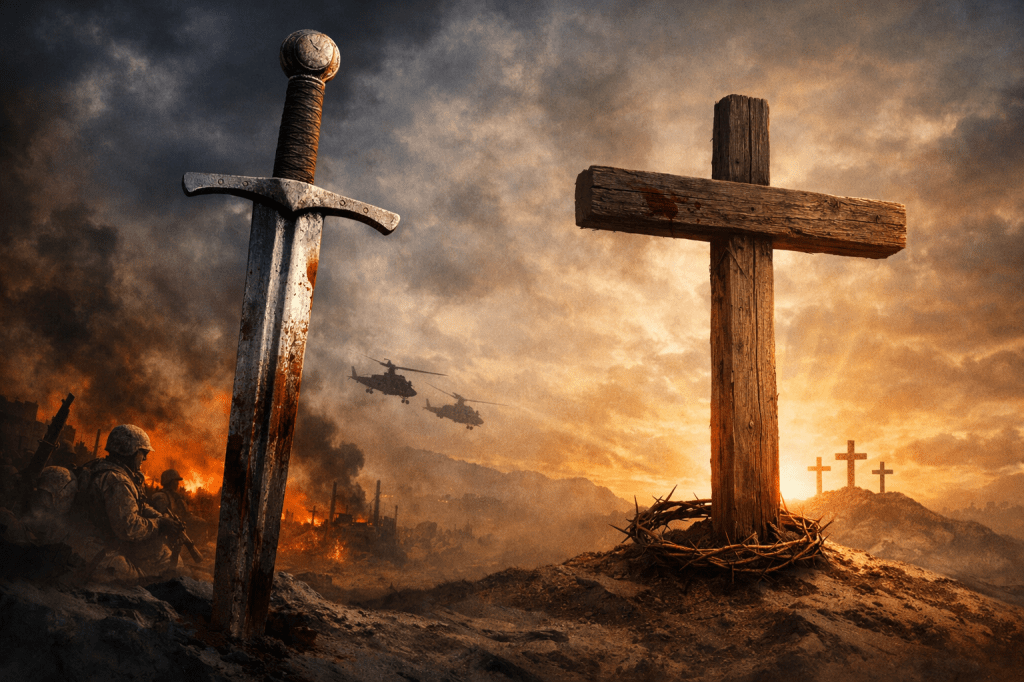
There is a dangerous instinct in man.
When faced with the horror of war, some rush to justify it.
Others rush to condemn it entirely.
But Scripture will not allow either extreme.
Because while Part 1 forced us to wrestle with the reality of war…
Part 2 forces us to wrestle with something even more difficult:
Can war ever be righteous?
Not necessary.
Not inevitable.
Not politically useful.
But righteous before God.
The Christian Refusal to Think Lightly
Before we ever build a framework, we must establish a posture.
War is not a tool to be discussed casually.
It is not a chess move.
It is not a headline.
It is not a talking point.
It is the tearing apart of image-bearers.
It is fathers who do not come home.
It is mothers who bury sons.
It is cities reduced to rubble.
It is children who learn the sound of explosions before they learn the sound of laughter.
So if we are going to ask whether war can be “just,” we must begin here:
If you can speak of war without grief, you are not yet ready to speak of it at all.
The Early Church’s Tension
The earliest Christians did not live in positions of power.
They lived under the boot of Rome.
They were persecuted. Marginalized. Killed.
And many of them responded not by taking up arms—but by refusing them.
There was a strong current of practical pacifism in the early church:
- Not because they denied the reality of evil
- But because they took seriously the commands of Christ
Love your enemies.
Pray for those who persecute you.
Turn the other cheek.
And yet—even here—the tension remained unresolved.
Because while Christians were called to suffer…
the world still required order.
The question lingered:
If all Christians refused the sword… who would restrain evil?
Augustine and the Burden of Reality
It is here that we meet one of the most important voices in Christian history.
Augustine did not write about war from the comfort of theory. He lived in a collapsing world. The Roman Empire—the structure that had provided order—was crumbling. Chaos was not hypothetical. It was at the door.
And Augustine understood something many do not want to admit:
Peace is not preserved by good intentions alone.
So he began to wrestle—not with how to justify war—but with how to restrain it.
His argument was not that war is good.
His argument was that war may be tragically necessary in a fallen world.
And so he asked the question:
If war must sometimes be fought… how do we fight it without becoming what we hate?
The Birth of Just War Thinking
Out of that question came what we now call Just War Theory.
Not a celebration of war.
A limitation on it.
A fence built around human violence, saying:
“You may not go beyond this.”
Over time, these ideas were refined—especially by Thomas Aquinas—into a set of criteria meant to evaluate whether a war could be considered morally justified.
Let’s walk through them—not academically, but soberly.
1. Just Cause
War must be fought for a morally right reason.
Not expansion.
Not revenge.
Not economic gain.
But to confront real injustice.
Defense against aggression.
Protection of the innocent.
Restraint of evil.
If the cause itself is corrupt, everything that follows is corrupted with it.
2. Legitimate Authority
Not every group gets to declare war.
Not every outrage justifies violence.
War must be declared by a proper governing authority—one entrusted with the responsibility of justice.
Why?
Because without authority, violence becomes chaos.
Every man becomes his own judge.
Every grievance becomes a justification for bloodshed.
3. Right Intention
Even if the cause is just… the heart can still be wrong.
You can fight a necessary war with:
- Hatred
- Pride
- Bloodlust
And when you do, something in your soul begins to rot.
The aim must not be destruction for its own sake.
The aim must be justice—and ultimately, peace.
4. Last Resort
This is where many modern conflicts begin to crack.
War must not be the first move.
It must be the final one.
After diplomacy fails.
After restraint is exhausted.
After every reasonable path to peace has been pursued.
Because once war begins, you cannot control what it becomes.
5. Proportionality
The response must match the threat.
Not exceed it.
Not escalate beyond necessity.
Because it is entirely possible to respond to evil in a way that creates greater evil.
A war that destroys more than it saves cannot be called just.
6. Reasonable Chance of Success
This one is often ignored—but it matters.
You are not permitted to throw lives away in a hopeless cause.
Heroism does not justify futility.
A war that cannot achieve its just aim becomes an exercise in wasted blood.
Not a Loophole—A Restraint
Here is where many misunderstand Just War Theory.
It is not a checklist to approve war.
It is a framework that makes war harder to justify.
If you apply these criteria honestly, most wars begin to fall apart under scrutiny.
And that is the point.
Because fallen men are always looking for reasons to fight.
Just War thinking forces us to slow down and ask:
- Is this truly necessary?
- Is this truly just?
- Or are we dressing ambition in the language of righteousness?
The Danger of Self-Deception
Here is the uncomfortable truth:
No nation believes its wars are unjust.
Every nation tells a story:
- We are the defenders
- We are the liberators
- We are the righteous
But history has a way of exposing what rhetoric hides.
Wars once celebrated become regretted.
Decisions once defended become questioned.
Motives once assumed become scrutinized.
Which means we must approach every modern conflict with humility.
Not cynicism.
But humility.
Because we are just as capable of self-deception as those who came before us.
The Christian in the Middle
So where does this leave the believer?
Not in simplicity.
But in responsibility.
You are not called to blind patriotism.
You are not called to detached pacifism.
You are called to discernment.
To evaluate not just what your nation does…
but whether it aligns with the moral order of God.
That requires courage.
Because sometimes it means supporting a war that is necessary.
And sometimes it means questioning one that is not.
And both will cost you.
A Warning Before We Move On
Before we move to historical examples in Part 3, you need to hear this:
Even a “just war” is still a tragedy.
It may be necessary.
It may be righteous in cause.
But it is never something to celebrate.
Because every war—just or unjust—is a reminder that the world is not as it should be.
It is a reminder that sin still reigns in the hearts of men.
It is a reminder that peace has not yet fully come.
The Shadow of the Cross
And this brings us back—once again—to Christ.
Because while we debate just war…
He endured the most unjust one.
Condemned without cause.
Executed without guilt.
Killed by the very people He came to save.
And instead of calling for justice…
He offered mercy.
So as we move forward in this series, do not lose sight of this:
Our ultimate hope is not in just wars.
It is in a just King.
One who will return—not to debate justice—but to establish it.
Fully. Finally. Forever.
In Part 3, we will step into history and test these principles against real wars—where theory meets blood, and clarity begins to fade.
Soli Deo Gloria
 TheoloJeep
Leave a comment