When Theory Meets Blood
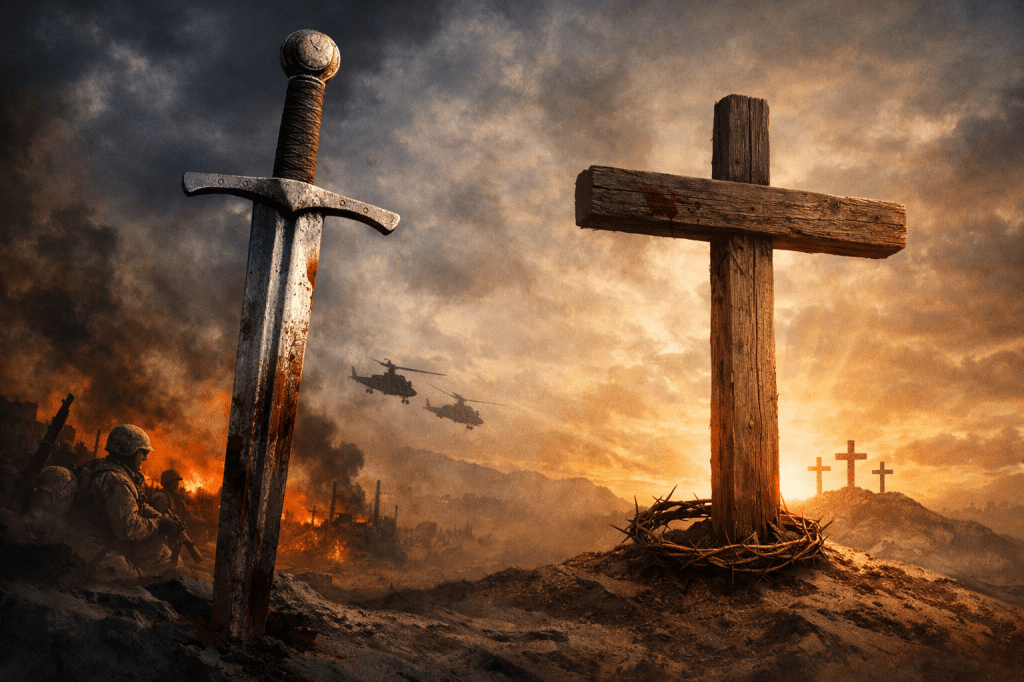
There is a difference between talking about war…
…and standing in the aftermath of it.
It is one thing to build a framework in the quiet of study—
to outline principles, to define categories, to speak of justice in clean, measured language.
It is another thing entirely to walk through a field where the ground has been torn open…
where smoke still rises…
where the air carries the smell of death.
Because here is the truth that must confront us in this part:
War is never experienced in theory.
It is experienced in flesh.
The Limits of Theory
In Part 2, we laid out the framework of Just War.
Just cause.
Legitimate authority.
Right intention.
Last resort.
Proportionality.
Chance of success.
And those categories matter.
They are necessary.
But they are not enough.
Because once war begins, something happens that no framework can fully contain:
Men go to war.
Not abstract agents.
Not moral categories.
Men.
Fallen men.
And when fallen men step into the chaos of war, even the most righteous cause begins to bleed into something more complicated.
World War II — A “Just War”?
If there is any war in modern history that seems to meet the criteria of justice, it is World War II.
Aggression was real.
Evil was undeniable.
The atrocities of Nazi Germany were not exaggerated—they were worse than anything the world had imagined.
Millions were slaughtered.
Genocide was not a byproduct.
It was policy.
And so the Allied response is often held up as a clear example of a just war:
- A just cause? Yes.
- Legitimate authority? Yes.
- Defense against evil? Undeniably.
And yet…
Even here, where the cause appears clear, the moral waters begin to churn.
Because war does not stay confined to clean lines.
Cities were firebombed.
Civilians were killed—not accidentally, but strategically.
And then came the use of atomic weapons.
The war may have been necessary.
But the methods used within it raise questions that cannot be easily dismissed.
Can a just cause justify unjust actions?
The Problem of Means and Ends
This is where Just War thinking becomes brutally practical.
It is not enough to ask:
“Why are we fighting?”
We must also ask:
“How are we fighting?”
Because a war that begins in justice can drift into something else entirely.
A soldier who begins with duty can end with hatred.
A nation that begins with defense can end with domination.
And the longer the war continues, the more temptation grows:
- To escalate
- To retaliate
- To justify what once would have been unthinkable
Which means this must be said clearly:
There is no such thing as a morally neutral battlefield.
Every decision carries weight.
Every action is accountable to God.
Vietnam — When Clarity Fades
If World War II represents a case where justice seems clear…
The Vietnam War represents something very different.
Here, the categories begin to blur.
Was there a just cause?
Some argued yes—containment of communism.
Others argued no—intervention in a conflict that did not directly threaten national survival.
Was it a last resort?
Was it proportional?
Was there a reasonable chance of success?
These questions were not theoretical.
They divided a nation.
And as the war dragged on, something else became clear:
Even if a war begins with justification, it can lose it.
Civilian casualties mounted.
Trust eroded.
The mission itself became unclear.
And what was once defended with confidence became questioned with urgency.
This is the danger:
Not only can unjust wars be fought…
Just wars can become unjust over time.
Iraq — The Weight of Assumption
Then we come to the Iraq War.
A war launched with strong claims:
- Weapons of mass destruction
- Imminent threat
- The need for preemptive action
And yet, as time unfolded, those claims were called into question.
The justification shifted.
The confidence wavered.
And once again, we are forced to ask:
- Was it truly a last resort?
- Was the threat as immediate as claimed?
- Were the consequences fully considered?
Because here is a hard truth:
When the foundation of a war is uncertain, everything built upon it becomes unstable.
Lives are still lost.
Families are still broken.
Nations are still changed.
But the moral clarity is gone.
The Illusion of Control
There is something else history teaches us:
War rarely stays where you put it.
You may begin with a limited objective…
…and end with a regional crisis.
You may strike to prevent instability…
…and create more of it.
Because once the sword is drawn, it has a way of carving paths no one intended.
This is why the “last resort” principle matters so deeply.
Not because war is always avoidable.
But because once it begins, it is unpredictable.
The Cost No One Escapes
It must be said plainly:
There are no spectators in war.
Even those far from the battlefield are affected.
- Soldiers carry scars—seen and unseen
- Families carry grief
- Nations carry consequences
And even when victory is declared, something is lost.
Something always is.
Because war, even when justified, is still a result of a broken world.
It is not the solution to sin.
It is evidence of it.
The Christian Must See Clearly
So what does this mean for us?
It means we must resist the temptation to think in slogans.
“Support the troops” is not the same as evaluating the war.
“Oppose the war” is not the same as understanding justice.
We must think deeper.
We must ask harder questions.
We must be willing to say:
This war may be necessary…
But this action within it is not.
Or:
This cause may sound right…
But it does not meet the standard of justice.
That kind of discernment is rare.
But it is required.
A Sobering Reality
If you walk through history honestly, you will come to an uncomfortable conclusion:
There are very few wars that meet the standard of justice cleanly.
Some come close.
Some begin well.
Some may even be necessary.
But almost all become complicated.
Messy.
Morally entangled.
And that should not surprise us.
Because war is carried out by sinners…
in a world still under the curse of sin.
The Cross Stands Above Every Battlefield
And this is where we must lift our eyes again.
Above the smoke.
Above the strategy.
Above the arguments.
To the cross.
Because while nations fight for dominance…
Christ died for enemies.
While kingdoms rise and fall…
His kingdom stands.
While war seeks to establish peace through force…
He establishes peace through sacrifice.
The Question That Remains
So now the question sharpens as we move forward:
Not just:
“Is this war just?”
But:
“Are we evaluating it rightly?”
Are we:
- Asking the right questions?
- Applying the right standards?
- Submitting our thinking to Scripture?
Or are we simply repeating the narratives we have been given?
The Road Ahead
In Part 4, we will bring all of this into the present.
We will examine the current conflict with Iran.
Not with political allegiance.
Not with emotional reaction.
But with the framework we have built—and the humility history demands.
Because the stakes are not theoretical.
They never are.
Soli Deo Gloria
 TheoloJeep
Leave a comment