War in Our Time: Iran and the Judgment of Men
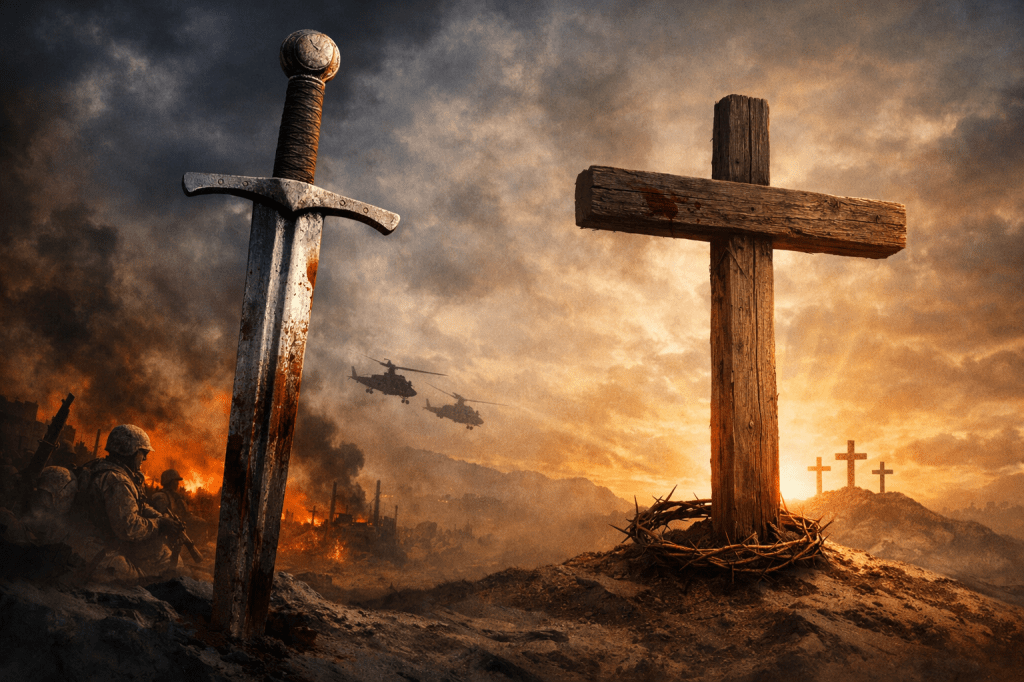
There comes a moment in every discussion about war when theory must give way to reality.
Not history.
Not distant conflicts.
But now.
And for us, that moment is here.
Because we are no longer asking about Rome…
or Augustine…
or World War II…
We are asking about our own nation.
Our own leaders.
Our own moment in history.
And that changes everything.
The Temptation of Proximity
It is easier to judge the past.
Time gives us distance.
Distance gives us clarity.
And clarity gives us confidence.
We can look back and say:
- That war was just
- That war was not
- That decision was wrong
But when the war is current…
when the headlines are fresh…
when the flags are waving…
Clarity becomes harder.
Because now:
- Emotions are involved
- Loyalties are tested
- Narratives are forming in real time
And the greatest danger emerges:
We begin to judge not by truth… but by allegiance.
The Current Conflict
The United States has entered into direct military conflict with Iran.
Strikes have been launched.
Targets have been hit.
Leaders have spoken with certainty.
And immediately, the familiar language begins to surface:
- Defense
- Security
- Justice
- Necessity
Words that sound right.
Words that feel right.
Words that have been used in nearly every war we have studied.
Which means we must slow down.
Because language alone does not make a war just.
Applying the Standard
We cannot approach this conflict emotionally.
We must approach it the same way we approached every other war in this series:
With the framework.
With sobriety.
With humility.
So we ask:
Is There a Just Cause?
Has a clear and present evil been committed that demands military response?
Is this defense?
Or is it preemption?
Because those are not the same.
One responds to aggression.
The other assumes it.
And assumptions—if wrong—cost lives.
Is This a Last Resort?
Have all reasonable diplomatic avenues been exhausted?
Not delayed.
Not avoided.
Exhausted.
Because once the first strike is launched, the path forward is no longer controlled by one nation.
War has a way of answering back.
Is It Proportional?
Will the response produce greater stability…
or greater chaos?
Will it restrain evil…
or provoke escalation?
Because history has shown us this again and again:
A strike meant to secure peace can ignite something far larger.
Is There a Clear Path to Peace?
Not just victory.
Peace.
Because removing a threat is not the same as establishing stability.
A regime may fall…
and something worse may rise in its place.
The Danger of Certainty
One of the most concerning patterns in modern conflict is how quickly certainty is claimed.
Leaders speak with confidence.
Media amplifies the narrative.
And the public is invited to accept conclusions before questions are fully asked.
But the Christian must resist that pressure.
Because we have already seen:
- Wars justified on faulty intelligence
- Conflicts entered with incomplete understanding
- Decisions made with unintended consequences
Which means we must say this plainly:
Speed is not the friend of discernment.
The Language of God
There is another danger—one more subtle, and more serious.
The invocation of God.
When war is framed not just as necessary…
but as righteous in a divine sense.
When language begins to sound like:
“God is on our side.”
That should stop us cold.
Because Scripture never commands us to assume that God stands with a nation simply because it claims righteousness.
The question is never:
“Is God on our side?”
The question is:
“Are we acting in accordance with His justice?”
And those are not the same.
The Christian’s Responsibility
So what is the role of the believer in a moment like this?
Not silence.
Not blind support.
Not reactionary opposition.
But discernment.
We are called to:
- Examine
- Question
- Weigh
- Pray
And yes—sometimes to speak.
Not as political partisans.
But as those whose allegiance is to Christ above all.
That means:
You may find yourself agreeing with aspects of the conflict…
while questioning others.
You may support the defense of life…
while grieving the cost of war.
You may stand with your nation…
without surrendering your conscience.
The Weight of the Moment
We must not pretend this is light.
Lives are at stake.
Families will be changed.
Decisions made now will echo for years—perhaps decades.
And while governments act…
The church must think.
The church must pray.
The church must remember:
We answer to a higher authority.
A Final Warning
There is something in the human heart that is drawn to conflict.
To resolution through force.
To the idea that problems can be solved decisively.
But war rarely delivers what it promises.
It may remove a threat.
But it often creates new ones.
It may feel like justice.
But it often leaves questions behind.
The King Above It All
And so we return—again—to Christ.
Not as an escape from reality.
But as the only true anchor within it.
Because while nations rise and strike and defend…
Christ reigns.
While leaders make decisions with limited knowledge…
Christ sees fully.
While war rages…
Christ remains King.
Where We Stand
So where does that leave us?
Not with easy answers.
But with clear responsibility.
We must:
- Refuse blind allegiance
- Reject shallow narratives
- Submit our thinking to Scripture
- Hold every war—including this one—under the judgment of God
Because one day, every action will be weighed.
Every decision examined.
Every war judged.
The Final Word
War will not have the last word.
Nations will not have the last word.
Even justice, as we imperfectly pursue it, will not have the last word.
Christ will.
And when He returns, He will not ask which side we stood on politically…
He will ask whether we walked in truth.
Soli Deo Gloria
 TheoloJeep
Leave a comment