The Christian in a World at War
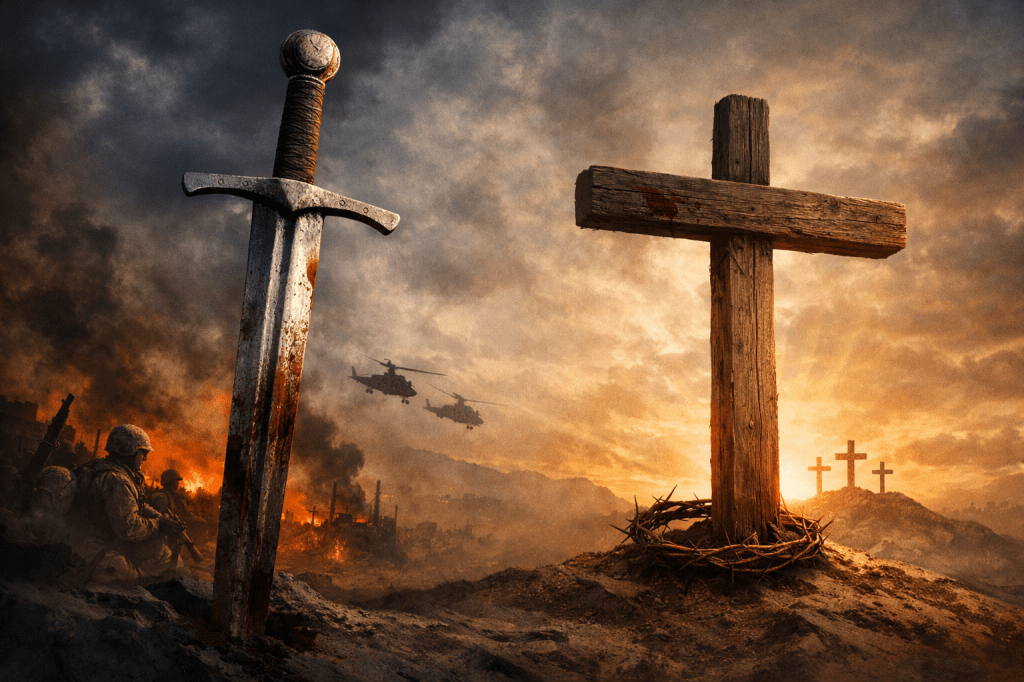
There is a temptation, after walking through something like this, to want resolution.
Clear lines.
Final answers.
A place to stand without tension.
But if this series has done anything, it should have stripped that illusion away.
Because the truth is this:
The Christian does not live in a world where war is simple.
We live in the tension.
What We Have Seen
We have seen that war is not an accident of history.
It is the fruit of sin.
From the first act of violence in Genesis…
to the wars that shape nations…
to the conflicts of our own time…
War is not foreign to humanity.
It is native to it.
We have seen that God has ordained the sword.
Not for chaos.
But for justice.
That governing authorities bear a responsibility to restrain evil—even through force.
And yet…
We have seen Christ.
The King who did not take up the sword.
The Savior who absorbed violence rather than unleashed it.
The Lord who conquered not by killing His enemies…
but by dying for them.
And then we have seen history.
Where even the most “just” wars become complicated.
Where motives blur.
Where actions exceed intentions.
Where the cost is always higher than expected.
And finally, we have stood in the present.
Not as observers.
But as participants.
As citizens.
As believers.
As those who must think, discern, and respond.
So What Now?
What does the Christian do with all of this?
Not in theory.
But in life.
1. Refuse the Simplicity of the World
The world demands quick conclusions.
Pick a side.
Take a position.
Speak with certainty.
But the Christian must resist that pressure.
Because we serve a King who calls us not to reaction…
but to truth.
And truth is often slower.
Heavier.
More costly.
2. Refuse Blind Allegiance
Your ultimate loyalty is not to a nation.
It is not to a political party.
It is not to a cultural identity.
It is to Christ.
That does not mean you reject your nation.
It means you refuse to elevate it beyond its place.
Because the moment you do…
you stop evaluating it.
And the moment you stop evaluating it…
you become vulnerable to justifying what God does not.
3. Refuse Naïve Pacifism
There is a kind of peace that sounds righteous…
but ignores reality.
A peace that refuses to confront evil.
A peace that leaves the innocent unprotected.
That is not biblical peace.
Because Scripture is clear:
There are times when evil must be restrained.
There are times when force is necessary.
There are times when the sword is not only permitted…
but required.
4. Refuse the Glorification of War
At the same time, we must reject the other extreme.
The celebration of war.
The excitement over conflict.
The language that turns violence into virtue.
Because even when war is justified…
it is still tragic.
It is still the result of sin.
It is still something to be entered into with grief—not enthusiasm.
The Posture of the Christian
So what remains?
If not simplicity…
then what?
A Posture of Discernment
We must think carefully.
We must ask hard questions.
We must evaluate every claim—not by emotion, but by truth.
A Posture of Humility
We must recognize that we do not see everything clearly.
That we are capable of being wrong.
That history has humbled those who once spoke with certainty.
A Posture of Prayer
Because ultimately, the decisions of nations are not in our hands.
But they are in God’s.
And so we pray:
- For leaders
- For wisdom
- For restraint
- For peace
A Posture of Hope
Not in governments.
Not in military strength.
Not in political outcomes.
But in Christ.
The Kingdom That Cannot Be Shaken
Every war in human history shares something in common:
It ends.
Nations rise.
Nations fall.
Empires expand.
Empires collapse.
Victories are declared…
and then forgotten.
But there is one kingdom that does not follow that pattern.
The kingdom of Christ.
It is not built by force.
It is not defended by weapons.
It does not expand through violence.
And yet…
It will outlast every nation that has ever existed.
The Final Victory
Scripture does not end with endless war.
It ends with final victory.
Not the victory of one nation over another.
But the victory of Christ over all things.
And when He returns:
- Justice will not be partial
- Peace will not be temporary
- Righteousness will not be contested
There will be no more war.
Not because man has finally figured it out.
But because Christ has made all things new.
Until That Day
We live in the in-between.
A world where:
- The sword still exists
- Governments still act
- Wars are still fought
And yet…
The cross still stands.
So we walk carefully.
We think deeply.
We speak truthfully.
We grieve what must be grieved.
We support what is just.
We question what is not.
And above all…
We remember where our hope lies.
The Final Word
War will continue—for a time.
Nations will continue—for a time.
Debates will continue—for a time.
But none of them will have the final word.
Christ will.
And when He does, every sword will be silenced…
and every knee will bow.
Soli Deo Gloria
 TheoloJeep
Leave a comment