Why the Martyrs Still Matter
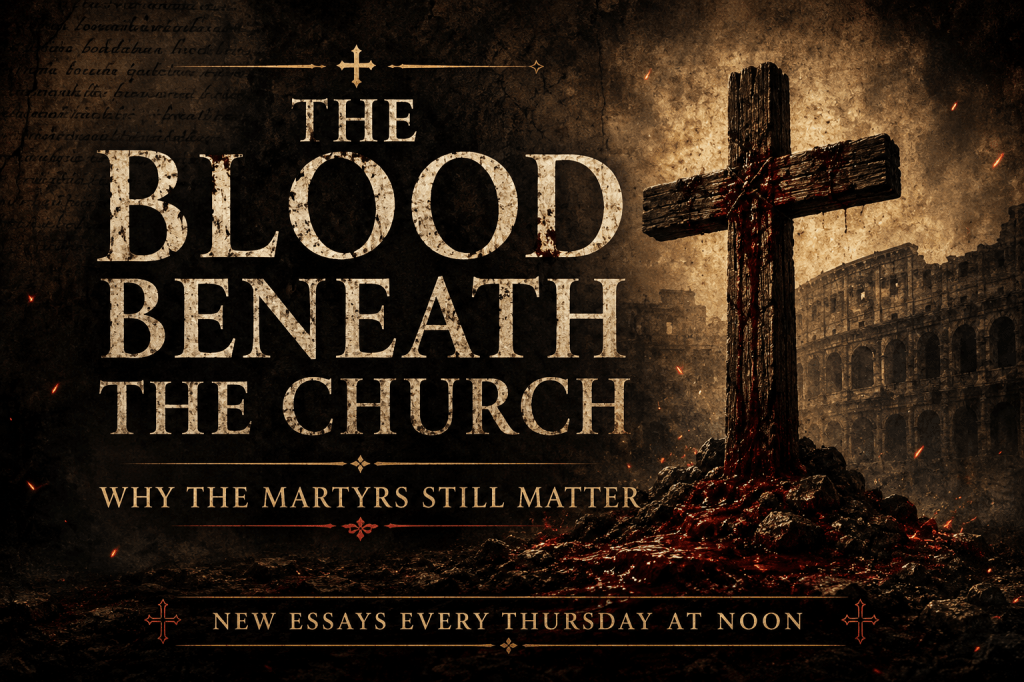
Part 1 — The Church Was Not Built by Comfortable Men
Beginning today, this new series will release every Thursday at noon as we walk through the lives, deaths, convictions, and enduring witness of the martyrs of the Christian faith.
There is a strange kind of Christianity growing in the modern West.
Soft. Polished. Safe.
A Christianity that wants the crown but recoils at the cross.
A faith that speaks endlessly about influence but very little about sacrifice.
A church culture that measures success by attendance, branding, stage design, and online reach—but seems almost embarrassed by suffering.
And yet the Church of Jesus Christ was not built by comfortable men.
It was built by martyrs.
The Greek word for martyr originally meant witness. Not merely someone who died, but someone who testified. Someone who declared Christ so boldly, so publicly, and so faithfully that the world eventually demanded silence—and they refused.
The blood of the martyrs is not a side note in Christian history. It is woven into the very foundation of the Church itself.
The early Christians did not conquer Rome with political leverage.
They did not possess cultural power.
They had no celebrities, no megachurches, no publishing companies, no radio stations, no voting blocs.
They had Christ.
And they believed Him enough to die.
The modern church often reads the book of Acts like a triumphal story of rapid growth and miracles. And it is. But we forget that nearly every page of Acts drips with danger. The apostles were beaten, imprisoned, hunted, mocked, and eventually executed. Stephen was crushed beneath stones while praying for the men murdering him. James was killed by the sword. Peter was imprisoned repeatedly. Paul carried scars on his body like signatures of faithfulness.
This was not abnormal Christianity.
This was Christianity.
Jesus never hid this reality from His followers. He told them plainly:
“If the world hates you, know that it has hated me before it hated you.”
— John 15:18 (ESV)
Again:
“Indeed, all who desire to live a godly life in Christ Jesus will be persecuted.”
— 2 Timothy 3:12 (ESV)
Not might be.
Will be.
For much of church history, believers understood this instinctively. To follow Christ was to place your life on the altar. Baptism itself was often viewed almost like a public funeral procession. New converts in the early centuries understood that confessing Christ could cost them family, employment, imprisonment, torture, or death.
And still they came.
Can you imagine that kind of conviction?
Can you imagine gathering for worship knowing soldiers could burst through the doors at any moment? Can you imagine singing hymns quietly underground while listening for footsteps above? Can you imagine holding your child while wondering if tomorrow you would be fed to beasts in an arena because you refused to burn incense to Caesar?
They did not merely “accept Jesus into their hearts.”
They counted the cost.
And what is astonishing is that persecution did not extinguish Christianity. It purified it.
Rome tried to crush the Church beneath violence. Instead, every execution became a sermon. Every martyr became a witness. Every public death exposed the weakness of the empire and the strength of Christ.
Pagan crowds watched Christians sing while burning alive.
They watched old men forgive executioners.
They watched women refuse to deny Christ while facing unimaginable torture.
They watched believers walk calmly into death with the kind of peace Rome could not manufacture.
And Rome could not understand it.
How do you defeat people who are no longer afraid to die?
You do not.
That is why the early church father Tertullian famously declared:
“The blood of the martyrs is the seed of the Church.”
He was right.
The Church grows strongest when it is stripped of worldly comfort and forced to cling to Christ alone.
And perhaps that is why the modern Western church often feels so weak.
We have grown accustomed to convenience. We expect sermons tailored to our preferences, worship crafted around our tastes, and churches designed to compete for our attention. We often speak more about personal fulfillment than holiness. More about platform than perseverance. More about success than sanctification.
But the martyrs remind us that Christianity is not consumerism.
It is surrender.
The martyrs stand across history like a line of burning torches, exposing how shallow modern faith can become. They remind us that Christ is not merely an addition to life. He is worthy of life itself.
These were not superhuman people. They were ordinary believers animated by extraordinary conviction.
Some were pastors.
Some were mothers.
Some were teenagers.
Some were slaves.
Some were scholars.
Some could barely read.
But they shared one thing in common:
They believed Jesus Christ was better than life itself.
And this series exists because we desperately need to remember them.
Not to romanticize suffering.
Not to glorify death itself.
But to recover the weight of Christian conviction.
Because the Church in every age drifts toward forgetfulness.
We forget that the gospel spread through suffering.
We forget that truth has always carried a cost.
We forget that faithfulness is often measured not in applause, but endurance.
The martyrs call us back.
Back to courage.
Back to conviction.
Back to the kind of Christianity that trembles before God more than it fears man.
In the coming posts, we will walk through the lives and deaths of men and women whose faith shook empires. Some names are well known. Others have been almost forgotten by history. But all of them testify to the same truth:
Christ is worthy.
Worthy of ridicule.
Worthy of exile.
Worthy of chains.
Worthy of death.
And worthy of your life now.
The modern church does not necessarily need more innovation.
It may simply need more Christians who believe like the martyrs did.
Soli Deo Gloria


Leave a Reply