Why the Martyrs Still Matter
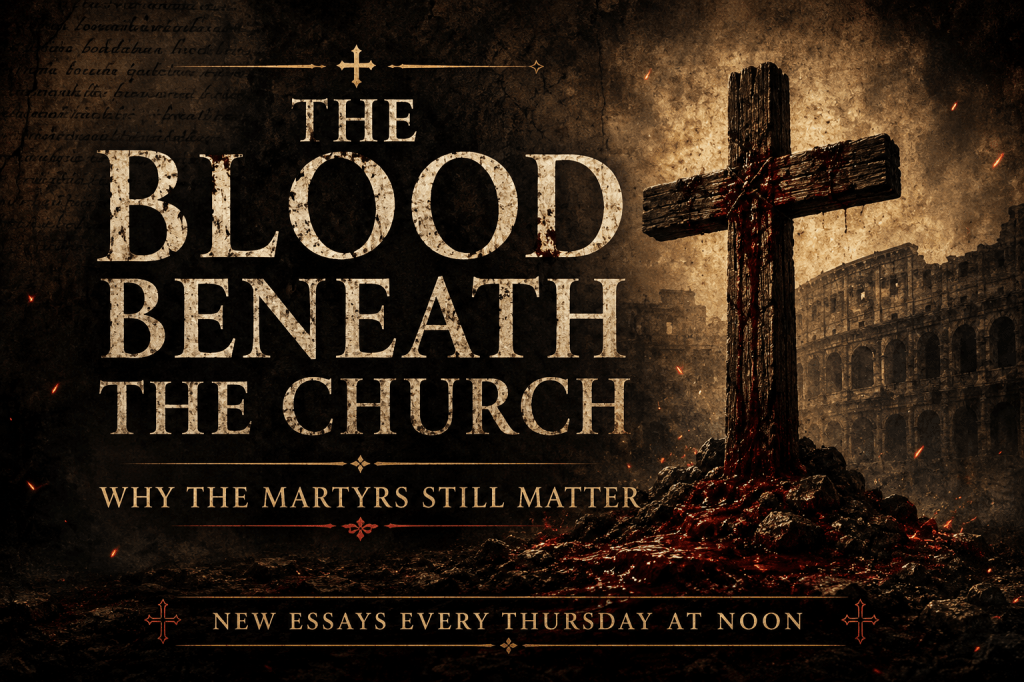
Part 7 — Blandina: The Slave Girl Rome Could Not Break
Part of an ongoing 52-week Thursday noon essay series exploring the lives, deaths, convictions, and witness of Christian martyrs throughout church history.
Rome understood power.
It understood armies. It understood law. It understood fear. It understood public spectacle.
What Rome did not understand was a slave girl who would not break.
Her name was Blandina.
She lived in the second century in Lugdunum, modern-day Lyon, during a period of fierce persecution against Christians. Around the year 177 AD, under the reign of Marcus Aurelius, believers in that region were arrested, tortured, humiliated, and executed because they confessed Jesus Christ as Lord.
And among them was Blandina.
By the world’s standards, she was nothing.
A young woman. A slave. Physically weak. Socially powerless. Easily dismissed.
In Roman society, she had no prestige to protect her. No citizenship to shield her. No status to make officials hesitate. She belonged near the bottom of the social order, the kind of person empires usually crush without memory or consequence.
But heaven knew her name.
And so does the Church.
That is one of the great reversals of Christian history.
The empire that tortured Blandina is gone. Its rulers have returned to dust. Its magistrates are forgotten by almost everyone. But the slave girl they tried to erase is still remembered nearly two thousand years later.
Why?
Because Christ delights to display His strength through weakness.
Blandina was arrested with other Christians during a wave of hostility in Lyon. The persecution was not quiet or private. It became public hatred. Christians were dragged from homes, questioned, accused of horrific crimes, beaten, and pressured to renounce Christ.
Rome wanted confessions.
Not true confessions.
Useful confessions.
The authorities wanted Christians to admit guilt, curse Christ, and return to the gods of the empire. If they would only say the words, only burn the incense, only submit outwardly, their lives might be spared.
But the martyrs understood something modern Christians often forget:
A false peace purchased by denying Christ is not peace at all.
Blandina was tortured with such brutality that even her executioners reportedly grew exhausted. They took turns inflicting pain on her throughout the day until they had nothing left to do. The expectation was simple: pain would force surrender.
Surely this weak slave girl would collapse.
Surely she would recant.
Surely enough suffering would make her deny Jesus.
But Blandina answered with one sentence again and again:
“I am a Christian.”
That was her defense.
That was her confession.
That was her whole identity.
Not slave. Not victim. Not property. Not powerless.
Christian.
The world tried to define her by her weakness. Christ defined her by His name.
And there is a lesson here the Church desperately needs.
We often imagine courage as something loud, muscular, and impressive. But Blandina’s courage was not worldly courage. It was not bravado. It was not personality. It was not the confidence of someone with control over her circumstances.
It was faith.
Faith that clings to Christ when the body trembles. Faith that confesses Christ when the crowd mocks. Faith that says, “I am a Christian,” when every earthly incentive says, “Deny Him and live.”
That is not weakness.
That is holy defiance.
The persecution in Lyon intensified. Christians were imprisoned in miserable conditions. Some died from abuse and confinement before they ever reached formal execution. Others were taken into the amphitheater where the violence became entertainment.
Blandina was brought into the arena with other believers.
She was bound to a stake and exposed to wild beasts.
The image was intentional.
Rome wanted her displayed as helpless. Suspended. Vulnerable. Waiting to be torn apart before a cheering crowd.
But according to the ancient account, the beasts did not touch her at first.
Instead of seeing a defeated slave girl, the other Christians saw in her suffering a reflection of Christ Himself. Bound in weakness, yet strengthened by God. Despised by the world, yet precious to heaven.
Her endurance encouraged the others.
That matters.
Blandina was not merely surviving her own trial. She was strengthening the Church while suffering.
This is one of the mysteries of Christian endurance. Faithfulness under pressure rarely belongs only to the person suffering. God uses steadfast believers to put courage into the bones of others.
A faithful prisoner strengthens free Christians.
A suffering saint preaches to the comfortable.
A dying martyr disciples generations not yet born.
Blandina’s witness did that.
After the first ordeal, she was taken back to prison. Rome was not finished with her.
Later she was brought out again, this time with a young believer named Ponticus. He was reportedly only about fifteen years old. Blandina encouraged him to remain faithful as he endured torment. Like a mother in the faith, she urged him onward until he died.
Then Blandina was left.
The last of the martyrs.
Rome had watched her endure torture, beasts, imprisonment, humiliation, and the deaths of her brothers and sisters in Christ.
Still she would not deny Jesus.
So the final cruelty came.
She was scourged. She was placed on a heated iron grate. She was enclosed in a net. She was thrown before a wild bull, which tossed her violently with its horns. And finally, after her body had been brutalized beyond recognition, she was killed with a dagger.
That is how Blandina died.
Not quietly. Not comfortably. Not peacefully in the earthly sense.
But faithfully.
The crowd saw weakness.
Heaven saw victory.
And the Church saw a witness that could not be erased.
There is a reason stories like Blandina’s must be told plainly. We do not honor the martyrs by sanitizing their deaths. We honor them by telling the truth.
The horror reveals the cost.
And the cost reveals the worth of Christ.
Blandina did not die for vague spirituality. She did not die for a moral philosophy. She did not die for a cultural tradition. She died because she belonged to Jesus Christ and would not deny Him.
That kind of faith exposes us.
We live in a time when many Christians are tempted to make peace with the world through small denials. Not always formal apostasies. Not always dramatic betrayals. Sometimes just silence. Sometimes embarrassment. Sometimes softening hard truths until no offense remains. Sometimes treating faith like a private accessory rather than a public allegiance.
Blandina reminds us that Christianity is not an accessory.
It is identity.
“I am a Christian.”
Those words were enough for Rome to kill her.
Are they enough for us to live by?
The modern Church does not need to become obsessed with persecution. It does not need to romanticize suffering or seek out conflict foolishly. But it does need to recover the kind of conviction that cannot be bought by comfort or broken by fear.
Blandina had nothing Rome respected.
No status. No wealth. No freedom. No earthly power.
But she had Christ.
And Christ was enough.
The empire could tear her body.
It could not take her crown.
The bull is gone. The arena is silent. The officials are forgotten. The crowd has disappeared into history.
But Blandina still speaks.
A slave girl became a witness. A weak body became a testimony. A bloody arena became holy ground.
And Rome learned once again what every empire eventually discovers:
You cannot break someone who belongs entirely to Christ.
Soli Deo Gloria
 TheoloJeep
Leave a comment