Why the Martyrs Still Matter
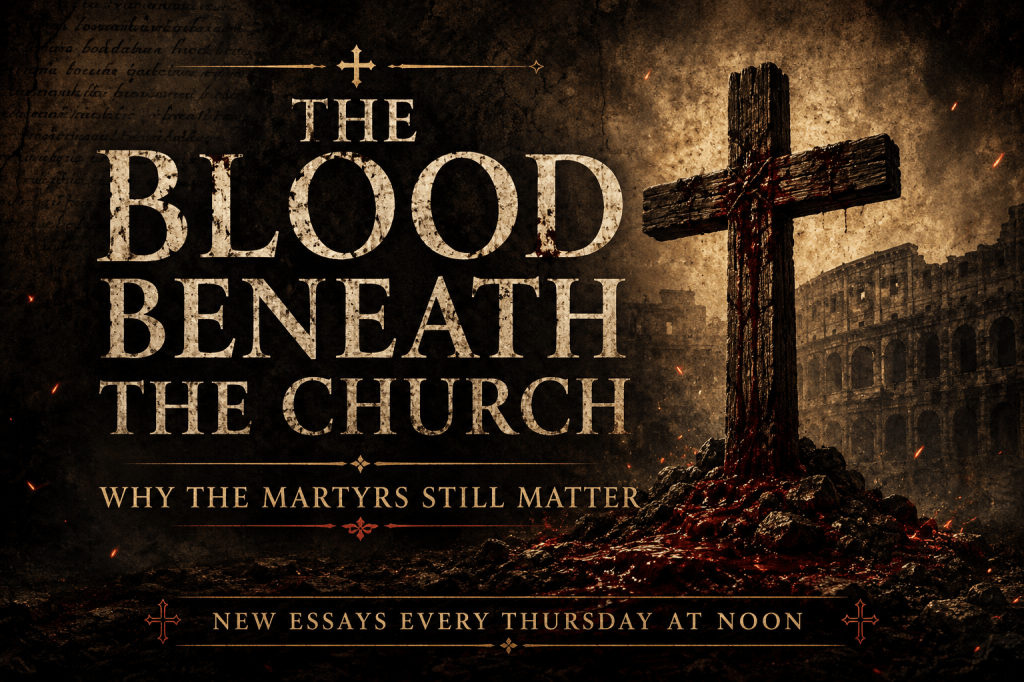
Part 8 — Cyprian of Carthage: The Bishop Who Would Not Bow
Part of an ongoing 52-week Thursday noon essay series exploring the lives, deaths, convictions, and witness of Christian martyrs throughout church history.
There are times when the Church needs shepherds who know how to suffer.
Not performers. Not celebrities. Not religious managers.
Shepherds.
Men who do not merely speak of courage from a distance, but who walk before the flock when death itself comes near.
Cyprian of Carthage was such a man.
He lived in the third century, when Christianity in North Africa was growing rapidly but dangerously. Carthage was one of the great cities of the Roman world, full of wealth, rhetoric, pagan religion, political power, and social pressure.
Cyprian knew that world well.
Before his conversion, he was educated, wealthy, and respected. He had been trained in rhetoric and had all the tools necessary to build a comfortable life of influence. By earthly standards, he had much to lose.
Then Christ claimed him.
And everything changed.
Cyprian did not drift quietly into private religion. He became a Christian with the seriousness of a man who knew he had found the truth. He gave away much of his wealth, devoted himself to the Church, and eventually became bishop of Carthage.
But the bishop’s chair was no throne of comfort.
It was a place of danger.
The Roman Empire did not view Christianity as a harmless private faith. Christians refused to sacrifice to the gods. They refused to confess Caesar as ultimate lord. They belonged to another kingdom, obeyed another King, and lived by another hope.
Rome called that rebellion.
Christians called it faithfulness.
During earlier persecution, Cyprian had gone into hiding. Some criticized him for it, accusing him of cowardice. But Cyprian argued that he had not fled to deny Christ, but to continue shepherding the Church. A pastor dead before his time could not guide the flock through crisis. So from hiding, he wrote, instructed, warned, comforted, and governed.
This is important.
Christian courage is not recklessness.
The martyrs did not chase death as though suffering itself were holy. They did not treat martyrdom as spiritual theater. They understood that life belonged to God, and therefore death did too.
Cyprian waited for the hour God appointed.
And when that hour came, he did not run.
Under Emperor Valerian, persecution intensified. Christian leaders were targeted directly. Bishops, priests, and deacons were ordered to participate in Roman religious ceremonies or face death.
Cyprian was arrested.
The Roman authorities demanded conformity.
Sacrifice to the gods. Submit to the empire. Abandon this stubborn allegiance to Christ.
Cyprian refused.
He was first exiled, removed from his people, and placed under watch. But exile could not silence him. Even away from Carthage, he continued to strengthen the Church. His letters carried pastoral fire. He encouraged believers to endure, warned them against compromise, and prepared them for suffering.
A true shepherd does not only feed sheep in calm pastures.
He prepares them for wolves.
Eventually Cyprian was recalled to Carthage and brought before the Roman proconsul. By then, the empire’s demand was clear. Christian clergy who refused to sacrifice were to be executed.
The hearing was brief.
The question was simple.
Would Cyprian obey Rome or Christ?
He chose Christ.
When ordered to conform to the Roman rites, Cyprian refused. The proconsul warned him to consider his own welfare.
Cyprian’s answer was steady:
Do what you have been commanded to do.
There is a holy simplicity in that kind of faith.
No panic. No bargaining. No desperate attempt to preserve himself.
Cyprian knew the issue was clear.
Christ is Lord.
That was enough.
The sentence was pronounced: Cyprian was to be executed by the sword.
His response was not rage.
It was worship.
“Thanks be to God.”
Then he was led away.
A great crowd followed him to the place of execution. Some were Christians grieving their bishop. Others were curious spectators. Rome intended the death to be a warning.
But once again, the empire misunderstood the power of martyrdom.
Cyprian removed his outer garments. He knelt down. He prayed. He blindfolded himself. Then, according to ancient accounts, he even instructed that payment be given to the executioner.
And there, outside Carthage, the bishop was beheaded.
That is how Cyprian died.
Not in an arena. Not torn by beasts. Not burned in flames.
But by the sword of Rome.
His blood marked the ground as the blood of a shepherd who would not abandon Christ or His Church.
There is something deeply sobering about Cyprian’s death. He was not a young believer swept suddenly into persecution. He was a mature pastor. A teacher. A leader. A man responsible for souls.
And in the end, his final sermon was not written with ink.
It was written with blood.
The modern Church needs to remember this.
We live in an age where pastoral ministry is often measured by visibility, charisma, influence, online reach, and institutional success. But Cyprian reminds us that the first calling of a shepherd is faithfulness.
Not popularity.
Faithfulness.
A pastor must be willing to tell the truth when lies are fashionable. He must guard the flock when wolves appear respectable. He must refuse compromise when safety becomes an idol. He must stand before the people of God as one who fears the Lord more than man.
Cyprian was not perfect.
No martyr was.
But he belonged to Christ, and when the empire demanded his worship, he refused to give Rome what belonged only to God.
That is the heart of martyrdom.
Not a love of death.
A love of Christ greater than the fear of death.
Cyprian’s witness confronts every generation of Christians with a simple question:
When pressure comes, what will we protect first?
Our comfort? Our reputation? Our future? Our influence? Our life?
Or our confession?
The martyrs teach us that confession is not merely something spoken during worship. It is something proven under pressure.
Anyone can say “Jesus is Lord” when the room agrees.
But when the sword is drawn, those words become costly.
Cyprian counted the cost.
And Christ was worth it.
Rome thought it had silenced a bishop.
But it only gave the Church another witness.
The proconsul is forgotten. The imperial edicts have turned to dust. The sword that killed Cyprian is gone.
But the testimony remains.
A shepherd knelt before death and rose into glory.
And his blood still speaks beneath the Church.
Soli Deo Gloria


Leave a Reply