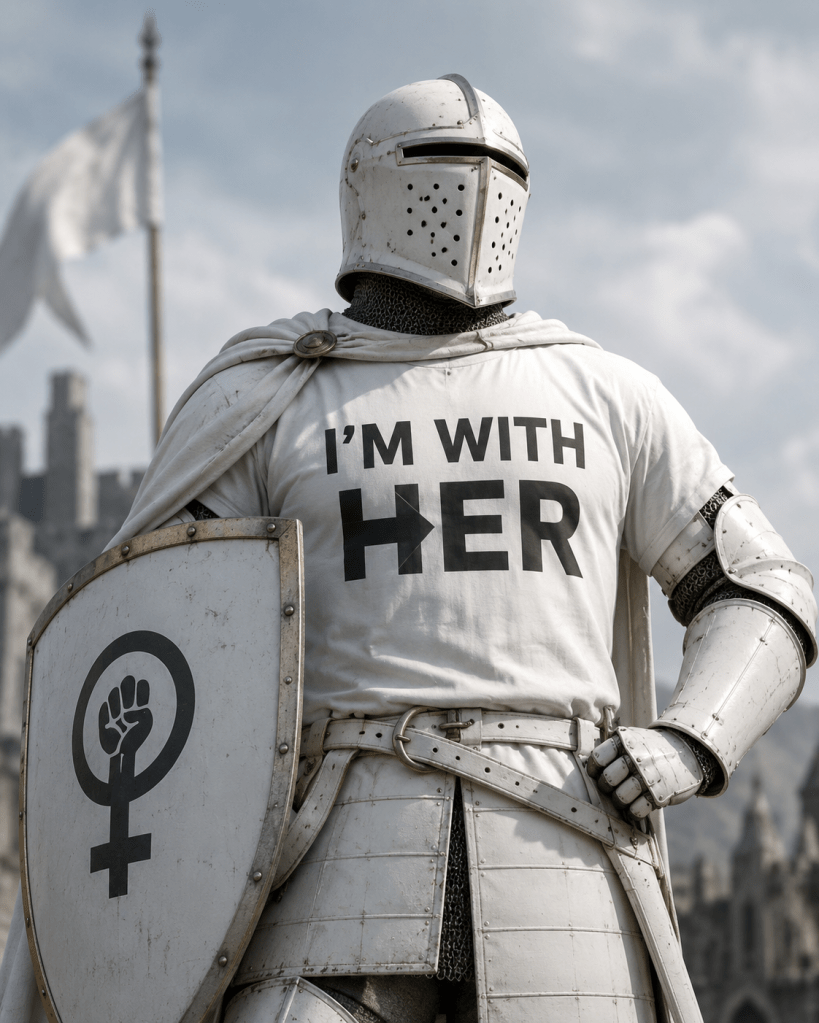
There is a peculiar form of cowardice that has become respectable in the modern West. It does not present itself as fear. It presents itself as compassion, enlightenment, and moral sensitivity. It speaks the language of equality while practicing partiality. It claims to defend women, but often does so by abandoning truth, surrendering masculine responsibility, and treating honest disagreement as a form of aggression.
This is the cowardice of white knighting.
White knighting is not simply the act of defending a woman. Men should defend women when they are threatened, slandered, exploited, or treated unjustly. That impulse is not shameful. It is rooted in the masculine responsibility to protect. The problem begins when protection is separated from truth, when a woman is defended merely because she is a woman, and when a man assumes that his moral duty is to affirm her regardless of the facts.
At that point, protection becomes flattery, courage becomes performance, and justice gives way to favoritism.
The culture insists that the modern arrangement is the fruit of equality. In reality, equality between the sexes has often been distorted into a form of female social supremacy. Men and women are declared equal, but the rules of public discourse increasingly assume that women possess greater moral authority, greater emotional credibility, and greater entitlement to protection from criticism. A woman may speak with anger and be called empowered. A man who answers plainly may be called threatening. A woman may condemn men as a class and be praised for speaking her truth. A man who challenges feminist assumptions may find himself dismissed as bitter, insecure, misogynistic, or toxic before his argument is even considered.
This is not equality.
It is an imbalance disguised by the language of fairness.
The slogan may still be equality, but the practical demand is often deference. Men are expected to listen, affirm, apologize, step aside, and remain silent. Women are encouraged to find their voices, assert their independence, reject male authority, and treat resistance as evidence that patriarchy is still alive. The cultural anthem is still, in effect, “I am woman, hear me roar,” while men are told that the most virtuous thing they can do is lower their heads and agree.
Those who attempt a more balanced approach quickly discover how little balance is actually tolerated.
A man may affirm the equal dignity of women, condemn abuse, reject chauvinism, honor female intelligence, and defend women from genuine mistreatment. Yet if he also argues that men and women are different, that those differences matter, that male leadership can be good, or that women are not morally infallible, he may still be condemned. The offense is not necessarily hatred. Often, the offense is simply refusing to submit to the approved narrative.
Many men have responded to this pressure by capitulating.
They did not all become committed ideologues. Some merely decided that resistance was exhausting. They learned that agreement produced peace, while disagreement produced accusation. They discovered that repeating feminist assumptions made them appear safe, progressive, and emotionally intelligent. They realized that a public display of deference could protect their reputation, preserve relationships, and spare them from uncomfortable conflict.
So they went along to get along.
This is one of the most ordinary forms of moral weakness. It is not always dramatic. It rarely announces itself as betrayal. It begins with silence, small compromises, nervous laughter, and calculated agreement. A man hears something false but says nothing. He watches another man condemned unfairly but refuses to intervene. He accepts an accusation he knows is exaggerated because challenging it would be socially costly. He apologizes for being male, distances himself from masculine authority, and adopts the language expected of him.
Not because he is convinced.
Because he is afraid.
He fears being labeled toxic. He fears being regarded as unsafe. He fears losing the approval of women. He fears tension at home, criticism at work, rejection online, or isolation within his social circle. In many cases, he does not even need to be threatened directly. The culture has already trained him to police himself.
This is how a man is socially neutered without anyone ever laying a hand on him.
He becomes careful where courage is required. He becomes vague where truth demands clarity. He becomes agreeable where conviction demands resistance. He may continue to appear masculine in dress, occupation, hobbies, or mannerisms, but morally he has surrendered the authority to stand, judge, protect, and lead.
Society applauds this man because he is useful.
He poses no threat to the prevailing order. He will not question its assumptions. He will not challenge the emotional framing of an argument. He will condemn other men quickly enough to prove that he belongs among the enlightened. He will place himself between a woman and criticism, not necessarily because the criticism is unjust, but because doing so advertises his virtue.
Yet the same society that applauds him rarely respects him.
It may praise his compliance, but it does not admire his weakness. It may reward his apologies, but it will always demand another one. It may tell him that he is one of the good men, but only so long as he continues proving that he is not like the others. His acceptance remains conditional upon continued surrender.
The white knight imagines that submission will purchase peace. It never does.
Every concession becomes the foundation for the next demand. Every apology is treated as confirmation that the accusation was justified. Every surrender narrows the range of acceptable speech until even mild disagreement appears radical. Appeasement does not restrain an ideology that seeks dominance. It teaches the ideology that pressure works.
Men must accept responsibility for allowing this to happen.
It is easy to blame feminism, but feminism did not conquer the culture alone. Men opened the gates. They abandoned their posts, neglected their households, tolerated falsehood, surrendered institutions, and increasingly treated leadership as a burden to escape rather than a responsibility to bear. Some were intimidated. Others were seduced by comfort. Many simply wanted to avoid conflict.
The result was not merely the liberation of women from genuine injustice. It was the gradual delegitimization of male authority itself.
That distinction matters. There were real abuses to confront. Women were sometimes denied justice, exploited by powerful men, silenced in the face of mistreatment, and treated as though their dignity were inferior. Those wrongs deserved correction. But the correction did not remain correction. It became inversion. Rather than restoring justice between the sexes, the culture increasingly embraced a framework in which masculinity itself was treated as suspect and femininity was granted a kind of moral immunity.
The answer is not a return to cruelty, domination, or the degradation of women. Biblical manhood has no room for such things. A man who uses authority to serve himself, intimidate his wife, mistreat his daughters, or excuse his own sin is not masculine in any biblical sense. He is a tyrant, and tyranny is not strength.
But neither is capitulation.
The biblical man does not despise women, nor does he idolize them. He honors them as image-bearers of God. He protects them from injustice. He listens to wisdom when they speak it. He receives correction when they are right. He also refuses to flatter them, fear them, or pretend that their sex exempts them from error.
He understands that women, like men, are capable of wisdom and folly, courage and manipulation, righteousness and sin. He therefore judges fairly, speaks truthfully, and refuses the partiality that modern culture often mistakes for compassion.
Jesus Christ is the perfect model of this balance. He treated women with extraordinary dignity. He welcomed them as disciples, defended them from genuine injustice, received their service, and revealed profound truth to them. Yet He never surrendered His authority to gain their approval. He corrected them when necessary, called them to repentance, exposed false assumptions, and refused to make sentiment the measure of truth.
His love was neither harsh nor servile.
It was holy.
This is what modern men must recover. Not a louder masculinity, but a steadier one. Not bitterness toward women, but freedom from the need for their approval. Not domination, but responsibility. Not reflexive opposition to feminism, but the courage to reject what is false within it while acknowledging whatever is true.
Biblical manhood gives a man the strength to stand between a woman and genuine danger, but it also gives him the strength to stand against her when she is wrong. It teaches him to protect without groveling, to lead without abusing, to listen without surrendering discernment, and to love without lying.
A man who fears God is not controlled by the threat of labels. He does not collapse because someone calls him toxic. He examines himself honestly, repents when the accusation is true, and stands firm when it is false. He does not need to posture, rage, or prove himself. His courage rests in obedience, not public approval.
The white knight bends because he wants peace with the world.
The biblical man stands because he has peace with God.
Until men recover that foundation, the culture will continue rewarding their weakness, exploiting their fear, and calling their surrender virtue.
Soli Deo Gloria.
 TheoloJeep
Leave a comment