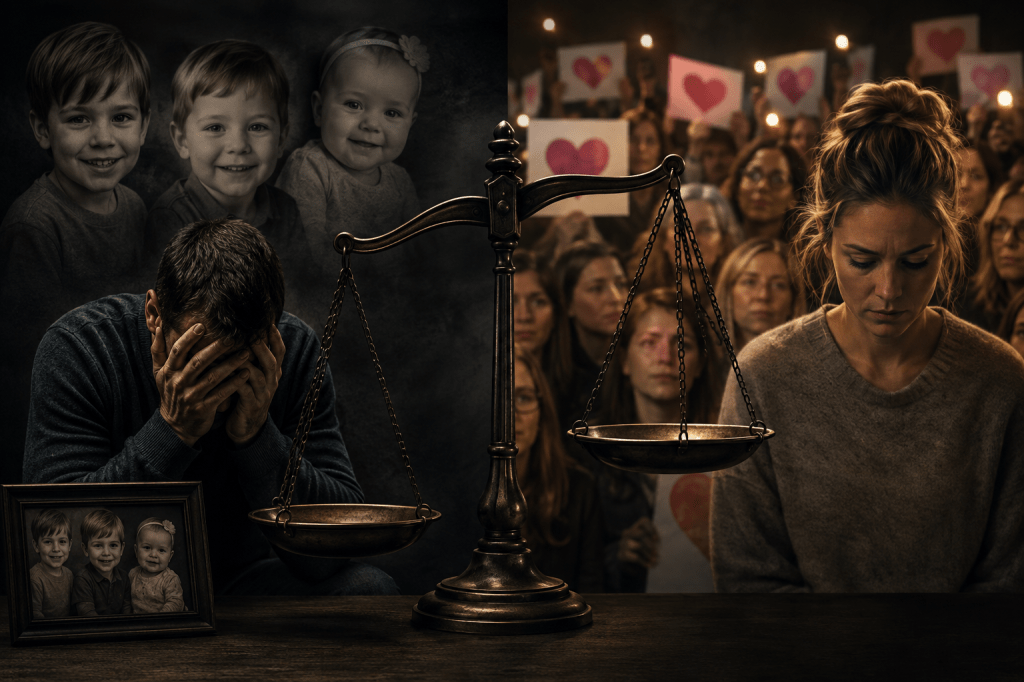
Three children are dead.
Their mother killed them.
And somehow, people have found a way to blame their father.
If you want to understand how thoroughly feminist ideology has distorted the way our culture thinks about men, women, marriage, motherhood, responsibility, and victimhood, look no further than the public reaction surrounding the trial of Lindsay Clancy.
Cora was five.
Dawson was three.
Callan was eight months old.
Their mother strangled them.
That fact is not disputed. The question before the court concerns Lindsay Clancy’s mental state and whether she was legally responsible for what she did. Her defense argues that she was suffering from severe mental illness and psychosis. The prosecution disputes that characterization of her condition and argues that she understood what she was doing.
Let the evidence be heard. Let the jury decide the legal question.
But outside the courtroom, something else has been happening that deserves our attention.
A movement has emerged portraying Lindsay primarily as a victim. People have rallied in her support. Social media has filled with sympathy for her. And perhaps most bizarrely, people have searched for ways to place responsibility upon Patrick Clancy—the father whose three children were killed.
Apparently, even when a woman kills her own children, feminism can still find a man to blame.
The Ideology Requires a Male Villain
This shouldn’t surprise us.
For more than half a century, our culture has been catechized in a particular understanding of the relationship between men and women.
Men possess power.
Women suffer beneath it.
Men oppress.
Women are oppressed.
Marriage restricts women.
Motherhood burdens women.
Traditional gender expectations exploit women.
And when something goes terribly wrong within a family, we have been conditioned to search upstream for the man who must somehow be responsible.
That worldview has become so deeply embedded in Western culture that many people don’t even recognize it as ideology anymore. It is simply the water in which they swim.
And then a case like Lindsay Clancy’s exposes just how absurd the framework can become.
A mother kills three children, and instead of beginning with the obvious moral reality—three innocent children were killed by their mother—people immediately begin searching for circumstances that will transform the perpetrator into the victim.
Who failed her?
Who wasn’t helping her?
Who put too much pressure on her?
Who should have recognized the warning signs?
Who left her alone?
What did her husband do?
What didn’t her husband do?
The questions continue until responsibility has been diluted among doctors, medications, society, motherhood, expectations, and eventually the husband.
Everyone seems capable of bearing responsibility except the woman who actually committed the act.
That is not compassion.
It is an ideology choking on reality.
Feminism Has Made Female Accountability Almost Taboo
One of feminism’s most destructive legacies has been its tendency to describe female wrongdoing through the language of victimization.
When men behave wickedly, we are comfortable talking about responsibility.
When women behave wickedly, there is often an immediate cultural instinct to ask what happened to her that caused her to behave that way.
There must be trauma.
There must be abuse.
There must be oppression.
There must be mental illness.
There must be an absent husband.
There must be an inattentive husband.
There must be an overbearing husband.
There must be societal expectations.
There must be something.
Anything.
Just don’t stop with she did something evil.
Of course circumstances matter. Mental illness matters enormously in this particular case because it bears directly upon criminal responsibility. If Lindsay Clancy was genuinely incapable of understanding the nature or wrongfulness of her actions, the law should take that into account.
But psychiatric explanation and ideological excuse-making are not the same thing.
One asks whether a person’s mind was so impaired that she met a specific legal standard.
The other begins with the assumption that the woman must somehow be the victim and then searches for someone—or something—to blame.
And that is where Patrick enters the story.
Patrick Clancy Has Already Been Victimized
Patrick Clancy went out on an errand.
He came home to a nightmare.
His three children had been strangled.
Stop there for a moment.
Imagine coming home and discovering that the children whose voices filled your house—the children you tucked into bed, fed breakfast, carried when they were tired, comforted when they cried—were dying or dead.
There are experiences from which a human being never fully recovers.
Patrick lost Cora.
Patrick lost Dawson.
Patrick lost Callan.
Yet people sitting safely behind their phones have decided to investigate whether Patrick sufficiently supported the woman who killed them.
Why didn’t he know?
Why did he leave her alone?
Was he doing enough around the house?
Was she overwhelmed?
Was he sufficiently attentive to her mental health?
Maybe Patrick bears some responsibility.
For what?
His children’s murder?
There is no evidence that Patrick killed those children.
There is no evidence that he participated in killing them.
There is no evidence that he wanted them dead.
Yet the ideological machine needs a male oppressor badly enough that the grieving father can be dragged into the defendant’s chair in the court of public opinion.
That should disgust us.
Reverse the Sexes and Watch the Sympathy Disappear
The hypocrisy becomes obvious with one simple exercise.
Reverse the sexes.
Imagine a father strangled his five-year-old daughter.
Then his three-year-old son.
Then his eight-month-old baby.
His wife had left the house briefly and returned to discover what he had done.
Now imagine crowds gathering outside the courthouse carrying signs supporting him.
Imagine thousands of social-media posts saying:
“We failed fathers.”
Imagine people asking whether his wife was attentive enough.
Maybe she didn’t appreciate him.
Maybe she expected too much.
Maybe she didn’t notice his declining mental health.
Maybe she left him with the children when she should have known better.
Maybe society places unreasonable expectations upon fathers.
Maybe she should have done more.
The reaction would be immediate and furious.
And rightly so.
People would call it victim-blaming.
They would demand that everyone stop interrogating the grieving mother and focus upon the man who killed her children.
Yet reverse the sexes again and suddenly the murderer becomes the sympathetic figure while the surviving father gets interrogated.
That isn’t principled compassion.
It is a double standard.
The Children Are Being Erased
Perhaps the ugliest result of all of this is what happens to Cora, Dawson, and Callan.
They slowly disappear from their own story.
The discussion becomes about postpartum care.
Lindsay’s medications.
Lindsay’s psychiatric condition.
Lindsay’s burdens.
Lindsay’s marriage.
Lindsay’s treatment.
Lindsay’s suffering.
Lindsay’s supporters.
Lindsay’s future.
And eventually you have to ask:
Does anybody remember the children?
Cora.
Dawson.
Callan.
Say their names.
They were not symptoms of a maternal mental-health crisis.
They were not props in a conversation about feminism.
They were not unfortunate consequences of inadequate social support.
They were image-bearers of God whose lives possessed immeasurable value.
And they were killed.
Whatever conclusion the jury reaches concerning their mother’s legal responsibility does not change that.
Feminism’s Anthropology Is the Deeper Problem
The problem goes deeper than one murder trial.
Modern feminism did not simply campaign for women to receive equal protection under the law. It gradually taught generations of women to understand themselves through a framework of grievance and generations of men to understand masculinity through suspicion.
Marriage became patriarchy.
Authority became oppression.
Submission became abuse.
Motherhood became unpaid labor.
Homemaking became exploitation.
Male leadership became domination.
Female dependence became victimization.
The family itself increasingly came to be understood through the language of power rather than covenant, obligation, sacrifice, and love.
Once you accept those assumptions, the reaction to Lindsay Clancy begins to make a twisted sort of sense.
Because feminism needs female suffering to originate somewhere outside the woman herself.
She must have been failed.
She must have been oppressed.
She must have been unsupported.
And somewhere nearby there must be a man whose privilege, neglect, incompetence, selfishness, or authority explains what happened.
Even when his children are lying dead.
Christianity Offers Something Far More Honest
Scripture does not divide humanity into oppressor men and victim women.
It gives us a much less flattering anthropology.
We are sinners.
Men sin.
Women sin.
Husbands sin.
Wives sin.
Fathers sin.
Mothers sin.
Sometimes men are victims of women.
Sometimes women are victims of men.
Sometimes powerful people are innocent.
Sometimes vulnerable people are wicked.
The Bible refuses to grant moral innocence according to sex, class, race, wealth, or social status.
“For all have sinned and fall short of the glory of God.”
— Romans 3:23
That doctrine is offensive to every ideology built upon group innocence.
Christianity does not need Lindsay Clancy to be a monster in order to take her actions seriously. Nor does it need to deny the possibility that she was catastrophically mentally ill.
Both things can be considered.
We can look at a broken human being and have compassion.
We can demand better psychiatric treatment for mothers.
We can recognize postpartum psychosis as a horrifying and legitimate condition.
We can insist upon due process.
We can recognize that severe mental illness can affect criminal culpability.
And we can still possess enough moral clarity to say:
She killed her children. Her husband did not.
If the evidence establishes that mental illness rendered her legally incapable of responsibility, then let the law recognize it.
But stop searching for a man to blame simply because your worldview cannot tolerate a woman occupying the category of perpetrator.
Accountability Is Not Hatred
Our culture has also adopted the strange idea that holding someone accountable is somehow incompatible with compassion.
It isn’t.
Accountability acknowledges human dignity because it recognizes human beings as moral agents.
Treating women as though their choices must always be explained by forces acting upon them isn’t liberation.
It is infantilization.
You cannot simultaneously insist that women are strong, independent, autonomous moral agents and then abandon female agency whenever a woman does something horrifying.
Either women possess moral agency or they don’t.
You don’t get to invoke autonomy when discussing sexual ethics, career, marriage, abortion, and independence, then suddenly discover determinism when a woman’s choices become indefensible.
That contradiction deserves to be exposed.
Three Children Are Dead
This case is tragic beyond words.
It may ultimately prove to be a horrifying example of what severe mental illness can do to the human mind.
If so, there are lessons that physicians, psychiatrists, hospitals, families, and communities desperately need to learn.
But those questions do not require us to participate in the ideological inversion taking place around this case.
Three children were killed.
Their father lost all three of them.
Their mother killed them.
Those are the facts around which every other conversation must orbit.
Cora mattered.
Dawson mattered.
Callan mattered.
And Patrick’s suffering matters too.
If your ideology looks at three murdered children, a devastated father, and the mother who killed them—and your instinct is to ask what the man did wrong—perhaps the problem isn’t Patrick Clancy.
Perhaps the problem is your ideology.


Leave a Reply