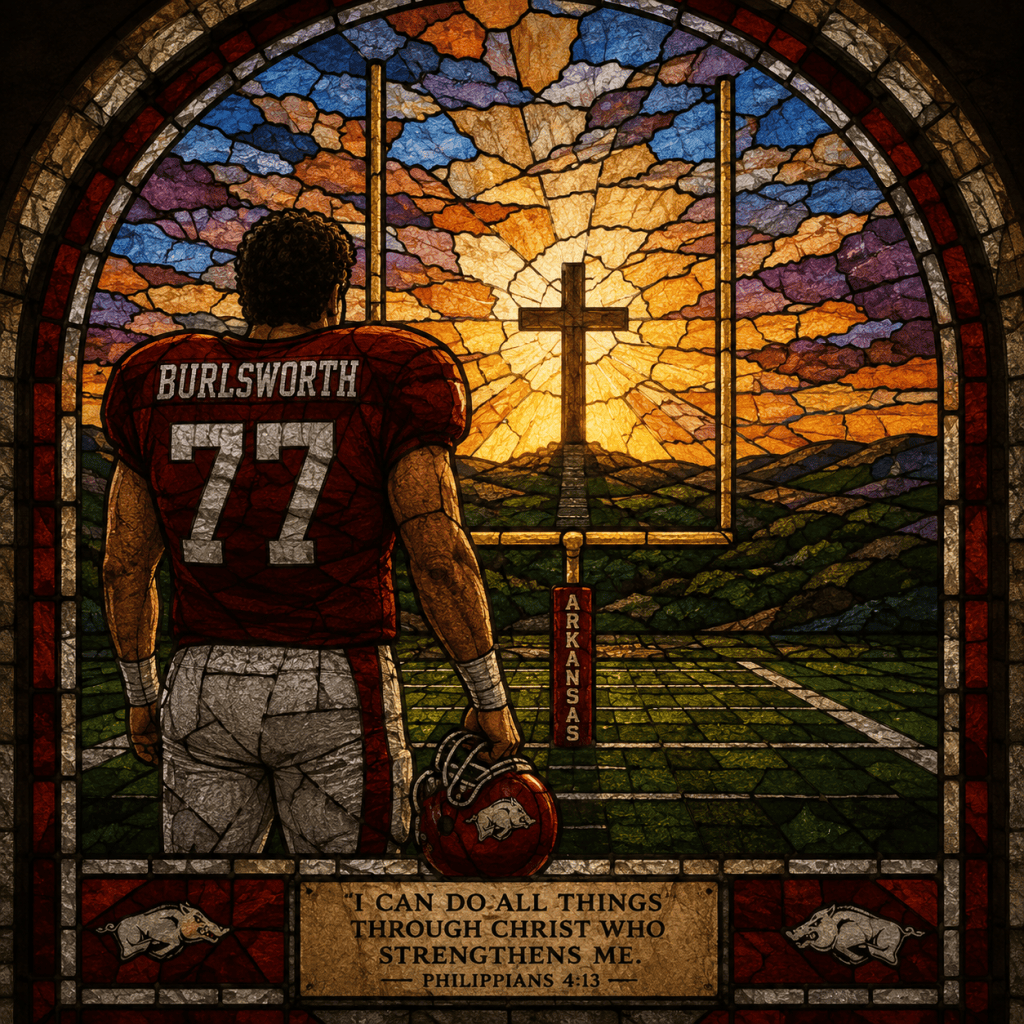
I had never heard of Brandon Burlsworth.
I didn’t know his story. I didn’t know what he accomplished at Arkansas. And, perhaps most importantly, I didn’t know how his story ended.
I only learned his name because my wife and I didn’t want to go home yet.
We were out on a date one evening. We had eaten dinner, still had some time to ourselves, and decided we might as well go see a movie. The problem was that neither of us had any idea what was playing.
So I started looking through the showtimes.
There was a movie called Greater.
I hadn’t seen a trailer. I hadn’t seen an advertisement. I knew absolutely nothing about it. But the description said it was about a football player.
That was good enough for me.
We bought our tickets.
And for the next couple of hours, I watched the story of a man I had never heard of become one I would never forget.
The Kid Who Wasn’t Supposed to Be There
Brandon Vaughn Burlsworth was born September 20, 1976, in Harrison, Arkansas.
He didn’t look like the future face of one of college football’s great underdog stories. He was an overweight kid with thick black glasses and a dream that seemed considerably larger than his natural ability.
He wanted to play football for the Arkansas Razorbacks.
Arkansas wasn’t exactly waiting for him.
Burlsworth received opportunities from smaller schools, but no Division I scholarship offer. So in 1994, he did something that probably looked foolish to a lot of people.
He walked on at the University of Arkansas.
No scholarship.
No guarantee.
No reason to believe he would ever become anything more than another anonymous body on a practice field.
And then Brandon went to work.
He transformed himself physically. He became stronger. He became disciplined. He earned a scholarship. Then he earned a starting position.
Eventually, the kid who wasn’t supposed to be there became one of the best offensive linemen in college football.
He started 34 consecutive games for Arkansas. He earned All-SEC honors and became a first-team All-American. He became a team captain. And while accomplishing all of that on the football field, he excelled academically as well, eventually earning his master’s degree.
The walk-on had become an All-American.
The kid nobody recruited had become an NFL prospect.
And those thick black glasses that once made him look anything but the part had become unmistakably his.
Brandon Burlsworth had made it.
Or so it seemed.
The Call He Had Worked His Whole Life For
In the 1999 NFL Draft, the Indianapolis Colts selected Brandon Burlsworth in the third round with the 63rd overall pick.
Think about that journey.
No Division I scholarship offer.
Walk-on.
Scholarship player.
Starter.
All-American.
NFL draft pick.
And this wasn’t a sentimental selection because someone liked his story. Brandon Burlsworth could play football. The Colts believed he could become an important part of an offensive line protecting a young quarterback named Peyton Manning.
Everything Brandon had spent years working toward was suddenly in front of him.
An NFL career.
Financial security.
A future.
Then, eleven days after the draft, Brandon Burlsworth got into his car.
Fifteen Miles From Home
On April 28, 1999, Brandon was driving back toward his hometown of Harrison.
He was going home to see his mother and attend church with her.
He never made it.
About fifteen miles from home, Brandon was involved in a collision with two tractor-trailers.
He was killed.
He was 22 years old.
Eleven days.
That’s the part of Brandon’s story that is so difficult to reconcile with everything that came before it.
Years of obscurity.
Years of discipline.
Years of lifting weights when nobody cared.
Years of practice.
Years of studying.
Years of proving people wrong.
And finally, the door opens.
Eleven days later, he is dead.
When I sat down in that theater, I didn’t know that was coming.
I thought I was watching a football movie.
Suddenly the question wasn’t whether Brandon Burlsworth would make it.
He had already made it.
The question was much harder:
What was all of it for?
When the Story Doesn’t End the Way We Think It Should
There is a version of Christianity that has a difficult time making sense of Brandon Burlsworth’s story.
It is the version that quietly assumes faithfulness produces the outcomes we desire.
Work hard.
Trust God.
Do the right thing.
Remain faithful.
And eventually God will reward you with the life you’ve been working toward.
For most of the movie, Brandon’s life almost seems to follow that script.
Until April 28, 1999.
If the purpose of his discipline was merely to reach the NFL, then his story ends in almost unbearable tragedy. He reached the doorstep of his dream and died before ever playing a professional snap.
But Christianity does not teach us that God’s faithfulness is measured by the length of our lives or by the fulfillment of our earthly ambitions.
God tells us:
“For my thoughts are not your thoughts, neither are your ways my ways, declares the LORD.”
— Isaiah 55:8
We see only the small portion of the story God allows us to occupy.
We count years.
We count accomplishments.
We count careers, championships, money, children, grandchildren, retirements and dreams fulfilled.
God sees eternity.
That distinction changes the way we understand Brandon Burlsworth.
Because perhaps the great tragedy of his life isn’t that he never got to play in the NFL.
Perhaps our mistake is believing the NFL was ever the point.
Doing Things the Right Way
A phrase became associated with Brandon’s legacy after his death:
“Do it the Burls Way.”
Do things the right way, even when nobody is looking.
There is something profoundly Christian about that idea.
Not because hard work saves us.
Not because discipline earns favor with God.
And certainly not because Christianity is merely about becoming a nicer, harder-working person.
But because Christian character is revealed precisely in those moments when applause is absent.
Jesus spoke repeatedly about the things done in secret.
Prayer when nobody is listening.
Giving when nobody is watching.
Faithfulness when nobody is applauding.
Character is what remains when the crowd goes home.
Brandon Burlsworth spent much of his life doing things for which there was initially very little applause.
He worked when he wasn’t the starter.
He studied while carrying the demands of major college football.
He remained grounded when success could easily have convinced him that the world suddenly revolved around him.
And after being drafted into the NFL, he was still the son driving home to see his mother and go to church with her.
That detail has always stayed with me.
He had just been drafted into the National Football League.
And where was he going?
Home.
Watching It Again
But something has changed since the first time I watched Greater.
Me.
When I first sat in that theater with my wife, Brandon Burlsworth was someone else’s son.
I could watch the wreck and understand intellectually that something terrible had happened. I could feel the sadness of it. I could imagine the devastation of his family.
But I could still walk out of the theater having experienced it from the outside.
I can’t do that anymore.
On June 27, 2022, my own son, Isaac, died unexpectedly.
He was 24 years old.
There are some things about grief that cannot be understood from the outside.
You can sympathize with them.
You can imagine them.
You can weep with those who experience them.
But there is a difference between knowing that parents bury their children and knowing what it means to bury yours.
So when I revisit Brandon’s story now, I don’t watch it the same way.
I still see the football player.
I still see the walk-on.
I still see the remarkable discipline and the improbable journey from an overlooked kid in Arkansas to an NFL draft pick.
But now I also see his mother.
I see the empty chair.
I understand the phone call.
I understand how violently the future can become the past.
One moment, you’re thinking about what your son is going to do with the rest of his life.
And then there is no rest of his life.
There are only the years he was given.
And the memories left behind.
The Cruel Arithmetic of Grief
There is a particular cruelty in losing someone young.
You don’t merely grieve what happened.
You grieve what never will.
The birthdays that will not come.
The conversations you expected to have.
The milestones you assumed you would witness.
The person you expected them to become.
When someone dies young, you don’t only lose their present.
In a very real sense, you lose an imagined future with them.
Brandon was 22.
Isaac was 24.
Those numbers feel impossibly small when you’re the one left counting them.
And yet Scripture refuses to allow us to measure the value of a life simply by its duration.
James writes:
“Yet you do not know what tomorrow will bring. What is your life? For you are a mist that appears for a little time and then vanishes.”
— James 4:14
We usually read that verse as a warning against presumption.
And it is.
But grief makes you read it differently.
A mist.
A little time.
Then gone.
Suddenly those aren’t abstractions.
They’re names.
They’re faces.
They’re voices you can still hear in your memory.
They’re photographs on your phone.
They’re stories you tell because telling them is one of the ways you refuse to allow someone you love to disappear.
Greater Than Football
After Brandon died, Arkansas retired his number 77. His family established the Brandon Burlsworth Foundation, which continues helping children and students. The Burlsworth Trophy now bears his name and honors the most outstanding college football player who began his career as a walk-on.
More than two decades after Brandon’s death, young men who never met him still hear his name.
Children who weren’t alive when he played football have benefited from programs established in his memory.
Walk-ons across the country compete for an award bearing the name of a walk-on who refused to accept that obscurity meant insignificance.
And people like me can wander into a movie theater on a date night, knowing absolutely nothing about Brandon Burlsworth, and walk out profoundly affected by the life of a man who had already been gone for years.
That is a remarkable legacy.
And perhaps that’s why Greater is such an appropriate title.
At first, we assume the “greater” thing is Brandon’s rise.
Greater strength.
Greater discipline.
Greater recognition.
Walk-on to scholarship player.
Scholarship player to starter.
Starter to All-American.
All-American to NFL draft pick.
But by the end, something else emerges.
There are things greater than football.
There are things greater than success.
There are things greater than accomplishing everything we dreamed of accomplishing.
There is character.
There is faithfulness.
There is the influence one life can have upon another.
And ultimately, there is God.
If I Were Writing the Story
If I were writing Brandon Burlsworth’s story, I wouldn’t have written it this way.
I would have let him play in the NFL.
I would have given him years.
I would have given him a wife and children.
Maybe a Super Bowl.
Maybe a coaching career.
Maybe grandchildren sitting around him someday listening to stories about the time Grandpa blocked for Peyton Manning.
I would have given him a long life.
And if I were writing Isaac’s story, I would change that ending too.
I would give almost anything to pick up the pen and rewrite those pages.
There are things I would add.
Things I would erase.
Years I would put back.
Conversations I would restore.
Birthdays I would return.
But I am not the Author.
That may be one of the hardest confessions faith ever requires of us.
God is sovereign even over pages we desperately wish He had written differently.
That doesn’t make death good.
Scripture never asks us to pretend that it is.
Death is an enemy.
Jesus Himself wept at the grave of Lazarus even though He knew resurrection was moments away.
Christian hope does not require us to call tragedy beautiful.
It allows us to say that tragedy does not get the final word.
That is a much stronger hope.
The Movie I Had Never Heard Of
My wife and I could have gone home that night.
We almost did.
Instead, we decided to see a movie.
I found some film called Greater. I had never seen the trailer. I had never heard Brandon Burlsworth’s name.
The description said it was about football.
That was enough for me.
I couldn’t have known then that years later I would revisit Brandon’s story as a father who had buried a son of his own.
I couldn’t have known that scenes I once found sad would someday feel familiar.
Grief has a way of changing the stories we thought we understood.
But it has also made one truth considerably clearer to me:
The worth of a life cannot be measured merely by how long it lasted.
Twenty-two years seems too short.
Twenty-four years seems too short.
And from where I stand, they are.
I would gladly take more.
But love does not become meaningless because death interrupts it.
Faithfulness does not become meaningless because the future we imagined never arrived.
And a short life is not necessarily a small life.
Brandon Burlsworth lived only twenty-two years.
Yet here I am, decades after his death, writing his name.
Remembering his story.
Thinking about his faith.
Thinking about my son.
Thinking about my own life and however many days God has appointed for me.
I originally walked into that theater because I like football.
I walked out thinking about life.
Now, years later, I can watch Brandon Burlsworth’s story and see something I couldn’t fully see then.
I see a son.
I see the people who loved him.
I see a future that disappeared without warning.
I see the terrible brevity of life.
But beyond all of that, I see the stubborn Christian hope that death, terrible as it is, is not sovereign.
God is.
And perhaps that is what makes Brandon Burlsworth’s story greater.


Leave a Reply