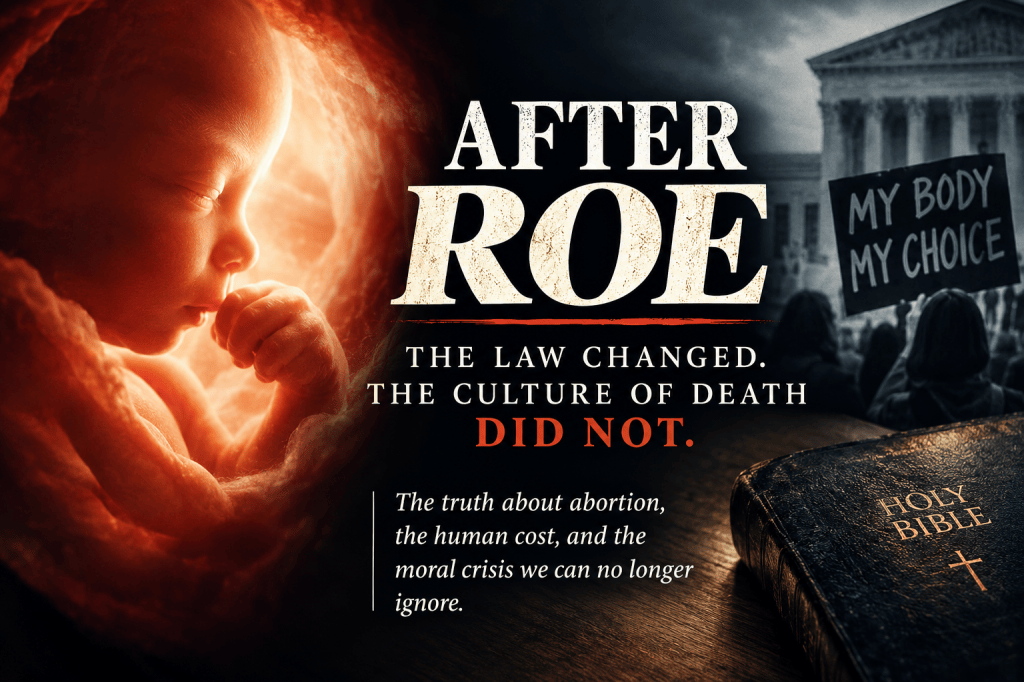
On June 24, 2022, Roe v. Wade fell.
For nearly fifty years, Roe had imposed one of the most morally grotesque legal regimes in American history. The Supreme Court had taken something nowhere found in the Constitution—the supposed right to kill an unborn child—and placed it beneath constitutional protection.
Then came Dobbs v. Jackson Women’s Health Organization.
I rejoiced when Roe died.
I still rejoice that it is dead.
But four years later, Christians need to confront a painful reality:
We overturned a court decision. We did not overturn the culture that produced it.
The killing continues.
In some respects, it has become easier, quieter, more private, and more socially insulated from the ugliness of what is actually taking place.
The clinic is no longer necessary in every case.
Now the abortion can arrive in the mail.
The killing can happen at home.
The evidence can disappear down a toilet.
And everyone involved can continue calling it “healthcare.”
That is where America stands after Roe.
We changed the law.
We did not change the heart.
Stop Hiding the Body Behind the Vocabulary
There are moments when careful language is necessary.
This is not one of them.
Abortion kills a human being.
Not potentially human.
Not a hypothetical child.
Not a meaningless clump of biological material waiting for society to grant it personhood.
A living human organism exists in the womb. Abortion is undertaken precisely so that this human being will no longer be alive.
We can describe the procedure clinically. We can discuss gestational age. We can distinguish chemical abortion from surgical abortion. We can bury the entire conversation beneath medical terminology.
None of it changes what happens.
A human being is alive before a successful abortion and dead afterward.
That death is not an unfortunate side effect of the procedure.
That death is the intended result.
That is why our vocabulary has become so dishonest.
“Reproductive healthcare.”
“Termination.”
“Choice.”
“Medication abortion.”
“Pregnancy management.”
Every euphemism performs the same little magic trick: make the child disappear linguistically before making the child disappear physically.
Ask the obvious questions.
Choice to do what?
Terminate what?
Healthcare for whom?
Because there are two human bodies involved, and only one of them is expected to survive the procedure.
Christians should refuse to participate in the linguistic anesthesia.
Abortion kills children in the womb.
The sentence is disturbing because the reality is disturbing.
Softening the sentence does not soften the act.
An American Slaughter Hidden in Plain Sight
The numbers are almost impossible to comprehend.
Since 1973, tens of millions of unborn human beings have been killed by abortion in the United States. Depending upon the historical dataset and methodology used, cumulative estimates are now approaching 70 million.
Seventy million is almost too large to picture.
So don’t picture a statistic.
Picture children.
Millions upon millions of individual human lives.
A boy who never took his first step.
A girl who never heard her father tell her he loved her.
A child who never learned to read.
A teenager who never got a driver’s license.
A young woman who never married.
A young man who never became a father.
Entire generations of Americans are missing.
They weren’t lost to an earthquake.
They weren’t taken by cancer.
They weren’t casualties of a foreign invasion.
They were deliberately killed before they could be born.
And much of American society has spent half a century congratulating itself for making their deaths legal.
There are words severe enough to describe such a thing.
There ought to be.
I have no interest in protecting our consciences from the horror by choosing gentler vocabulary.
This has been an enormous slaughter of human life.
And the victims were killed in the one place that should have been safer than anywhere else on earth:
their mothers’ wombs.
Roe Fell. The Bodies Kept Falling.
This is what should disturb every Christian who thought Dobbs represented the finish line.
According to Guttmacher’s estimates, there were approximately 1.12 million clinician-provided abortions in the United States in 2024 and approximately 1.13 million in 2025.
More than a million in a year.
Then more than a million again.
The constitutional fiction created by Roe disappeared, but America’s appetite for abortion remained.
Why?
Because Roe was never powerful enough to create the evil it protected.
The soil was already fertile.
America had embraced a conception of freedom in which individual desire increasingly outranked obligation. Sex could be separated from covenant. Parenthood could be separated from procreation. Children could be evaluated according to whether they were planned. And human dependence could increasingly be treated as a burden from which autonomous adults deserved liberation.
Roe gave that philosophy legal protection.
Then fifty years of abortion gave that philosophy cultural reinforcement.
And eventually Americans stopped merely tolerating abortion.
We learned how to think like a civilization that requires it.
That is the part Dobbs could never overturn.
We Built a Morality Capable of Killing Children
Abortion required more than permissive laws.
It required moral reconstruction.
A society that once instinctively understood that mothers protect their children had to be taught that motherhood itself could constitute an injustice when it arrived at the wrong time.
We had to be taught that dependence diminishes another person’s claim upon us.
We had to be taught that an unwanted human being possesses fewer practical protections than a wanted one.
We had to be taught that compassion is primarily measured by alleviating the distress of the powerful rather than protecting the life of the powerless.
Most importantly, we had to be taught to begin every moral calculation with the adult.
What does she want?
What will pregnancy cost her?
What plans will this interrupt?
What hardship will she experience?
What does motherhood require of her?
What does continuing this pregnancy do to her emotional well-being?
Some of those questions describe very real suffering.
But notice what has happened.
The child has been placed on trial for the circumstances of his own existence.
He must now justify the inconvenience he creates.
She must demonstrate why her life should outweigh the ambitions, fears, finances, relationships, or emotional distress of someone vastly more powerful than herself.
And because the child cannot make that argument, society makes the decision for her.
Death.
We call it compassion.
Chemical Abortion Made the Killing Easier to Ignore
The post-Roe abortion regime has another horrifying feature.
Increasingly, the abortion room is simply the home.
Medication abortion now constitutes a large majority of abortions in America.
That change matters culturally as much as medically.
The abortion clinic at least forced society to acknowledge that something consequential was occurring. There was a building. A physician or provider. Protesters sometimes stood outside. Women physically entered one place pregnant and left after their pregnancies had been deliberately ended.
Chemical abortion makes the reality easier to conceal.
Take the pills.
Cramp.
Bleed.
Expel the pregnancy.
And behind those sterile words is a developing human being whose life has been intentionally ended.
No suction machine is necessary.
No abortionist necessarily stands in the room.
No one outside the house needs to know.
The killing has been domesticated.
We have taken an act that ends an innocent human life and made it convenient enough to perform in a bathroom.
That is not moral progress.
It is evidence of how thoroughly abortion has embedded itself into our conception of ordinary life.
The Philosophy Does Not Stay in the Womb
This is where I believe the abortion debate becomes larger than abortion itself.
Ideas do not remain inside the boxes where we first place them.
For more than fifty years, abortion culture has taught Americans a particular way of resolving conflicts between vulnerable children and distressed adults.
Begin with the adult.
Center the adult’s suffering.
Describe the adult’s circumstances.
Emphasize the adult’s emotional state.
Then determine what obligation remains toward the child.
In abortion, we have carried that logic to its ultimate conclusion: under enormous numbers of circumstances, the child may legally be killed.
It would be astonishing if decades of thinking this way produced no consequences beyond the womb.
We have trained ourselves to believe that an adult’s suffering can fundamentally alter the moral significance of what happens to a child.
And once that instinct becomes embedded deeply enough, it begins appearing elsewhere.
That is one reason I cannot watch the public discussion surrounding the Lindsay Clancy case without seeing something familiar.
The Clancy Case and the Moral Habits Abortion Taught Us
The connection must be stated carefully.
Lindsay Clancy’s case is not an abortion case.
Her children had been born.
The legal questions surrounding her mental condition and criminal responsibility are real questions, and serious psychiatric illness can be relevant to culpability.
But the cultural instinct surrounding the case should trouble us.
Clancy admitted killing her three young children. The prosecution and defense have contested whether her mental state left her legally responsible for those acts. Her first trial ended without a verdict when the jury could not reach unanimity.
Those legal questions belong in the courtroom.
My concern here is different.
Listen to how quickly our culture knows where to direct its gaze.
Toward the adult.
Her psychiatric condition.
Her suffering.
Her medications.
Her exhaustion.
Her circumstances.
The pressures surrounding motherhood.
Whether enough was done for her.
Again, none of those matters is necessarily irrelevant.
But something becomes grotesquely distorted when explaining the suffering of the person who killed children begins to overwhelm our recognition of the children who were killed.
And abortion culture has been rehearsing that moral maneuver for decades.
The adult suffers; therefore begin with the adult.
The adult is overwhelmed; therefore reconsider the adult’s responsibility toward the child.
The adult’s circumstances are terrible; therefore moral judgment must become increasingly uncomfortable.
Abortion takes that reasoning all the way to death.
The child’s life itself becomes negotiable.
That does not prove what verdict a jury should return in the Clancy case.
It does reveal something deeply diseased about the culture observing it.
We have become extraordinarily skilled at describing the anguish of adults while standing beside the graves of children.
Compassion Cannot Become an Acid That Dissolves Responsibility
We desperately need to recover something our culture increasingly struggles to understand:
Compassion and accountability can occupy the same sentence.
Someone can suffer terribly and still commit a terrible act.
Someone can be mentally ill without mental illness automatically erasing moral agency.
Someone’s circumstances can help us understand what happened without turning what happened into something morally weightless.
A just society investigates those distinctions carefully.
An unjust society simply decides that sufficient suffering transforms the perpetrator into the primary victim.
Christian compassion cannot operate that way.
Mercy does not require us to lie.
Understanding is not acquittal.
Explanation is not exoneration.
And suffering is not a moral solvent.
There may be circumstances in which mental disease truly destroys the capacity required for criminal responsibility. That is why we have courts, psychiatric testimony, standards of evidence, judges, and juries.
But “she was suffering” cannot become a theological or cultural synonym for “she bears no responsibility.”
Otherwise we have not created compassion.
We have created a morality in which responsibility disappears whenever circumstances become sufficiently tragic.
And children will always suffer most under such a system because children possess the least power to defend their own interests.
Abortion Taught Us to Look Away From the Smallest Body
That may be abortion’s darkest cultural achievement.
It trained us not to look.
An ultrasound becomes “pregnancy tissue.”
A heartbeat becomes politically inconvenient terminology.
Tiny hands and feet become emotionally manipulative if someone dares mention them.
Fetal development becomes something we are strangely reluctant to describe plainly.
Why?
Because reality threatens the euphemism.
The more clearly we see the child, the more monstrous abortion becomes.
So the child must remain abstract.
And once a civilization learns to avert its eyes from millions of dead unborn children, we should not be shocked when it becomes morally disoriented whenever children stand between us and the sympathetic narrative we prefer.
The victims become inconvenient.
Their humanity complicates our compassion.
Their deaths demand judgment when we would rather offer explanation.
So we look somewhere else.
“My Body, My Choice” Was Always a Lie
There is another body.
That alone destroys the slogan.
The unborn child possesses his own DNA, his own developing organs, his own body, and his own human life.
He is dependent upon his mother.
But dependence does not erase humanity.
If it did, the newborn would have little claim upon us either.
Neither would the profoundly disabled.
Neither would the elderly parent who can no longer feed herself.
The Christian answer to dependence has never been:
You are burdensome, therefore you may be killed.
It is:
You are vulnerable, therefore I have a greater obligation to protect you.
The womb should embody that principle more beautifully than anywhere else.
The larger shelters the smaller.
The strong nourishes the weak.
The mother’s body protects the child’s body.
Instead, our culture converted the child’s complete vulnerability into the very circumstance that makes killing him possible.
He cannot run.
She cannot cry loudly enough for us to hear.
He cannot call the police.
She cannot hire an attorney.
The unborn child is utterly defenseless.
And American law has repeatedly answered that defenselessness not with extraordinary protection, but with permission for destruction.
That is not liberty.
That is power exercised against the powerless.
Convenience Is Not a Justification for Killing
We also need to stop pretending that every abortion occurs amid extraordinary tragedy.
Hard cases exist.
So do ordinary ones.
Children are aborted because pregnancies came at inconvenient times.
Because relationships were unstable.
Because another child seemed unaffordable.
Because education might be interrupted.
Because careers might be affected.
Because the father did not want a baby.
Because the mother did not want a baby.
Because the child had a disability.
Because the timing was wrong.
Because life would become harder.
The circumstances vary.
The dead child does not.
And Christianity cannot accept the proposition that another human being may be intentionally killed because keeping him alive demands sacrifice from us.
If inconvenience justifies killing, then the weakest people in society will always be in danger.
Children are inconvenient.
Elderly parents are inconvenient.
Disabled people can be inconvenient.
Sick spouses are inconvenient.
Love itself is inconvenient.
Every meaningful human obligation eventually interferes with something we would rather be doing.
Christianity does not teach us to destroy the person creating the obligation.
It teaches us to die to ourselves.
That is why abortion and Christianity are not merely competing political positions.
They proclaim opposite visions of human existence.
One says:
My life belongs to me.
The other says:
My life belongs to God.
The Womb Has Become an Altar to the Self
Ancient civilizations sacrificed children to their gods.
Modern Americans recoil at the thought.
We should.
But we should also have enough courage to ask whether changing the name of the god changes the nature of the sacrifice.
Our idols are more sophisticated.
Autonomy.
Sexual freedom.
Economic security.
Lifestyle.
Career.
Self-fulfillment.
Personal choice.
And when an innocent child’s continued existence stands in the way, millions have been offered upon those altars.
We don’t hear drums.
We don’t see pagan priests.
We have pharmacies, clinics, telehealth appointments, sterile packaging, political slogans, and carefully engineered vocabulary.
But beneath all the modern machinery lies an ancient proposition:
Someone weaker may die so that someone stronger can have what he or she wants.
Dress it in whatever language makes us comfortable.
The child is still dead.
And Men Must Not Hide Behind Women
None of this permits men to stand at a comfortable distance pointing fingers at women.
Men have financed abortions.
Demanded abortions.
Threatened to leave unless women aborted.
Used women sexually and disappeared when pregnancy exposed their selfishness.
Men have enjoyed a sexual culture in which abortion functions as an emergency exit from fatherhood.
There is cowardice in that.
A man who helps create a child and then tells the mother to “take care of it” is not liberated.
He is abandoning his son or daughter because responsibility became expensive.
The sexual revolution did not merely give women abortion.
It gave selfish men another means of escaping the consequences of using women for pleasure.
Christian men should be among the loudest opponents of that arrangement.
Fatherhood means staying.
Providing.
Protecting.
Sacrificing.
Loving the mother.
Defending the child.
And accepting responsibility for the life you helped create.
Roe Was Never the Cancer
This is what Dobbs ultimately revealed.
We treated Roe as though it were the disease.
It wasn’t.
It was a metastasis.
The disease lies deeper.
We have rejected God’s authority over human life.
We have made autonomy sacred.
We have confused compassion with the removal of consequences.
We have transformed children from blessings to consumer decisions.
We have taught ourselves that wantedness determines obligation.
And then we created laws reflecting what we had already decided to worship.
That is why overturning Roe could never be enough.
You can overturn precedent without overturning an idol.
You can close a clinic without changing a heart.
You can elect a pro-life legislature while fathers continue abandoning pregnant women.
You can pass a heartbeat law while Christians quietly treat an unexpected pregnancy in their own family as a catastrophe.
A culture of death cannot be defeated merely at the ballot box because it was never merely political.
It is spiritual.
Abolition Means Abolition
So I am not interested merely in making abortion somewhat rarer.
I want it abolished.
Completely.
The intentional killing of unborn children should be legally unthinkable for the same reason the intentional killing of born children is legally unthinkable.
The location of a human being does not determine his humanity.
Neither does his size.
Neither does his level of development.
Neither does whether somebody wants him.
Neither does whether protecting him will be expensive.
From conception, there exists a new human life.
And because human beings bear God’s image, innocent human life is not ours to dispose of.
We do not need arbitrary lines determining when children finally become valuable enough that killing them should be prohibited.
They were valuable before we drew the line.
Tell the Truth—and Then Be Ready to Help
Abolition also places obligations upon those of us demanding it.
If we tell a frightened mother that she must not kill her child, we had better be prepared to help her care for that child.
That may mean money.
Housing.
Food.
Childcare.
Adoption.
Transportation.
Friendship.
A seat at our dinner table.
A church refusing to let a woman walk through pregnancy alone.
It also means refusing to treat pregnancy outside marriage as though the child were the shame.
Sin may have occurred in conception.
The baby did not commit it.
Protecting children means loving mothers enough to offer something better than the abortion industry’s answer:
Your problem can disappear if your child does.
The Church should answer:
Your child does not have to disappear. And neither will we.
And There Is Mercy for Those With Blood on Their Hands
Calling abortion killing raises an obvious pastoral question.
What about the person who has already participated in one?
The answer is not to change the definition of abortion so nobody feels guilty.
That is counterfeit mercy.
If abortion is killing, then say so.
If it is sin, call it sin.
If blood has been shed, don’t pretend otherwise.
Then preach Christ.
There is forgiveness for the woman who aborted her child.
There is forgiveness for the boyfriend who paid for it.
There is forgiveness for the husband who demanded it.
There is forgiveness for the parent who drove his daughter to the clinic.
There is forgiveness for the physician who performed abortions.
There is forgiveness for the Christian who knew what abortion was and remained comfortably silent.
The gospel does not require us to minimize sin before Christ can forgive it.
The cross tells us precisely the opposite.
Our sin was so terrible that the Son of God had to die to save us from it.
And His blood is sufficient.
We don’t honor Christ by making sin smaller.
We honor Christ by confessing how enormous our guilt really is—and discovering that His grace is greater still.
After Roe
Roe v. Wade is gone.
Thank God.
But the philosophy that made Roe possible remains everywhere.
It remains every time autonomy outranks obligation.
Every time a child becomes less valuable because he is unwanted.
Every time compassion is invoked to obscure responsibility.
Every time adult suffering becomes more morally significant than a child’s death.
Every time sterile vocabulary is used to disguise spilled blood.
Every time the smallest human being in the room becomes the easiest one to ignore.
That is why the work did not end with Dobbs.
The law changed.
America did not.
And until we do, the slaughter will continue—sometimes in clinics, increasingly in homes, hidden behind pills and euphemisms and a civilization determined not to look too closely at what it has done.
Christians must look.
We must tell the truth.
We must protect the innocent.
We must care for frightened mothers.
We must demand responsibility from fathers.
We must reject the lie that killing can become compassion when the victim is sufficiently small.
And we must preach repentance and forgiveness through Jesus Christ to a nation with blood on its hands.
The goal cannot simply be another Supreme Court victory.
It cannot merely be fewer abortions.
It cannot be a more tasteful culture of death.
The killing must end.
Not become cleaner.
Not become safer for everyone except the child.
Not become more private.
Not become easier to obtain.
End.
Every child in the womb should possess the same legal protection against intentional killing that we demand for every child sleeping in a crib.
No child should have to earn the right to live by being wanted.
No mother should be told that killing her child is the solution to her suffering.
No father should be permitted the moral cowardice of treating abortion as an escape hatch from responsibility.
And no Christian should be satisfied simply because Roe is dead while children continue dying by the hundreds of thousands.
The Court has done what the Court could do.
The harder battle remains.
It is a battle over what we worship.
What we call freedom.
What we mean by compassion.
Whether responsibility survives suffering.
And ultimately, whether human life belongs to us or to God.
Scripture has already answered.
“The earth is the LORD’s and the fullness thereof,
the world and those who dwell therein.”
—Psalm 24:1
The child belongs to God.
The mother belongs to God.
The father belongs to God.
We are not our own.
And once we understand that, the entire moral architecture supporting abortion begins to collapse.
Roe is dead.
May the culture that needed Roe die with it.


Leave a Reply