My History as a Seminole Fan — Part Two
There are some games you remember because you were there.
There are others you remember because you were surrounded by people who were there.
And then there are the games you remember because you were grounded.
For me, one of the most important games of the early years of my Florida State fandom happened on September 28, 1991.
I just happened to watch most of it from the doorway of my bedroom.
I had done something stupid.
I don’t even remember what it was.
Apparently, whatever it was had earned me two weeks without television.
Two weeks.
Which, as a kid, felt like an eternity.
Unfortunately for my parents, those two weeks happened to include one of the biggest games Florida State had played to that point.
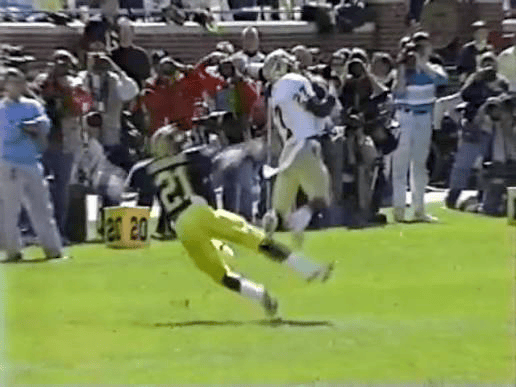
The Seminoles were going to Ann Arbor to play Michigan.
And this wasn’t just any Michigan team.
The Wolverines were ranked No. 3 in the country.
Florida State was No. 1.
And Michigan had a player named Desmond Howard.
Howard was already a star. He was electric with the ball in his hands, dangerous as a receiver and returner, and was putting together the kind of season that would eventually earn him the Heisman Trophy.
But Florida State had a star of its own in the secondary.
Terrell Buckley.
And on this Saturday afternoon, those two would become central figures in one of the most memorable games in Seminole history.
I couldn’t sit down and watch it.
I couldn’t turn on the television.
I couldn’t even really admit that I was watching.
So I did what any properly chastised Florida State fan would do.
I stood in the doorway of my bedroom and watched.
At least that’s how I remember it.
Maybe I was there longer than I remember.
Maybe I spent more time trying to sneak a look than actually watching.
But I remember the feeling.
I remember knowing that something big was happening.
And then, almost immediately, it happened.
Michigan had the ball.
Elvis Grbac dropped back.
He looked toward Desmond Howard.
Terrell Buckley stepped in front of the pass.
Interception.
And Buckley took it all the way back for a touchdown.
Florida State 7.
Michigan 0.
The No. 1 team in the country had just walked into Michigan Stadium and announced that it wasn’t intimidated.
The Seminoles would eventually win 51–31.
At the time, those 51 points were the most any visiting team had ever scored at Michigan Stadium. Florida State’s offense, led by quarterback Casey Weldon, rolled up 460 yards, with Weldon throwing for 268 yards and three touchdowns.
And Casey Weldon was becoming a star.
That’s one of the things I remember most about that period.
Peter Tom Willis had been my first Seminole quarterback.
Now there was Casey.
He was a Tallahassee kid who had waited for his opportunity, and in 1991 he took the reins of a team that would spend much of the season ranked No. 1. He finished the year as the Heisman Trophy runner-up, throwing for 2,527 yards and 22 touchdowns while leading Florida State to an 11–2 season and a Cotton Bowl victory over Texas A&M.
I didn’t know all of those numbers then.
I didn’t need to.
I knew Casey Weldon could play.
And I knew Florida State was becoming something different.
That Michigan game wasn’t just another win.
It felt like a statement.
Florida State wasn’t the upstart program I was just beginning to discover.
We were becoming one of the powers.
And I was beginning to understand what that meant.
Of course, being a Florida State fan in 1991 also meant learning another lesson.
Nothing comes easy.
Not even when you’re No. 1.
The Seminoles eventually lost to Miami, 17–16, on Gerry Thomas’ infamous missed field goal as time expired.
Wide right.
Again.
That loss cost Florida State a chance at the national championship.
The Seminoles finished 11–2 and No. 4 in the final AP poll.
But by then, something had changed.
At least for me.
I wasn’t just the kid who had gone to a game with Uncle John two years earlier.
I wasn’t just the kid who remembered a quarterback named Peter Tom Willis because the people around him kept shouting his name.
I was becoming a Florida State fan.
And being a fan meant something different now.
It meant knowing the players.
Knowing the coaches.
Knowing the schedule.
Knowing who we were playing and why it mattered.
It meant feeling personally offended when we lost.
It meant celebrating wins that I had no part in creating as though somehow I had contributed.
It meant learning that a football team could occupy a strange little corner of your heart where logic doesn’t always get a vote.
And it meant sometimes being grounded at exactly the wrong time.
I wish I could tell you I remember exactly what I did to deserve those two weeks without television.
I don’t.
Whatever it was, it obviously wasn’t important enough to survive the passage of time.
But I remember standing in that doorway.
I remember sneaking those glimpses of the television.
I remember trying to contain myself.
Because I couldn’t exactly run into the living room screaming every time Florida State scored.
I had been grounded, after all.
So I celebrated quietly.
Or at least as quietly as a young Seminole fan could.
There is something almost funny about that memory now.
One of the most important Florida State games of my childhood was also one of the most inconvenient.
I couldn’t sit on the couch.
I couldn’t yell at the television.
I couldn’t watch the whole thing the way I wanted.
I had to watch from the doorway of my bedroom.
And somehow, that makes the memory even better.
Because that’s what fandom is.
It’s not always the perfect seat.
It’s not always the perfect Saturday.
It’s not always a championship.
Sometimes it’s standing in a doorway because you got in trouble for doing something stupid.
Sometimes it’s listening to your great uncle yell “PT!” in a stadium.
Sometimes it’s watching a player you’ve never met become part of your childhood.
Sometimes it’s a missed field goal that you remember decades later.
And sometimes it’s realizing, almost without noticing, that a football team has become part of the story of your own life.
In 1989, I walked into Doak Campbell Stadium and became a Seminole.
By 1991, I was standing in my bedroom doorway, trying desperately to watch my team beat Michigan.
I didn’t know it then, but I was going to be doing this for a very long time.
And there would be a whole lot more games worth remembering.
Some would make me proud.
Some would make me furious.
Some would break my heart.
And some would make me wonder why I cared so much in the first place.
But I cared.
I was a Seminole.
And I was just getting started.
 TheoloJeep
Leave a comment