My History as a Seminole Fan — Part Three
By 1992, something had changed.
I wasn’t just watching Florida State anymore.
I was studying Florida State.
I knew the players.
I knew the depth chart.
I read the scouting reports.
I knew who was starting and who was coming off the bench. I knew the strengths of the offense and the defense. I knew which players were becoming stars and which young players were waiting for their opportunity.
I had gone from a kid who remembered one name—Peter Tom Willis—to a young fan who wanted to know every name.
And there were a lot of names to learn.
Casey Weldon had become a star. Then, in 1992, Charlie Ward took over at quarterback.
And Charlie was different.
There was something about watching him play that immediately grabbed your attention.
He could throw.
He could run.
And when a play broke down, he could turn it into something.
But what really captured me was that by now I understood what I was seeing.
I wasn’t just watching a quarterback scramble.
I was watching Charlie Ward scramble.
I wasn’t just watching a linebacker make a tackle.
I knew who the linebacker was.
I knew what he was supposed to do.
I knew why the play mattered.
Somewhere along the way, Florida State football had become more than entertainment.
It had become a hobby.
An obsession.
A part of my identity.
And Florida State was becoming something else, too.
After decades as an independent, the Seminoles were entering the ACC.
For most of my experience as a fan, Florida State had been an independent program. There was something almost strange about watching the Seminoles suddenly have a conference home.
And once they got there, they didn’t exactly ease into it.
They started doing what Florida State did.
They won.
And they won big.
The ACC was about to learn what the rest of college football had already begun to understand.
Florida State wasn’t coming into the conference to become part of the pack.
Florida State was coming to run it.
Then came 1993.
By then, I was all in.
Florida State entered the season ranked No. 1 in the country and carried the expectations that came with it. The Seminoles weren’t simply hoping to contend for a championship.
The championship was the expectation.
And Charlie Ward was at the center of it all.
I knew his name.
I knew his number.
I knew the offense.
I knew the players around him.
I knew what we were capable of.
And I was about to get another chance to see it all in person.
On October 16, Uncle John came calling again.
“Want to go to the Virginia game?”
Did I?
Of course I did.
The timing couldn’t have been better.
The week before, Florida State had finally done something I had desperately wanted to see.
They had beaten Miami.
After two straight years of heartbreak—two straight Wide Right losses with national championship implications—the Seminoles finally got over the hump.
Florida State beat Miami 28–10.
I had watched it as a fan who had now accumulated some history with this rivalry.
So when Uncle John offered me another trip to Doak the following week, I was ready.
And once again, I found myself sitting in that same general section on the west side.
Same stadium.
Same side.
Same great uncle.
But it wasn’t quite the same Doak.
Construction had begun on the brick façade that would eventually become one of the defining visual features of the stadium.
I was watching the place change.
And, without realizing it, I was changing with it.
The kid who had sat against that chain-link fence in 1989 had become a football fan who knew exactly what he was watching.
And what I was watching that afternoon was domination.
Virginia came into Tallahassee ranked No. 15.
It didn’t matter.
Florida State won 40–14.
And there was never really much doubt about what was going to happen.
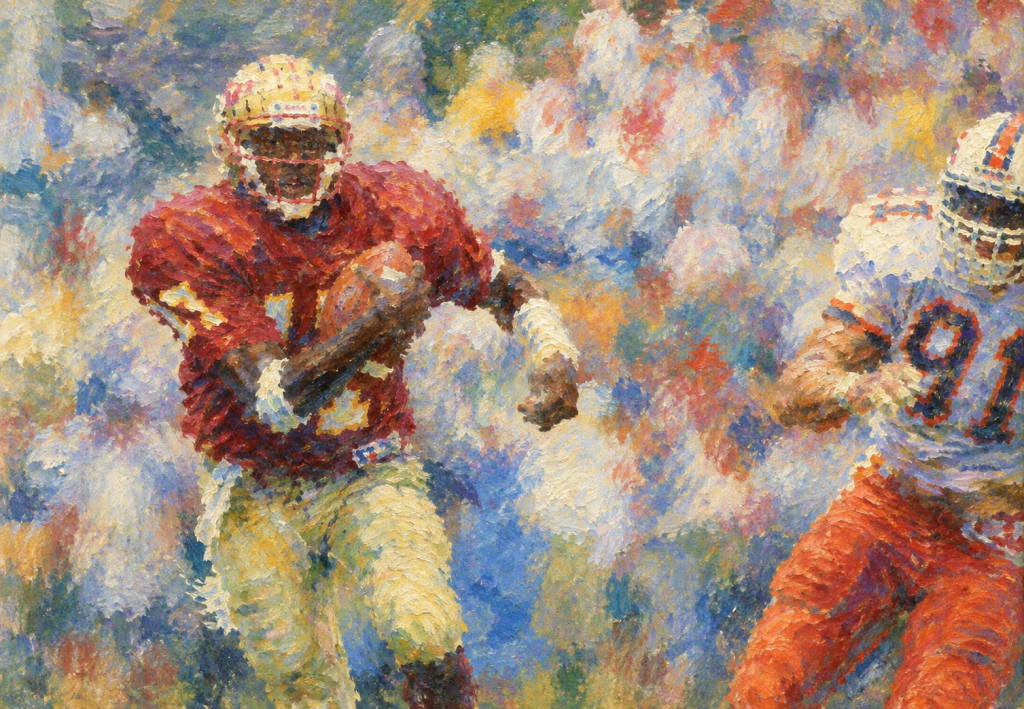
I remember Charlie Ward.
I remember him scrambling.
And I remember him taking off toward the end zone and leaping from around the six-yard line.
That image has stayed with me.
Charlie Ward in the open field.
Then airborne.
Then touchdown.
The crowd exploding.
Forty points on the board.
Another opponent overwhelmed.
Another Saturday where Florida State looked like exactly what everyone expected Florida State to be.
A national championship contender.
And I was sitting there watching it happen.
Again.
From the west side.
The same place where, four years earlier, I had first heard the name Peter Tom Willis.
But now I knew everybody.
Or at least it felt like I did.
That is one of the things I remember most about those years.
The feeling that I was no longer simply watching someone else’s team.
I knew these guys.
I knew the roster.
I knew the storylines.
I knew the expectations.
I knew what was supposed to happen.
And in 1993, what was supposed to happen was simple:
Florida State was supposed to win the national championship.
The season started exactly the way you would expect.
Kansas.
Duke.
Clemson.
North Carolina.
Georgia Tech.
Miami.
Virginia.
Wake Forest.
Maryland.
Win after win after win.
The Seminoles opened the season 9–0, and the numbers were ridiculous. Florida State was averaging more than 50 points per game over its first several ACC victories and had built one of the most dominant teams in the country.
It felt inevitable.
Until it didn’t.
November 13.
Notre Dame.
South Bend.
The Game of the Century.
I remember watching that one with the same kind of anticipation that had become familiar to me.
Florida State was No. 1.
Notre Dame was No. 2.
The winner would have the inside track to the national championship.
And Florida State lost.
31–24.
Just like that, the dream appeared to be over.
For a young fan, this was almost too much to process.
We had been the best team in the country.
We were supposed to win.
And now we had lost.
The national championship picture had suddenly become someone else’s story.
At least that’s what we thought.
Then the next week, Notre Dame went to Boston College.
And lost.
On a last-second field goal.
Suddenly, somehow, Florida State was back in the conversation.
The door that had seemed slammed shut the week before had cracked open again.
And I remember thinking:
You’re kidding me.
This was too much.
This was what being a Florida State fan had become.
The expectation of greatness.
The crushing disappointment.
Then, somehow, another chance.
The Seminoles responded by destroying NC State 62–3.
The season wasn’t over.
The dream wasn’t dead.
Florida State still had a path.
And eventually that path led through Gainesville, through the Florida Gators, and into the Orange Bowl.
Nebraska was waiting.
So was a national championship.
But that’s another story.
Because when I think back on the 1992 and 1993 seasons, I don’t just remember Charlie Ward.
I don’t just remember the wins.
I don’t just remember the championships.
I remember becoming a different kind of fan.
In 1989, I had gone to a football game.
By 1993, I was living and breathing Florida State football.
I knew the players.
I knew the depth chart.
I read the scouting reports.
I knew who was supposed to win and why.
I knew when a game mattered.
And I cared deeply when Florida State lost.
That may be the real marker of becoming a fan.
Not when you celebrate the wins.
When the losses hurt.
When a missed field goal stays with you.
When you remember the opponent.
When you know what was at stake.
When a Saturday in November can change your entire mood.
I had started this journey four years earlier as a kid sitting on the west side of Doak, listening to Uncle John yell for Peter Tom Willis.
Now I was sitting in almost the same place, watching Charlie Ward fly through the air toward the end zone.
The stadium was changing.
The team was changing.
College football was changing.
And I was changing, too.
I just didn’t know yet how much that one season was going to mean.
Because 1993 wasn’t simply the year I watched Florida State chase a national championship.
It was the year I learned that being a fan means allowing a team to become woven into your own story.
And by then, Florida State wasn’t just a team I watched.
It was part of mine.
 TheoloJeep
Leave a comment