My History as a Seminole Fan — Part Eight: No. 1
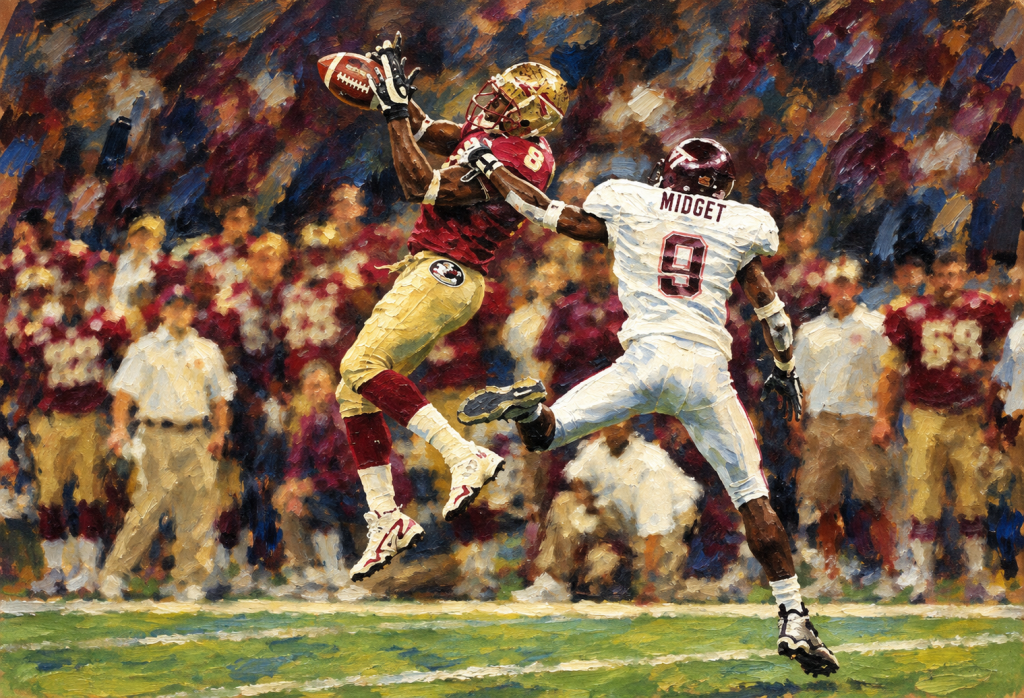
By the time 1999 rolled around, I had been a Florida State fan for ten years.
Ten years.
It had started with a Saturday afternoon at Doak Campbell Stadium in 1989, sitting high on the west side with Uncle John and leaning against a chain-link fence.
I had watched Peter Tom Willis.
I had watched Casey Weldon.
I had watched Charlie Ward.
I had watched Danny Kanell.
I had watched Florida State win its first national championship.
And now I was watching as a husband and a father.
There was a lot more going on in my life than football.
But football was still there.
And in 1999, Florida State was about to give me something I had never experienced before.
The Seminoles started the season ranked No. 1 in the country.
And they never moved.
The Expectation
There was something different about watching a team that was already expected to be the best.
In 1993, Florida State was chasing a championship.
In 1998, they were trying to get back there after losing Chris Weinke and watching Marcus Outzen lead them past Florida.
But 1999 felt different.
There was no climbing.
There was no proving that Florida State belonged.
Everyone already knew.
The question was whether they could stay there.
And Bobby Bowden’s team wasn’t short on talent.
Chris Weinke was now the established quarterback.
Peter Warrick was one of the most electrifying players in the country.
Travis Minor was becoming a major weapon.
The defense was loaded with players who would go on to play in the NFL.
And Bobby Bowden was still at the helm.
This wasn’t simply another good Florida State team.
This was a team carrying the weight of being No. 1 every single week.
The season started with a 41–7 win over Louisiana Tech.
Then came Georgia Tech.
And that one was a little different.
Florida State won 41–35, but the Seminoles had to work for it.
That would become a theme of 1999.
Being No. 1 didn’t mean every game was easy.
It meant everybody wanted to knock you off.
Miami
Then came Miami.
The Hurricanes came to Tallahassee ranked No. 19.
Florida State won 31–21.
It wasn’t a championship game.
It wasn’t even particularly close by the standards of some of the games I had already watched.
But there was something satisfying about it.
Florida State was still No. 1.
Still undefeated.
Still in control of its own destiny.
And the weeks kept coming.
NC State.
North Carolina.
Duke.
Wake Forest.
Then Clemson.
Death Valley
The Clemson game became part of the story for a couple of reasons.
First, Florida State was in trouble.
The Seminoles trailed 14–3 at halftime.
Then they came back and won 17–14.
But the bigger story was Bobby Bowden.
With the victory, he became the fifth coach in NCAA Division I-A history to reach 300 career wins.
And there was another little piece of history attached to the game.
Clemson’s head coach was Tommy Bowden.
Bobby’s son.
It was the first time in college football history that a father and son had faced each other as opposing head coaches.
And Bobby won.
Florida State was now 8–0.
Still No. 1.
Still perfect.
But there were still four games left.
Virginia.
Maryland.
Florida.
And then, if everything held together, the national championship.
Gainesville
By November, the pressure was different.
Every game mattered.
Every Saturday brought another opportunity for something to go wrong.
And then there was Florida.
Of course there was Florida.
The Seminoles traveled to Gainesville on November 20.
Florida was ranked No. 3.
Florida State was No. 1.
I had watched enough Florida State–Florida games by then to know that rankings didn’t mean much once those two teams stepped on the field.
The Seminoles won 30–23.
They had beaten Florida in Gainesville.
They were 11–0.
One game remained.
One.
And Florida State was still No. 1.
The Perfect Season
By the time the Sugar Bowl arrived, Florida State wasn’t simply playing for a national championship.
They were playing for perfection.
The opponent was Virginia Tech.
The Hokies had Michael Vick.
They were ranked No. 2.
It was exactly the kind of matchup you would expect for a team that had spent the entire season at the top.
No. 1 versus No. 2.
Bobby Bowden versus Frank Beamer.
Chris Weinke versus Michael Vick.
Peter Warrick versus a Virginia Tech defense that knew exactly what was at stake.
And for the first time since I had started watching Florida State, I knew exactly what perfection looked like.
Twelve wins.
No losses.
No ties.
No excuses.
Just one final game.
And Florida State delivered.
The Seminoles beat Virginia Tech 46–29.
Peter Warrick was named the game’s MVP after catching six passes for 163 yards and two touchdowns and returning a punt for another touchdown.
Florida State was national champion.
Again.
But this one felt different.
The 1993 championship had been about finally getting there.
This one was about staying there.
Florida State had started the season No. 1.
They had finished the season No. 1.
They had gone 12–0.
Wire to wire.
Perfect.
And Bobby Bowden had finally gotten the perfect season he had spent so many years chasing.
Ten Years
When I think about the 1999 season now, I don’t just think about Peter Warrick or Chris Weinke or Michael Vick.
I think about the ten years that came before it.
I think about that kid sitting next to Uncle John in 1989.
I think about Peter Tom Willis.
I think about Charlie Ward and 18–16.
I think about the Choke at Doak.
I think about Danny Kanell.
And I think about how much my own life had changed while Florida State kept showing up every Saturday.
I had met Liz.
We had gotten married.
We had Isaac.
Then Jordan.
Then Timothy.
The little boy who first walked into Doak Campbell Stadium had become a husband and a father.
And somehow, Florida State had been there for the whole journey.
Ten years after I first sat in those west-side bleachers, I watched Florida State finish a perfect season as the No. 1 team in America.
Maybe that’s why 1999 means so much to me.
Not simply because they won.
Not simply because they were undefeated.
But because by then, Florida State wasn’t something separate from my life.
It had become part of the soundtrack of it.
And there was no way for me to know it then, but the next decade would bring some of the highest highs—and some of the lowest lows—of my life as a Seminole fan.
For now, though, there was only one place to be.
At the top.
No. 1.
And for the second time in seven years, Florida State was national champion.
I was still watching.


Leave a comment