My History as a Seminole Fan — Part Ten: The Rebuild
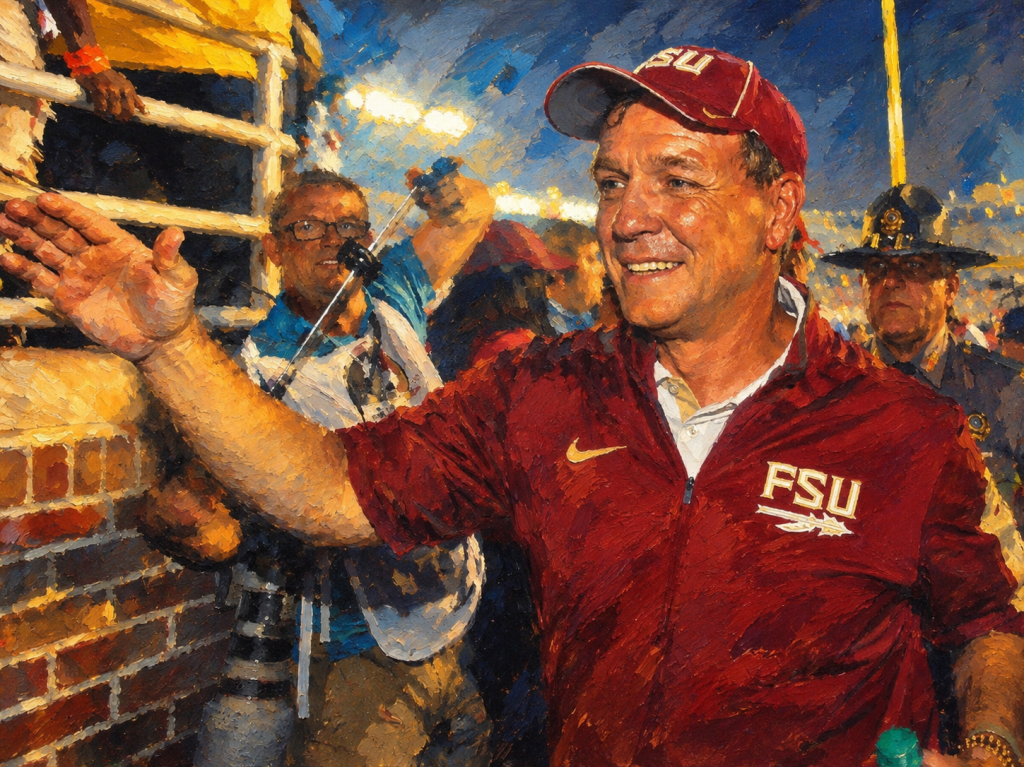
When Bobby Bowden walked off the field for the final time after the 2009 Gator Bowl, something more than a football game had ended.
For me, it was the end of an era.
I had never known Florida State without Bobby Bowden.
He was the coach when I first sat in the west-side bleachers at Doak Campbell Stadium.
He was the coach when Peter Tom Willis was throwing passes.
He was the coach when Charlie Ward won the Heisman and led us to our first national championship.
He was the coach when Florida State went wire to wire at No. 1 in 1999.
For more than twenty years, Bobby Bowden had been part of the backdrop of my life.
And now he was gone.
Jimbo Fisher was taking over.
The Rebuild
Jimbo wasn’t an unknown quantity.
He had been Bowden’s offensive coordinator and had been part of the program’s transition for several years.
But being the offensive coordinator is one thing.
Being the guy is something else.
Now Jimbo had the job of taking Florida State back to where I believed it belonged.
And I wanted to believe he could do it.
The first season gave me plenty of reason for optimism.
Florida State went 10–4 in 2010, won the ACC Atlantic Division, beat Florida 31–7, and earned a spot in the ACC Championship Game.
But the Seminoles weren’t quite back yet.
Virginia Tech beat Florida State 44–33 in the championship game.
Still, the season ended on a high note. The Seminoles went to the Chick-fil-A Bowl and beat South Carolina 26–17.
Ten wins.
A victory over Florida.
A bowl victory.
It wasn’t 1993.
It wasn’t 1999.
But it felt like the program was moving again.
There was energy.
There were young players who looked like they could become stars.
And, perhaps most importantly, there was a sense that Florida State had a direction again.
But then came 2011.
Not So Fast, My Friend
Florida State began the 2011 season ranked No. 6.
There was excitement surrounding the program.
And then came Oklahoma.
The Sooners arrived in Tallahassee ranked No. 1 in the country.
Florida State lost 23–13.
Then came Clemson.
The Seminoles lost 35–30 in Death Valley.
Then Wake Forest.
Another loss.
35–30.
And finally Virginia.
Florida State lost 14–13 in a game that came down to the final seconds.
Four losses.
The Seminoles finished 9–4.
For a program that had spent so many years at the top of college football, it still wasn’t where I wanted it to be.
But there were signs.
Florida State beat Miami 23–19.
Then came the trip to Gainesville.
The Seminoles beat Florida 21–7.
And the season ended with another bowl victory, this time over Notre Dame 18–14.
So 2011 wasn’t a disaster.
It was something more frustrating.
It was a reminder that rebuilding a program isn’t a straight line.
The talent was there.
The defense was getting better.
The wins over Miami and Florida mattered.
But the Seminoles still had to learn how to consistently beat the teams standing between them and the top.
2012
Then things started to look different.
Florida State entered the 2012 season ranked No. 7.
And this team had serious talent.
E.J. Manuel was now the quarterback.
The defense was loaded.
There were young players who would soon become household names.
And for the first time in a long time, I began to think:
Maybe.
Maybe this was the team.
Maybe Florida State was finally ready to take that next step.
The Seminoles opened the season by scoring 69 points against Murray State.
Then 55 against Savannah State.
Then 52 against Wake Forest.
Then came Clemson.
Florida State beat the Tigers 49–37.
The offense was rolling.
The defense was making plays.
And the Seminoles were beginning to look like the kind of team I remembered from the 1990s.
Then came NC State.
A game Florida State probably expected to win.
Instead, the Wolfpack won 17–16.
There was another loss later in the season.
Florida.
The Gators came into Tallahassee ranked No. 6 and beat the No. 10 Seminoles 37–26.
That one hurt.
But unlike some of the previous years, there was still something to play for.
Florida State won its next game against Georgia Tech in the ACC Championship Game.
21–15.
Finally.
The ACC championship was back in Tallahassee.
And then came the Orange Bowl.
Northern Illinois.
Florida State won 31–10.
Twelve wins.
Two losses.
An ACC championship.
An Orange Bowl championship.
A final ranking of No. 10.
It wasn’t a national championship.
But something was happening.
The program was becoming relevant again.
And I could feel myself getting sucked back into the old feeling.
That feeling I remembered from the 1990s.
The feeling that maybe Florida State was about to become Florida State again.
The Next Generation
There was something different about watching this team.
I wasn’t watching as the kid who had first discovered the Seminoles.
I wasn’t watching as the teenager who memorized depth charts.
I wasn’t even watching as the young husband and father who had watched the 1999 team go wire to wire.
I was older now.
My boys were growing up.
I had spent more than twenty years watching this program rise, fall, and begin to climb again.
And now I was watching a new generation of Seminoles emerge.
E.J. Manuel.
Nick O’Leary.
Telvin Smith.
Bjoern Werner.
And a freshman quarterback who had barely begun to show us what he could do.
Jameis Winston.
I didn’t know it yet, but the 2012 season was the last season before everything changed again.
Jimbo had spent three years rebuilding the program.
The Seminoles had gone 10–4.
Then 9–4.
Then 12–2.
An ACC championship was back.
The defense was becoming dominant.
The talent was accumulating.
And somewhere beneath all of it was a feeling I hadn’t had in a long time.
Hope.
Real hope.
The kind that makes you start looking at the schedule differently.
The kind that makes you start thinking about rankings in September.
The kind that makes you believe that maybe—just maybe—your team could finally return to the place where you had spent your childhood watching them live.
The mountaintop.
I had no idea how close we were.
Because in 2013, Florida State wasn’t just going to return to the top.
They were going to do something that would make the 1990s feel like they had happened all over again.
And this time, I was going to experience it as a very different man than the one who had watched Charlie Ward lead the Seminoles to 18–16.
The next chapter was about to begin.


Leave a comment